
Morning Jaw Pain: Read the Clues and Choose Your Next Step
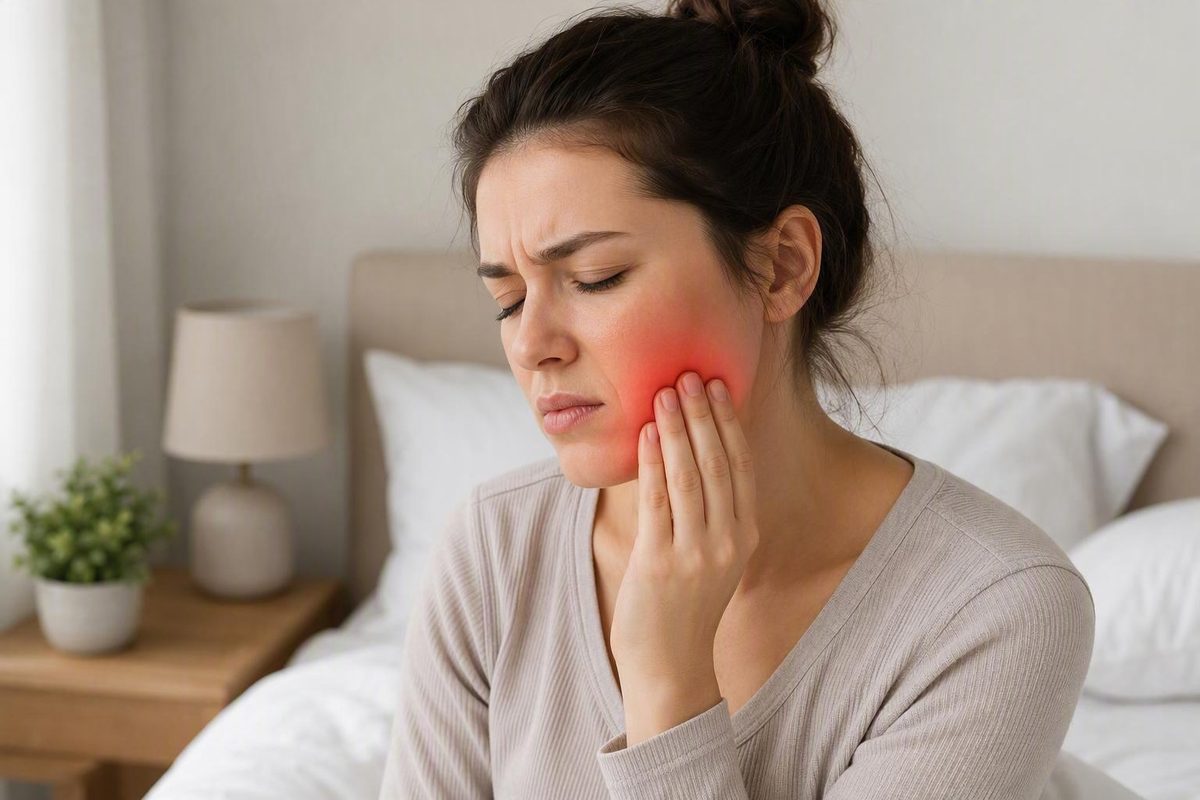
The short answer: your jaw may be working or under pressure while you sleep
If you are wondering, “Why does my jaw hurt when I wake up?” one possible explanation is that your chewing muscles were active overnight. Repeated clenching or grinding can fatigue those muscles, load the jaw joints, and put pressure on the teeth. The result may be soreness, tightness, or stiffness that is most noticeable when you first get up.
This activity is called bruxism. It includes involuntary clenching or grinding of the teeth, as well as bracing or thrusting the jaw. It can happen during sleep or while awake. Sleep bruxism may occur without your realizing it and without making an audible grinding sound, according to Johns Hopkins Medicine’s overview of bruxism.
Morning timing is useful evidence, but it is not a diagnosis. Tooth decay or infection, gum disease, a problematic wisdom tooth, a temporomandibular disorder, sinus pressure, sleep posture, recent dental work, repetitive chewing, and other problems can create a similar pattern. Pain that eases after you get moving is compatible with nighttime muscle activity, but it does not prove that you grind or clench.
Two terms are often confused:
- TMJ means the temporomandibular joint—the joint in front of each ear where the lower jaw meets the skull.
- TMD means a temporomandibular disorder—a problem affecting a jaw joint, the chewing muscles, or related structures.
This distinction matters because everyone has TMJs, but not everyone has a TMD. Likewise, bruxism and TMD can overlap without being the same condition. Bruxism describes an activity or behavior; TMD describes a group of disorders involving the joints, muscles, or associated structures.
The most useful next step is to combine timing with location, type of pain, jaw movement, tooth symptoms, and any sleep, sinus, or broader health symptoms. The patterns below can help you choose an appropriate evaluation pathway, but they cannot identify your individual diagnosis.
Match the pain pattern to the main possible causes
Do not rank possible causes based only on the fact that pain appears in the morning. Instead, identify where the pain feels centered, what brings it on, whether jaw movement is affected, and what other symptoms occur with it.
| Possible cause | Typical clues | Appropriate next step |
|---|---|---|
| Sleep bruxism | Tired or tender cheek muscles; temple headache; tooth sensitivity; flattened, worn, chipped, or cracked teeth; cheek or tongue marks; facial or neck soreness; discomfort strongest after sleep. These findings can occur with bruxism but are not diagnostic. MedlinePlus describes the variable symptoms and effects of grinding. | Arrange a dental assessment if the pattern recurs, teeth appear damaged, or pain affects eating or daily activities. |
| TMD | Pain in front of the ear; joint tenderness; stiffness; painful clicking or popping; jaw deviation; catching or locking; difficulty opening normally. A dental-practice overview describes pain, clicking, and limited movement as possible TMD features, while noting that an examination may be needed for persistent symptoms. See its discussion of morning jaw pain. | See a dentist or clinician, particularly if movement is limited, noises are painful, or the jaw catches or locks. |
| Tooth decay, infection, gum disease, or a problematic wisdom tooth | Pain centered on a tooth or gum; sensitivity to temperature or pressure; throbbing; pain when biting; swollen gum or face; fever; bad taste or drainage. Dental pain may spread across the jaw rather than staying neatly confined to one tooth. A medically reviewed differential includes decay, gum disease, and wisdom-tooth problems. | Seek dental care. Swelling, fever, swallowing trouble, or rapidly worsening pain calls for prompt assessment. |
| Sinus-related discomfort | Pressure across the upper jaw or several upper molars together with nasal congestion or other sinus symptoms. Sinus inflammation may refer pressure toward the upper molars, although location alone cannot distinguish it from dental disease. Aspen Dental includes sinus pressure in its morning-jaw-pain differential. | Consider medical advice for the congestion. Seek dental assessment if tooth-region pain is localized, severe, related to biting, or persistent. |
| Sleep-position or repetitive-use strain | Symptoms after stomach sleeping, prolonged head rotation, direct pillow pressure on the jaw, or sleeping with a hand beneath it. Recent gum chewing, ice chewing, hard foods, nail biting, prolonged talking, or unusually wide opening may also overload the muscles or joints. Cleveland Clinic discusses both sleep pressure and excessive chewing as possible contributors. | Reduce direct pressure and temporarily pause aggravating activities. Seek assessment if pain keeps returning or jaw function changes. |
| Recent trauma or dental work | Pain began after a blow, procedure, prolonged mouth opening, new dental work, or an apparent change in how the jaw moves or teeth meet. | Tell the treating dentist or clinician. Seek prompt assessment after trauma if movement, opening, or the bite has changed. |
Bruxism often feels more like diffuse muscle fatigue than one sharply defined toothache. The cheeks may feel as though they have been exercising, and discomfort may extend to the temples, face, ear region, or neck. Tooth sensitivity or visible wear strengthens the case for dental review but still does not confirm the cause.
A TMD pattern puts more emphasis on the joint and movement. Pain may sit directly in front of an ear and increase when opening, chewing, or yawning. Clicking or popping becomes more relevant when it is painful or occurs with stiffness, catching, locking, or restricted opening.
Dental disease can be deceptive because pain from a tooth or gum may be felt across the jaw. A crowded or impacted wisdom tooth may produce pain and stiffness near the back of the jaw. Facial swelling, fever, drainage, or a bad taste makes prompt evaluation more important.
Sinus inflammation can create pressure near the roots of the upper teeth, especially when nasal congestion occurs at the same time. However, location alone cannot reliably separate sinus pressure from tooth disease. Persistent pain that seems to arise from one tooth or one region of the gums deserves a dental examination.
Position may matter when the jaw is pressed into a pillow, the head remains turned, or a hand is tucked beneath the face. That possibility is more convincing when symptoms follow a particular position and improve after direct pressure is reduced. It should not, however, be used to dismiss localized tooth pain, swelling, restricted opening, or recurrent symptoms.
Finally, disclose recent dental work or trauma even if it seems minor. Prolonged mouth opening during a procedure changes the immediate context. Trauma may involve the joint, teeth, or jawbone and should not automatically be treated as ordinary muscle soreness.
Signs you may be clenching or grinding while asleep
You do not need to make a loud grinding noise to have sleep bruxism. Grinding can be audible, but clenching, bracing, or thrusting may be silent. A partner who hears nothing cannot rule it out.
Try this morning self-check:
- Do the chewing muscles in your cheeks feel tired, tight, or tender?
- Are your temples sore, or do you wake with a headache?
- Are one or more teeth newly sensitive?
- Do teeth look flattened, chipped, cracked, or more worn?
- Is the inside of a cheek sore, rough, or ridged?
- Are there marks along the sides of your tongue?
- Does your face, ear region, or neck feel sore?
- Does your sleep feel poor or unrefreshing?
- Is the discomfort strongest immediately after sleep and less noticeable later?
- Has anyone heard grinding, or have you ever awakened while clenching?
These are supporting clues, not confirmation. Headaches and facial soreness have many possible causes. Tongue or cheek marks do not identify one mechanism on their own, and some people clench or grind without pain.
The basic mechanism is straightforward: repeated contraction can fatigue the chewing muscles, put load through the jaw joints, and apply pressure to the teeth. The intensity, duration, and effects vary considerably between people. Some develop muscle symptoms, some develop tooth wear or fractures, and some notice few or no symptoms.
Factors worth discussing with a dentist or clinician include:
- Stress or anxiety
- Disrupted or poor-quality sleep
- Evening caffeine or alcohol
- Tobacco use
- Family history of bruxism
- Selected psychiatric medicines
- Other sleep symptoms or known sleep disorders
These factors may contribute to or be associated with bruxism; none automatically explains your pain. Stress, in particular, should not be treated as the sole answer simply because life has been difficult. Johns Hopkins lists stress, sleep disorders, tobacco, heavy alcohol use, caffeine, and certain psychiatric medicines among factors worth reviewing with a healthcare professional.
If symptoms started after beginning or changing a prescribed medicine, speak with the prescriber. Do not stop, reduce, or change a medicine on your own. Whether a medicine may be contributing—and whether an alternative is appropriate—depends on the medicine, your condition, and the risks of changing treatment.
A short diary can make an appointment more productive. For several mornings, record:
- Pain location and intensity
- Whether the pain fades or persists during the day
- Headaches, tooth sensitivity, or apparent bite changes
- Clicking, locking, or opening difficulty
- Sleep quality and awakenings
- Snoring or gasping reported by another person
- Stress level
- Evening caffeine, alcohol, or tobacco
- Medicines and recent changes
- Gum, ice, hard-food, object-biting, or nail-biting habits
- Sleep posture and direct pressure on the jaw
- Any recent dental procedure or injury
The goal is not to diagnose yourself. It is to identify a pattern that a dentist or clinician can compare with examination findings.
When joint, tooth, sinus, or sleep symptoms point beyond uncomplicated clenching
Diffuse, tired chewing muscles fit a different pattern from severe pain centered on one tooth or a jaw that catches during opening. Associated symptoms help determine where to look next.
Joint and movement clues: Painful clicking, persistent stiffness, catching, locking, deviation during opening, or reduced range of motion shifts attention toward a possible TMD. Painless joint noise by itself does not establish a disorder, but noise accompanied by pain or impaired function deserves assessment.
Tooth and gum clues: Severe, throbbing, or localized pain; hot or cold sensitivity; pain with biting; gum tenderness; facial swelling; drainage; a bad taste; or fever requires dental evaluation. Decay, a crack, infection, gum disease, and wisdom-tooth problems require a different response from uncomplicated muscle overuse. Changing pillows or repeatedly applying a compress will not identify or treat an infected or damaged tooth.
Sinus clues: Pressure spread across the upper jaw or several upper molars may occur with nasal congestion and sinus inflammation. Even then, do not assume every upper-tooth ache is sinus-related. Persistent, one-tooth, biting-related, or severe pain should still be assessed by a dentist.
One-sided pain: Laterality does not provide a diagnosis. One tooth, one joint, uneven muscle loading, unilateral sinus pressure, or direct pillow pressure can all produce pain on one side. The more localized the pain, the more useful a targeted examination becomes.
Sleep and breathing clues: Habitual snoring, witnessed gasping, unrefreshing sleep, morning headaches, pronounced daytime sleepiness, fatigue, or concentration difficulty may justify primary-care or sleep evaluation. Bruxism and obstructive sleep apnea can occur in the same person, but that association does not prove that sleep apnea caused the grinding or jaw pain.
A dentist evaluating these patterns may check the chewing muscles and joints for tenderness, observe the path and range of opening, and look for flattened or broken teeth, cheek damage, or other dental changes. Depending on the history and findings, the dentist may also evaluate for decay, gum disease, infection, or another source of pain. Dental or jaw imaging may be considered when it would clarify a suspected problem; it is not automatically necessary for every person with morning soreness. Mayo Clinic outlines bruxism assessment and possible referral for a sleep study.
What you can safely do for a mild morning flare
Self-care is best viewed as temporary symptom relief for mild pain—not treatment for an unknown underlying cause. If symptoms are severe, recurrent, worsening, or accompanied by warning signs, move to professional assessment rather than cycling through home remedies.
For a brief, mild flare:
-
Reduce the chewing load. Choose softer foods temporarily and cut food into smaller pieces. Avoid gum, ice chewing, tough or hard foods, nail biting, and chewing pens or other objects.
-
Use a relaxed-jaw cue. At rest, allow the upper and lower teeth to remain apart and let the jaw muscles soften. Do not repeatedly test your bite or hold your teeth together to check whether the pain is still present.
-
Try comfortable warmth or wrapped cold. Warmth may feel better over tense muscles; a wrapped cold pack may suit a newly irritated, tender area. Neither is universally superior. Protect your skin, use a comfortable temperature, and stop if the pain worsens.
-
Keep any movement gentle and pain-free. Light external massage may feel comfortable. Small, easy movements may reduce a sense of stiffness, but do not force the mouth open or stretch through pain. This is especially important if the jaw catches or locks.
-
Reduce nighttime pressure. Notice whether you bury the jaw in the pillow, sleep with a hand beneath it, or keep your head sharply rotated. Adjust your position or pillow so that your head and neck feel comfortably supported without direct pressure on the jaw. There is no single best sleeping position for everyone.
-
Review evening habits. A calmer wind-down routine and less late caffeine or alcohol are reasonable experiments when those factors apply to you. Treat them as observations to test, not guaranteed treatments.
-
Pause aggravating activities. Long chewing sessions, unusually wide opening, or repeatedly opening the mouth to “loosen it” can sustain irritation. Avoid pushing through pain while the area is sore.
Professional dental-society guidance supports temporary soft foods, avoiding gum, keeping the teeth apart at rest, and using whichever feels more comfortable—moist heat or wrapped cold—for jaw muscle or joint discomfort. The British Society for Occlusal Studies summarizes these self-care measures.
Stop any measure that increases pain. Repeatedly treating a recurring problem at home can delay recognition of a damaged tooth, infection, TMD, or another cause.
Ask a clinician or pharmacist for individualized advice rather than assuming that a particular pain reliever or dosing schedule is safe for you.
What a night guard can—and cannot—do
A night guard, splint, or other oral appliance creates separation or cushioning between the upper and lower teeth. When appropriately selected, it may limit wear, fractures, and other tooth damage from clenching or grinding.
The key limitation is easy to miss:
A guard may protect your teeth without stopping the underlying jaw-muscle activity or eliminating pain.
That distinction explains why someone can wear an appliance faithfully and still wake with tired chewing muscles. The teeth may be better protected while clenching continues.
Appliance choice should follow an examination when pain recurs, the bite feels different, teeth are damaged, or clicking, locking, or opening difficulty is present. Fit, material, purpose, and the underlying problem all matter.
Persistent or worsening pain while using a guard deserves reassessment because:
- Clenching or grinding may be continuing.
- The appliance may not fit or function appropriately.
- A TMD may be contributing.
- A tooth or gum problem may have been missed or may have developed.
- The pain may have a non-dental source.
Not every person with mild bruxism requires active treatment. Decisions depend on pain, severity, tooth wear or fractures, function, and any underlying dental, medical, or sleep condition. Mayo Clinic notes that splints and guards can prevent damage even though dental approaches may not stop bruxism itself, and that many mild cases do not require treatment.
Be cautious with promises that bite correction, Botox, physical therapy, supplements, or any single intervention will cure grinding. Different measures may have a role for selected patients, but treatment should respond to examination findings and relevant underlying conditions—not morning timing alone.
Who to see and what an evaluation may include
For recurring morning pain, suspected grinding, tooth sensitivity or damage, focal tooth symptoms, or pain with chewing, a dentist is usually a practical starting point.
A dental evaluation may include questions about:
- When the pain occurs and how long it lasts
- Whether it is centered in a tooth, muscle, or joint
- Headaches, ear-region symptoms, clicking, or locking
- Sleep quality, snoring, or witnessed gasping
- Medicines and recent medication changes
- Caffeine, alcohol, tobacco, and other relevant substances
- Gum chewing, nail biting, hard-food habits, and other repetitive jaw use
- Recent dental work or trauma
- Current or previous night-guard use
The examination may assess jaw-muscle and joint tenderness, opening range and deviation, painful movement, tooth wear, chips or fractures, cheek damage, bite contact, gums, decay, and signs of infection. Imaging may be considered when the history and examination suggest it would clarify a dental, bone, or joint concern. It is not an automatic requirement for every case.
Seek primary-care or other medical evaluation when symptoms suggest a non-dental condition, a systemic illness, a medication effect, or persistent unexplained facial pain. Congestion with broader sinus symptoms or pain that does not fit a tooth, muscle, or joint pattern may need a different pathway.
Discuss sleep evaluation if jaw pain occurs with habitual snoring, witnessed gasping, marked daytime sleepiness, persistent unrefreshing sleep, or other signs of sleep-disordered breathing. When clinically appropriate, a sleep specialist may use a sleep study to assess sleep apnea, sleep grinding, or another sleep disorder.
Arrange an appointment when any of the following applies:
- Pain occurs on most mornings.
- Symptoms are worsening or no longer brief.
- A tooth is sensitive, worn, chipped, cracked, or painful to bite on.
- Headaches are frequent.
- Clicking is painful.
- The jaw catches or is becoming harder to open.
- Pain interferes with eating, speaking, sleep, work, or other daily activities.
- A guard is not helping or appears to affect how the teeth meet.
Dental guidance recommends evaluation for regular or worsening pain, tooth wear, frequent headaches, painful clicking, locking, or difficulty opening. Its morning-jaw-pain guidance also emphasizes functional impairment as a reason to seek care.
Severity, recurrence, function, tooth findings, swelling, fever, trauma, and associated symptoms determine how quickly you should be seen.
Red flags: when morning jaw pain needs prompt or emergency care
Morning jaw pain is often related to muscles, joints, or teeth, but an online checklist cannot safely exclude every serious cause. The following lists are not exhaustive.
Emergency medical warning signs
Seek emergency medical help for jaw pain accompanied by:
- Chest pain, pressure, squeezing, or discomfort
- Shortness of breath
- Symptoms that begin or worsen with exertion
Do not use the side of the jaw as a screening test. Heart-related jaw pain is uncommon, but it cannot be ruled out safely from its location or an online symptom list. Cleveland Clinic advises emergency attention when jaw pain occurs with possible heart-attack symptoms.
Urgent dental or jaw warning signs
Seek prompt clinical or dental assessment for:
- Facial, gum, or jaw swelling
- Fever
- Severe focal tooth pain
- Difficulty eating or swallowing
- Rapidly worsening pain
- Drainage, a bad taste, or other signs of possible infection
- A jaw that locks or cannot open normally
- Pain or altered movement after facial or jaw trauma
These symptoms are identified as warning signs in dental guidance on morning jaw pain. The guidance calls for urgent assessment when locking, swelling, fever, swallowing difficulty, or severe or worsening pain occurs.
Do not wait for repeated severe locking episodes to keep resolving on their own. Pain Catalog’s material is general education, not a diagnosis or substitute for clinical care.
A practical action ladder is:
- Mild, brief soreness: Rest the jaw, choose softer foods, avoid gum and forceful stretching, keep the teeth apart at rest, and try comfortable warmth or wrapped cold.
- Recurring, worsening, tooth-related, or movement-limiting pain: Arrange a dental evaluation.
- Sleep or broader health symptoms: Involve primary care or discuss sleep evaluation.
- Swelling, fever, locking, trauma, or swallowing difficulty: Seek prompt professional care.
- Chest symptoms, breathlessness, or exertional worsening: Seek emergency medical help.
The fact that pain appears on waking is a valuable clue—but it is still only one piece of the diagnosis.
Frequently asked questions about morning jaw pain
Can I have sleep bruxism even if nobody hears me grinding?
Yes. Sleep bruxism can involve silent clenching, bracing, or jaw thrusting rather than audible tooth grinding. A partner’s report can support suspicion, but the absence of noise does not rule it out. Morning muscle fatigue, temple headaches, tooth sensitivity, wear, chips, and cheek or tongue damage may add clues, although none confirms bruxism by itself. MedlinePlus notes that people may clench or grind without being aware of it.
Does jaw pain that fades later in the day mean I was clenching overnight?
It is compatible with nighttime muscle activity: overworked chewing muscles may feel stiff after sleep and less noticeable as the day progresses. But that pattern does not prove clenching or grinding. Sleep posture, joint irritation, tooth disease, and other causes may also fluctuate over the day. Recurrence, tooth changes, focal pain, or impaired movement warrants assessment. A dentist-authored discussion describes the morning-to-daytime pattern while cautioning that persistent pain needs dental evaluation.
Can my pillow or sleeping position make my jaw hurt?
Possibly. Direct pillow pressure, stomach sleeping with the head rotated, or resting a hand under the jaw may strain the jaw or nearby muscles in some people. Try reducing direct pressure and improving comfortable head and neck support, but do not assume one position is best for everyone. Persistent pain still deserves evaluation. Dental-society self-care guidance also recommends reviewing sleep position and jaw-straining habits.
Why does my jaw still hurt when I wear a night guard?
A night guard can cushion and separate the teeth while the jaw muscles continue to contract. Pain may therefore persist even if the appliance is protecting against tooth wear. Other possibilities include poor fit, a TMD, a damaged tooth, or another source of facial pain. Have the appliance and your symptoms reassessed rather than adding or modifying guards on your own. A specialty clinic’s explanation likewise distinguishes tooth protection from control of muscle activity.
When should morning jaw pain be treated as an emergency?
Seek emergency medical help when jaw pain occurs with chest discomfort, shortness of breath, or exertional worsening. Seek prompt dental or clinical care for swelling, fever, severe focal tooth pain, swallowing difficulty, rapidly worsening symptoms, jaw locking, inability to open normally, or recent facial trauma. Do not force a locked jaw open, and do not rely on an online symptom list to rule out a serious cause. Dental guidance distinguishes these urgent jaw and dental warnings from chest-related emergency symptoms.