
What a Night Guard Can—and Cannot—Do for Grinding and Jaw Pain
They reduce direct tooth contact and wear, though grinding usually continues. Pain relief varies, and a poor fit can aggravate jaw symptoms or alter the bite.
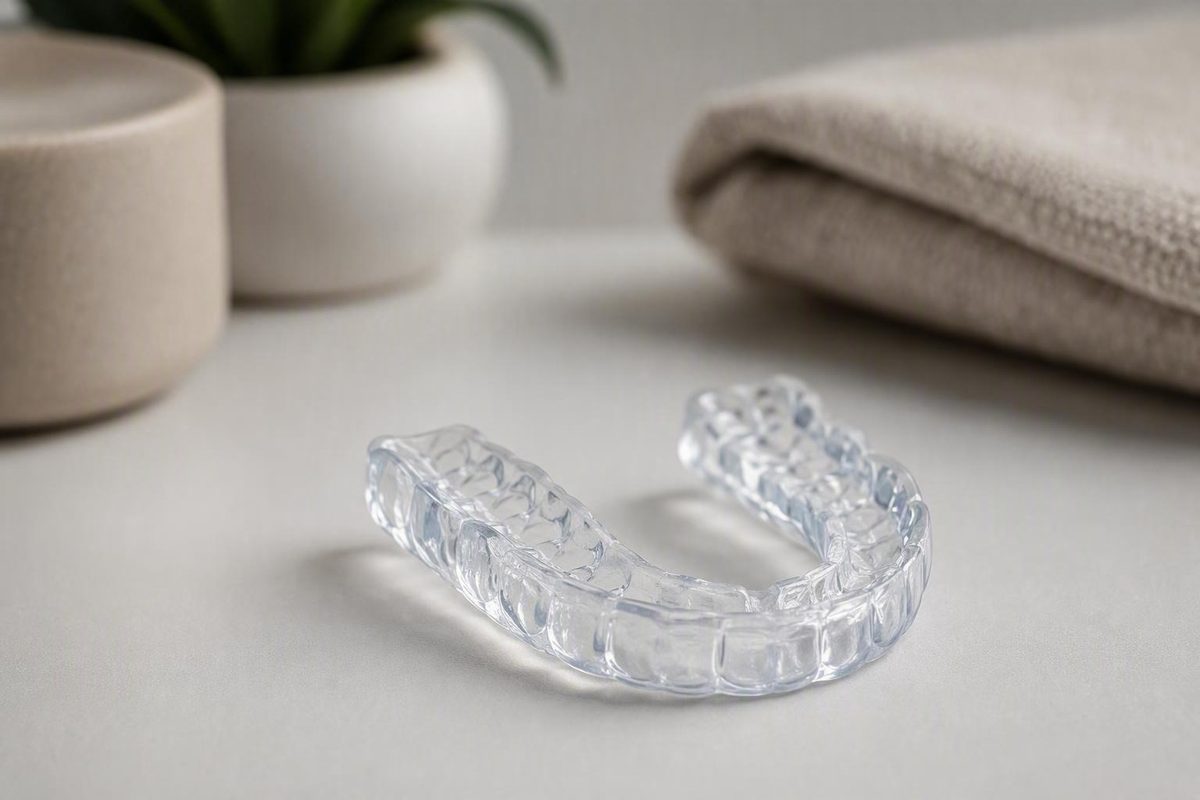
Night guards are often promoted as a simple answer to nighttime grinding, morning headaches and jaw pain. Their clearest benefit is narrower: a suitable guard separates opposing teeth and can limit grinding-related contact, wear and loading.
Pain relief is less predictable. Some people report less morning soreness, stiffness or headache, while others continue to have symptoms because the appliance does not stop jaw-muscle activity or address every possible cause. The result depends on the diagnosis, appliance design, fit, existing dental work and how the guard is monitored.
How a night guard works—and why that mechanism matters
A night guard—also called a dental splint, occlusal guard or bruxism guard—is a removable appliance worn over the upper or lower teeth, usually during sleep. Most cover one dental arch.
When you clench or grind, the guard places material between the opposing teeth. Depending on its design, it may:
- Prevent direct contact between natural teeth and restorations.
- Provide a surface that receives grinding wear.
- Cushion or redistribute some clenching forces.
- Change how the upper and lower teeth contact.
This mechanism explains both the main benefit and the central limitation. Most bruxism guards manage the consequences of grinding rather than switching off the muscle activity that produces it. The Sleep Foundation similarly notes that mouth guards usually do not stop clenching or grinding, even though they can create a barrier that limits tooth damage (guidance on sleep bruxism and mouthpieces).
A worn or chewed-looking guard does not necessarily mean treatment has failed. It can show that tooth contact is continuing and that the appliance is receiving some of that contact. Conversely, an intact guard does not prove that grinding has stopped.
A night guard is not the same as a sports mouth guard. A sports guard is designed primarily to protect the teeth and oral tissues during a blow or fall. A bruxism guard is intended to manage repeated contact during sleep. Materials, thickness, retention and coverage may differ.
Other oral appliances have still different purposes. A condition-specific splint may modify contact patterns or jaw position as part of temporomandibular disorder management. A mandibular advancement device holds the lower jaw forward to influence the airway. These devices are not interchangeable simply because they all fit inside the mouth.
Proposed night guard benefits fall into three practical tiers:
- Clearest benefit: reducing direct tooth contact and limiting grinding-related wear.
- Possible, condition-dependent benefit: reducing jaw soreness, facial discomfort, stiffness or morning headache.
- Uncertain or inappropriate expectation: curing bruxism, reliably improving sleep, treating every temporomandibular disorder or treating sleep apnea with an ordinary grinding guard.
The best-supported benefit: less damage to teeth and dental work
Repeated grinding can wear tooth surfaces, while forceful clenching can load teeth even when little movement occurs. Associated problems may include flattened or worn enamel, sensitivity, chips and cracks. Cleveland Clinic describes nighttime mouth guards as appliances that can reduce wear and tear from clenching and grinding (overview of mouth-guard purposes and types).
A useful way to think about a guard is as a sacrificial protective surface. If grinding continues, the appliance can develop scratches, grooves or thinning while keeping opposing teeth apart. That does not mean all force or wear has been harmlessly transferred, but it can reduce direct tooth-to-tooth contact.
This is damage control, not invulnerability. A guard cannot:
- Restore enamel that has already been lost.
- Repair an existing crack.
- Make a tooth immune to fracture.
- Guarantee that crowns, root canal treatment or other dental procedures will be avoided.
- Establish that no further dental damage will occur.
The supplied evidence supports tooth protection in principle but does not quantify how much a guard reduces the likelihood of fractures, tooth loss or future treatment. Precise prevention or cost-saving claims would therefore be misleading.
Protection for dental restorations
Grinding and clenching can also place pressure on crowns, veneers, bridges, fillings and other dental work. A suitably designed guard may reduce direct contact involving these restorations, but their condition and shape must be considered during fitting. Dentist-authored patient guidance also identifies reduced pressure on teeth and restorations as a principal purpose of grinding guards (night guards and restoration pressure).
Potential fitting concerns include:
- A guard edge irritating tissue around a restoration.
- Retention pressure being concentrated on dental work.
- Missing teeth changing how the appliance is supported.
- A recent filling, crown or other procedure changing the fit.
- An older guard no longer seating fully after dental treatment.
A dentist may need to inspect, adjust or replace it.
What wear on the guard can tell you
Scratches, grooves and thinned areas can provide useful evidence that contact is continuing.
Wear should still be interpreted cautiously. It does not show whether bruxism has become less frequent or intense, and it cannot establish the complete cause of a chipped tooth or failed restoration. The guard’s condition is one piece of information to consider alongside the teeth, symptoms, retention and bite.
Useful signs to monitor include:
- Tooth wear appears stable rather than progressing.
- New chips or restoration problems become less frequent.
- The guard remains secure and comfortable.
- Wear develops without creating sharp, cracked or severely thinned areas.
- The bite returns to normal after the guard is removed.
- Dental examinations do not identify new areas of concern.
A lack of pain relief does not necessarily mean the guard provides no tooth protection. The opposite is also true: comfort alone does not prove that the appliance is distributing contact appropriately.
Possible benefits for jaw soreness, facial pain and morning headaches
A night guard may reduce jaw or facial symptoms for some people. By changing where and how the teeth meet, it can alter force distribution and may reduce strain on certain teeth, muscles or joint structures.
Possible improvements include:
- Less jaw-muscle soreness on waking.
- Reduced facial or temple discomfort.
- Less morning stiffness.
- Fewer or milder headaches associated with clenching.
- Less sensitivity related to direct tooth loading.
These are possible outcomes, not expected results for every wearer. Jaw pain and headaches have many potential causes, so an appliance may not help when the symptom has been attributed to the wrong problem.
Even when bruxism is present, it may not be the main source of pain.
Why “TMJ night guard” is an imprecise label
The temporomandibular joints, or TMJs, connect the lower jaw to the skull. Temporomandibular disorders, or TMDs, encompass different muscle- and joint-related problems. Calling an appliance a “TMJ night guard” can obscure differences among both the conditions and the devices.
Commonly described splint categories include:
- Stabilization splints: Broad contact surfaces intended to distribute contact without continuously guiding the jaw into one fixed position.
- Anterior bite-plane splints: Devices that contact the front teeth while keeping the back teeth apart.
- Repositioning splints: Appliances designed to guide the jaw toward a defined position.
- Bruxism guards: Devices focused primarily on separating and protecting the teeth, although their shape can still affect muscles, joints and the bite.
Partial-coverage and repositioning designs warrant particular care because they intentionally change where the teeth contact. A commercial overview of TMD splints describes different proposed uses for stabilization, anterior and repositioning designs, but it also emphasizes that no single appliance is appropriate for every muscle-, joint- or disc-related presentation (commercial comparison of TMD splint designs). Because that source is produced by a splint seller, its detailed device recommendations should not be treated as an independent clinical guideline.
A device considered for one muscle-related problem may be unsuitable for a joint- or disc-related condition. Chronic or complex symptoms therefore call for individualized assessment rather than selection based on a broad “TMJ guard” label.
A night guard should not be described as a cure for TMD. At most, a selected appliance may help manage certain symptoms or protect the teeth while other contributors are investigated. A broader plan may involve exercises, physical therapy, activity modification, stress management, dental treatment or evaluation of sleep and breathing.
Persistent or worsening symptoms should prompt reassessment rather than an assumption that the mouth simply needs more time to adapt. Obtain professional guidance if pain increases, opening becomes restricted, or the jaw begins catching or locking. The appliance may require adjustment, but the original diagnosis or device choice may also need reconsideration.
What a standard night guard does not treat
An ordinary grinding guard usually does not stop the jaw muscles from contracting. It should not be presented as a cure for sleep bruxism. It may limit damage during an episode without preventing that episode.
This distinction matters because a person may continue to clench intensely while showing less direct wear on natural teeth. Pain may improve, remain unchanged or worsen depending on the fit, appliance design and underlying cause.
Sleep quality
Sleep may feel better if jaw discomfort decreases, grinding noise becomes less disruptive or concern about tooth damage eases. Those are plausible indirect benefits. Direct and reliable improvement in sleep duration or quality is not established merely because someone begins wearing a guard.
Ongoing fatigue, frequent waking or significant daytime sleepiness should not automatically be attributed to grinding. Those symptoms may require a broader sleep or medical assessment.
Snoring and obstructive sleep apnea
A standard bruxism guard and a mandibular advancement device have different functions:
- A bruxism guard places a barrier between the teeth.
- A mandibular advancement device holds the lower jaw forward to influence the airway.
Selected oral appliances may be prescribed for snoring or obstructive sleep apnea, but an ordinary store-bought grinding guard is not an apnea treatment. Cleveland Clinic distinguishes grinding guards from jaw-repositioning airway appliances and states that store-bought mouth guards are not appropriate for treating sleep apnea (mouth guards for grinding and sleep-related uses).
Seek clinical evaluation rather than self-treating with a standard guard if you or a sleep partner notices:
- Loud, persistent snoring.
- Gasping, choking or snorting during sleep.
- Observed pauses in breathing.
- Significant daytime sleepiness.
- Morning headaches occurring with breathing-related symptoms.
- A known sleep-breathing disorder that has not been reviewed recently.
A clinician can determine whether sleep testing or airway-focused treatment is appropriate. If you have diagnosed sleep apnea, consult the clinician managing it before adding or changing an oral appliance.
A guard may be only one part of management
Depending on the findings, a broader plan may include dental treatment, jaw exercises, physical therapy, sleep measures, stress management, behavioral strategies or airway assessment. A cracked tooth requires more than nighttime coverage, and an appliance cannot correct every source of joint inflammation, muscle overuse or disrupted breathing.
The practical question is not simply, “Does a guard work?” It is: “What problem is this particular guard intended to manage, and how will its safety and benefit be monitored?”
Custom, boil-and-bite and stock guards: how the options differ
Night guards range from generic devices used directly from a package to condition-specific splints designed and monitored by a dentist. Price is only one difference. Fit, retention, material, coverage, bite contact and access to follow-up can all affect whether a device is tolerable and appropriate.
| Category | How it is fitted | Professional oversight | Retention and comfort | Bite and restoration considerations | Principal limitations |
|---|---|---|---|---|---|
| Stock guard | Preformed in a standard size, with little or no fitting | Usually none unless the user later consults a dentist | May feel bulky, loose or tight depending on mouth shape | Limited ability to account for individual bite details or dental work | Variable retention; may interfere with sleep or fail to remain seated |
| Boil-and-bite guard | Softened in hot water and molded around the teeth at home | Usually self-fitted, although a dentist can inspect it | Can fit more closely than a stock guard, but results vary with molding | Some adaptation to tooth shape, with limited control over contact | Can distort or become thin during fitting; not suitable for every dental situation |
| Online-custom guard | The user takes an impression at home and sends it to a seller or laboratory | Remote instructions; an in-person examination and adjustment may be absent | Fit depends partly on impression accuracy | May reproduce tooth shape, but the provider may not directly examine the bite, muscles, joints or dental work | Impression errors and limited access to chairside adjustment |
| Dentist-made guard | Made from a professional impression or digital scan and checked in the mouth | Dental examination, fit assessment and adjustment are available | Generally allows more precise retention and refinement of pressure areas | Can be designed with existing dental work, missing teeth and bite relationships in mind | Usually costs more; still requires monitoring and is not guaranteed to relieve pain |
| Condition-specific splint | Designed for an assessed muscle, joint, disc or bite-related problem | Professional selection and follow-up are particularly important | Depends on therapeutic design | Contact pattern or jaw position may be intentionally modified | Incorrect selection or unmonitored use may worsen symptoms or alter the bite |
Dentist-made guards offer a more controlled fitting process and access to professional monitoring. A dentist can check the device after seating it and evaluate the teeth, gums, dental work, muscles, joints and bite.
That does not establish that every custom appliance produces a better outcome than every over-the-counter option. Some people may tolerate a carefully fitted boil-and-bite guard, while a custom device may still be uncomfortable or inappropriate if its design does not match the problem. Colgate’s comparison outlines stock, boil-and-bite, online and dentist-fitted options and describes the additional fitting and follow-up available through a dentist (comparison of over-the-counter and custom guards).
Material labels alone do not establish suitability. A guard may be described as:
- Soft: Flexible or cushioning.
- Hard: More rigid and resistant to deformation.
- Hybrid or dual-layer: Combining softer and firmer materials.
- Thin or low-profile: Intended to reduce bulk.
- Partial coverage: Covering selected teeth.
- Full coverage: Extending across the teeth of one arch.
None of these labels automatically identifies the best appliance for an individual. Grinding force, dental work, missing teeth, comfort, intended use, TMD findings and bite stability all matter.
Durability and value are similarly individual. A low initial price may not represent better value if a guard repeatedly dislodges or cannot be worn. A more expensive device is not automatically cost-effective if it addresses the wrong problem. Insurance coverage and service life vary, so universal savings or lifespan figures are not useful.
Fit, adjustment effects and signs a guard may be causing harm
A new night guard can feel unfamiliar. Early effects may include mild tightness, increased saliva, drooling, dry mouth, awareness of bulk, gagging or transient soreness. A commercial night-guard seller lists these as possible adjustment experiences but also advises evaluation for sharp pain, persistent discomfort or slipping (commercial guidance on night-guard adjustment).
The adjustment period varies by person, appliance and fit. There is no universal deadline by which a guard must feel completely natural.
A well-fitting guard should remain seated without requiring continuous clenching to hold it in place. It should not produce sharp pain, repeatedly fall out or create persistent pressure on individual teeth.
| Potentially temporary adjustment effects | Warning signs that need attention |
|---|---|
| Mild, generalized tightness when first inserted | Sharp, intense or persistent tooth or jaw pain |
| Extra saliva or brief drooling | Jaw symptoms that steadily worsen |
| Mild dry mouth | Mouth sores, cuts, bleeding or substantial gum irritation |
| Initial awareness of bulk | Repeated slipping, falling out or a need to clench the guard in place |
| A mild gag sensation that settles after removal | Loose teeth or newly mobile dental work |
| Brief, mild soreness that resolves | A damaged filling, crown or other restoration |
| A temporary different-bite sensation that promptly clears | A bite change that remains after removal |
| Mild, evenly distributed pressure | Persistent pressure or pain focused on individual teeth |
An unsuitable, distorted or poorly fitting appliance may irritate the gums or cheeks, create pressure points, aggravate muscle or joint symptoms, or affect how the teeth meet. The Sleep Foundation also warns that an improperly fitted guard may alter the bite and recommends dental review of fit, including for over-the-counter devices.
Do not continue wearing a guard through sharp pain or a lasting bite change in the hope that the mouth will eventually adapt. Stop using it and obtain professional guidance if concerning symptoms develop.
Product restrictions differ. For example, the manufacturer of one moldable over-the-counter guard tells people with braces, dentures, loose teeth or known TMJ problems not to use that product. It recommends asking a dentist before use when there is jaw or tooth pain, gum disease, mouth sores, missing teeth, loose dental work or serious breathing problems. It also advises stopping for poor retention, new pain, loose teeth or a lasting bite change (product-specific warnings and instructions). These warnings apply to that product and should not be generalized to every guard, but instructions for the appliance being used should not be ignored.
Pain Catalog’s separate educational safety notice says jaw locking, trauma or jaw pain accompanied by fever needs prompt clinician attention. These symptoms should not be treated as a routine fitting problem.
Cleaning, storage, inspection and replacement
Regular care helps limit odor, buildup and premature material damage. Follow the appliance instructions or directions from your dentist because materials are not all cleaned in exactly the same way.
A simple routine is:
- Rinse the guard with cool water after use.
- Clean it gently with mild soap and a soft brush reserved for the appliance.
- Rinse away cleaning residue.
- Allow the guard to air-dry completely.
- Store it in a clean, ventilated case.
- Keep the case clean and dry.
Avoid hot water, direct sunlight, a hot car, a dishwasher or other uncontrolled heat. Heat can distort the material and change how it seats. Dentist-provided care guidance supports cool rinsing, gentle cleaning, ventilated storage and avoiding hot water (night-guard cleaning and storage guidance).
Inspect the appliance regularly in good light. Look for:
- Cracks or splits.
- Deep grooves or areas that have become thin.
- Rough or sharp edges.
- Warping or loss of shape.
- Looseness or reduced retention.
- Persistent discoloration, odor or buildup that does not resolve with appropriate cleaning.
- A new pressure point.
- A change in how the teeth contact while the guard is in place.
- Repeated dislodging during sleep.
There is no dependable universal replacement schedule. Service life depends on the material, thickness, grinding force, cleaning, storage and changes in the mouth. New dental work can make an otherwise intact guard unsuitable.
Arrange an inspection when the appliance becomes loose, uncomfortable, visibly damaged, repeatedly dislodged or apparently less protective. Do not continue using a cracked guard with sharp or detachable areas.
Bring the guard to routine dental visits even when it seems satisfactory. A dentist can assess its fit, wear, retention and relationship to the teeth and restorations.
How to decide whether a night guard is appropriate
A night guard is most straightforward when there is credible evidence of sleep grinding or clenching and a clear goal: protecting teeth or dental work. The decision is more complex when the main concern is unexplained pain, headache, disrupted sleep or jaw dysfunction.
Signs worth discussing with a dentist
Consider an assessment if you have:
- Visible flattening, wear or shortening of tooth surfaces.
- Recurrent small chips or cracked teeth.
- Tooth sensitivity without an obvious explanation.
- Morning jaw or temple soreness.
- Facial stiffness or muscle fatigue on waking.
- Morning headaches that might relate to clenching.
- Grinding sounds reported by a sleep partner.
- Repeated damage to crowns, fillings, bridges or veneers.
- Grooves or rapid wear on a current guard.
- An appliance that no longer fits as it once did.
None of these findings is specific to bruxism. Headaches have many possible sources, and jaw pain may arise from teeth, muscles, joints or surrounding structures.
A dentist can examine the tooth surfaces, bite, dental work, gums, jaw muscles and joints. That evaluation may show whether a protective guard is reasonable or whether another problem should be addressed first.
Ask for advice before self-fitting a guard if you have:
- Loose teeth.
- Active gum disease.
- Mouth sores or significant tissue irritation.
- Substantial tooth or jaw pain.
- Cracked or loose dental work.
- Multiple missing teeth.
- Braces, dentures, retainers or clear aligners.
- Recent dental treatment that changed tooth shape.
- Persistent jaw clicking, catching, locking or limited opening.
- Known or suspected TMD.
- Snoring, gasping, breathing pauses or major daytime sleepiness.
- A known sleep-breathing disorder.
Some of these restrictions are product-specific rather than universal. Even so, they identify situations in which self-fitting without examination may be inappropriate.
Persistent or complex TMD symptoms particularly merit professional evaluation. Appliance choice may depend on whether the main problem is muscular, joint-related, disc-related, dental or mixed. An indiscriminate guard may delay assessment or introduce a new fit or bite problem.
How to monitor whether the guard is helping
Set a specific goal before judging the appliance. If its purpose is tooth protection, monitor the teeth and restorations rather than relying only on pain. If symptom relief is also a goal, look for trends instead of judging one unusually good or bad morning.
Useful measures include:
- Whether tooth wear remains stable at dental examinations.
- Whether chips or restoration problems recur.
- Trends in morning soreness, stiffness or headache.
- The location and progression of wear on the appliance.
- Whether the guard remains secure during sleep.
- Whether pressure feels broadly distributed rather than concentrated.
- Whether the bite returns to normal promptly after removal.
- Whether the guard remains comfortable enough for consistent use.
- Whether new symptoms begin after use.
Reassess the device if the expected benefit is absent, the fit changes or symptoms worsen. Lack of pain relief does not necessarily erase the protective value of a well-fitted guard, but protection should not be assumed without examining the appliance and teeth. Likewise, a comfortable guard can still be poorly suited to the bite or intended purpose.
Use this decision framework:
- Identify the goal. Tooth protection, TMD management and airway treatment are different purposes.
- Choose an appliance designed for that purpose.
- Check fit, retention and compatibility with dental work.
- Monitor the teeth, symptoms, appliance wear and bite stability.
- Seek review for persistent symptoms, fit changes or warning signs.
The strongest night guard benefit is limiting direct tooth-to-tooth contact and associated wear. Relief of jaw soreness or morning headache is possible but condition-dependent. An ordinary guard does not cure bruxism and cannot substitute for evaluation of TMD, dental disease or possible sleep apnea.
This article is for general education and cannot diagnose bruxism, a temporomandibular disorder, dental disease or sleep apnea. Pain Catalog’s educational terms and safety notice also identify jaw locking, trauma or pain with fever as reasons to contact a clinician promptly.
Does a night guard actually stop teeth grinding?
Usually not. Most night guards create a protective barrier and limit the consequences of grinding or clenching rather than stopping the underlying jaw-muscle activity. You may still clench or move your jaw while wearing one.
That does not make the appliance pointless. If it remains appropriately fitted, it can reduce direct contact between opposing teeth. Judge it primarily by tooth condition, restoration stability, fit, appliance wear and bite—not by an assumption that grinding must have stopped.
Can a night guard make jaw pain or my bite worse?
Yes. An unsuitable, distorted or poorly fitting guard can cause focused pressure, irritate tissues, aggravate jaw symptoms or contribute to a lasting bite change. Risk also depends on the design and how it is used.
Stop using the guard and obtain guidance if you develop sharp or persistent pain, worsening jaw symptoms, loose teeth, mouth sores, poor retention, damaged dental work or a bite change that lasts after removal. Mild initial awareness may settle, but persistent deterioration should not be treated as normal adjustment.
Is a custom night guard better than a boil-and-bite guard?
A dentist-made guard generally offers a more controlled fitting process, examination of the teeth and bite, and access to chairside adjustment and follow-up. A boil-and-bite guard usually costs less and may adapt more closely than a stock device, but the result depends on correct molding.
The supplied evidence does not establish that every custom appliance produces a better outcome than every over-the-counter guard. The more important questions are whether the device suits its purpose, remains securely seated, avoids concentrated pressure and can be monitored.
Can I use a normal night guard for snoring or sleep apnea?
No. A normal grinding guard is not an appropriate treatment for obstructive sleep apnea. Airway-focused oral appliances are designed to hold the lower jaw forward and are selected and monitored differently from ordinary bruxism guards.
If you have loud snoring, gasping, witnessed breathing pauses or substantial daytime sleepiness, seek a sleep or medical evaluation rather than trying to treat the problem with a store-bought guard.
When should I replace my night guard?
Arrange replacement or professional assessment when the guard becomes cracked, deeply worn, thinned, warped, loose, uncomfortable or unable to remain in place. A lasting fit change after dental work is another reason for review.
There is no single replacement interval that applies to every appliance. Material, grinding force, care and changes to the teeth all affect service life. Inspect the guard regularly and bring it to dental visits so its fit, wear and protective role can be assessed.