
NTI Splint: Design, Evidence, Benefits, and Bite Risks
Learn how an NTI splint differs from a full-coverage night guard, what the evidence shows, and why fit, bite checks and follow-up matter.
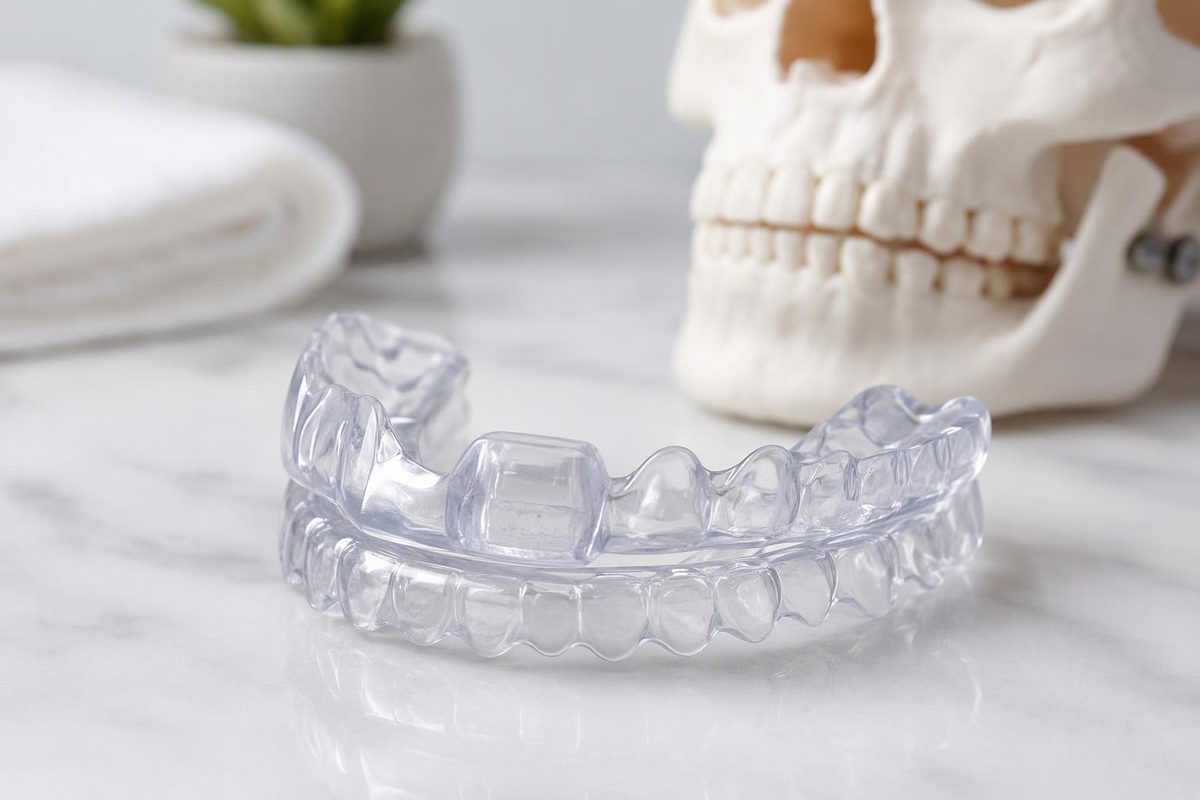
An NTI splint is a small, partial-coverage oral appliance fitted over a few front teeth. Unlike a full-coverage night guard, it keeps the back teeth apart and concentrates contact at the incisors. That design may reduce jaw-closing muscle activity, but it also creates distinctive risks: pressure on a small number of teeth, changes in how the teeth meet, and the possibility that a loose appliance could be swallowed or enter the airway.
An NTI should therefore be fitted and monitored by a dentist—not treated as a small, interchangeable version of an over-the-counter night guard.
What an NTI splint does
NTI is short for nociceptive trigeminal inhibition tension suppression system. The most familiar version is fitted over the upper central incisors and adjusted so that only the opposing lower incisors contact its platform. The canine and back teeth remain separated during closing and side-to-side movement.
This makes the NTI an anterior bite stop. By permitting contact at the incisors while keeping the canine and back teeth apart, the design is intended to limit clenching intensity. It does not simply cushion the teeth.
The term NTI refers to a particular device family, although people sometimes use it loosely for other small anterior appliances. Designs, materials and tooth coverage can differ, so the name alone does not establish how an appliance works.
NTI versus a full-coverage splint
| Feature | NTI splint | Full-coverage stabilization or Michigan splint |
|---|---|---|
| Tooth coverage | Usually a few incisors | All teeth in one arch |
| Contact | Concentrated at the front | Distributed across the opposing teeth |
| Main mechanical aim | Limit clenching intensity and posterior contact | Protect teeth and provide a stable contact surface |
| Important concern | Movement or loading of individual teeth; bite change; dislodgement | Fit, comfort, wear and possible bite change if poorly designed or monitored |
A Michigan splint is not automatically better for every problem, but its full-arch coverage distributes contact more widely. The NTI’s front-only contact is central to its intended effect—and its limited tooth coverage is why follow-up matters so much. Our broader guide compares additional TMJ mouth splint types.
What the evidence shows
Clenching and sleep bruxism
Small studies suggest that an NTI can reduce measured jaw-muscle activity while it is being worn. In a randomized pilot study of just 10 people with probable sleep bruxism, muscle activity decreased with the NTI but not with a Michigan splint; seven participants preferred the Michigan splint for comfort. The authors warned about possible irreversible bite changes with long-term NTI use (Clinical and Experimental Dental Research, 2021).
Reduced electrical activity in a muscle is not the same outcome as less pain, fewer cracked teeth or a cure for bruxism. Oral appliances are often used primarily to limit dental damage; the effects of different designs on sleep-related muscle activity remain uncertain.
TMD pain
The evidence does not establish that an NTI is consistently superior to a full-coverage stabilization splint. A 2008 systematic review identified five small or methodologically limited randomized trials. One TMD trial favored a stabilization appliance, another found no difference, and two muscle-activity studies favored the NTI on their electrical measurements. Reported complications predominantly affected individual teeth or the bite (BMC Oral Health).
More broadly, the National Institute of Dental and Craniofacial Research says there is not much evidence that intraoral appliances improve TMD pain. It advises choosing an appliance that is not intended to permanently change the teeth or bite and stopping use if it causes pain (NIDCR).
Migraine and headache
The FDA database records a 2001 510(k) clearance for the NTI Tension Suppression System under the classification “mouthguard, migraine/tension headache.” The decision was “substantially equivalent,” the regulatory finding used for this pathway (FDA 510(k) K010876). Clearance should not be read as proof that an NTI will prevent headaches in a particular person.
A later randomized crossover pilot study compared an NTI with a placebo appliance in 25 people with refractory chronic migraine; 19 completed both treatment periods. Headache-impact categories improved more often during NTI use, but the study was small and single-blinded. The devices were provided by an NTI distributor, and the corresponding author disclosed a financial interest in a device provider (BMC Neurology, 2022). The result is a preliminary signal, not definitive evidence.
Migraine requires medical diagnosis and management. An NTI is not a substitute for medical evaluation of a new, severe or changing headache.
The main NTI risks
Because only a few teeth support the device, unwanted forces may affect individual incisors or alter the relationship between the front and back teeth.
Stop wearing the device and contact the prescriber if you notice:
- a new gap between teeth or a change in tooth position;
- back teeth no longer meeting as they did before;
- persistent front-tooth tenderness or looseness;
- new or increasing jaw pain or headache;
- gum irritation, cracking or rough edges; or
- an appliance that has become loose or comes off during sleep.
A small, loose device also presents an ingestion or airway risk. The TMJ Association specifically notes the possibility of an NTI being swallowed or aspirated and warns that its limited coverage can stress the teeth (TMJ Association). Do not wear an NTI that no longer stays securely in place. If the device disappears and you have trouble breathing, call emergency services.
What to establish before accepting one
Ask the prescriber to document:
- The treatment target. Is the goal dental protection, reduced clenching intensity, short-term TMD symptom relief or adjunctive migraine care?
- Why partial coverage was chosen. Ask how an NTI compares with a full-coverage appliance for your teeth, gums, bite and symptoms.
- The wear schedule and review date. “Wear it nightly” is incomplete without a planned reassessment.
- How the bite will be monitored. A baseline record makes a later change easier to recognize.
- What counts as treatment success. Track a relevant outcome—such as morning jaw pain, headache days, chewing comfort or evidence of new tooth damage—rather than relying only on whether the device looks worn.
- The stopping rules. Know whom to contact if pain increases, teeth feel mobile, the bite changes or the appliance loosens.
An NTI is a distinct partial-coverage tool, not a universal upgrade from a night guard. Its possible benefit depends on the problem being treated, while safer use depends on secure retention, a clearly directed wear schedule and regular checks of the front teeth and bite.