
What Can Actually Change After You Start Wearing a Jaw Splint?
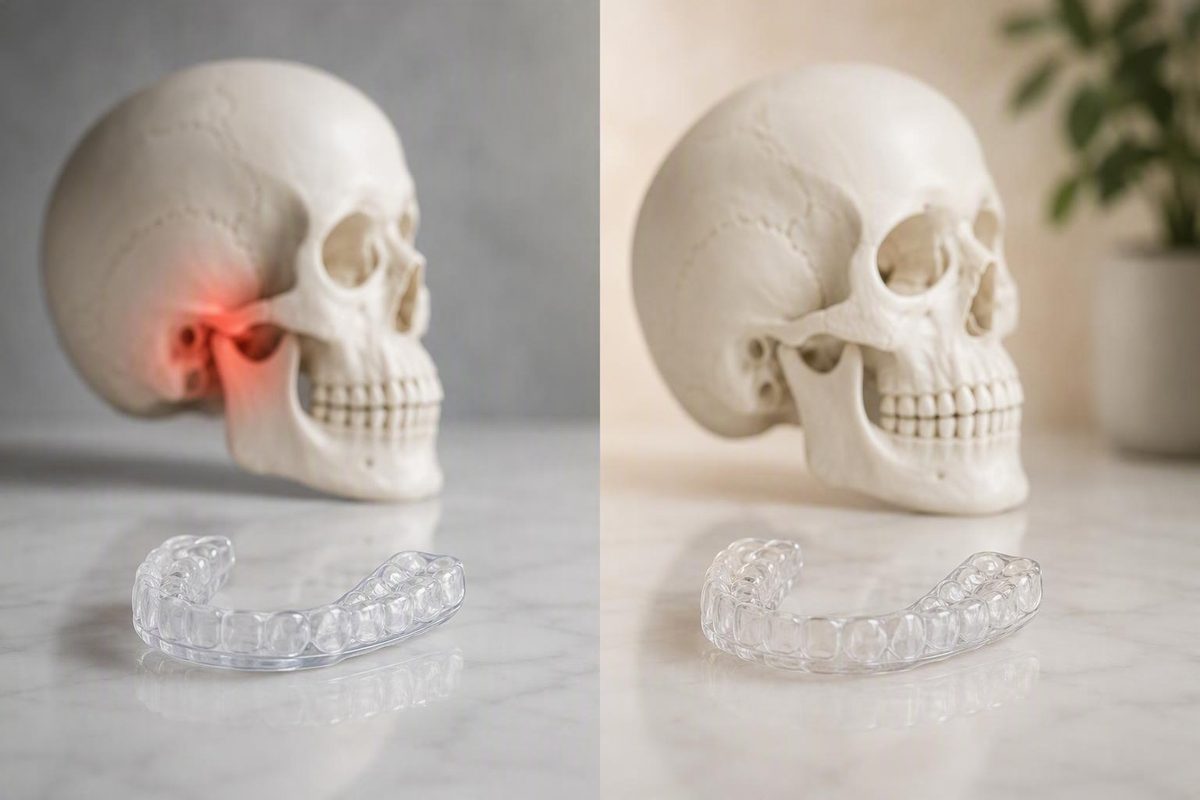
The most meaningful TMJ splint before-and-after result is usually not a visible transformation. It is a documented change in outcomes that matter to you: jaw-pain intensity, headache frequency, chewing comfort, locking or clicking, ease of movement, sleep disruption, pain-medication use, and whether your natural bite remains stable.
These are outcomes to track, not promises that every splint will improve them. A splint may ease symptoms without moving a displaced disc back into place, permanently correcting the bite, retraining the jaw, or changing facial structure. Results depend on the diagnosis, appliance design, fit, wear schedule, adjustments, and other care used alongside it.
At a glance
- What may improve: pain or day-to-day function in some appropriately selected patients.
- What photos cannot prove: reduced pain, restored disc position, easier chewing, or permanent bite correction.
- What the timeline evidence shows: one small, diagnosis-specific trial found earlier pain improvement in appliance groups, but it does not establish a universal deadline.
- What warrants reassessment: worsening pain, locking, restricted opening, new tooth soreness, altered joint sounds, appliance problems, or a persistent bite change.
This article is educational and cannot determine whether a particular appliance is appropriate for you. New, severe, or worsening symptoms require individual assessment.
What a meaningful TMJ splint before-and-after result looks like
A jaw splint is a removable oral appliance fitted over some or all of the upper or lower teeth. Depending on its design, it may distribute tooth contacts, protect teeth, support symptom management, or guide the lower jaw toward a specified position. Professional fitting, reassessment, and adjustment may be part of treatment, and different designs are not interchangeable. Overall evidence for intraoral appliances remains mixed and often limited in quality, so the diagnosis and intended purpose matter greatly, according to The TMJ Association’s overview of splints and their risks.
A useful before-and-after comparison covers five domains:
- Symptoms: jaw or facial pain, temple pain, headaches, stiffness, clicking, grinding, and sleep disruption.
- Daily function: chewing, speaking, yawning, opening the mouth, and eating previously avoided foods.
- Clinical findings: mouth-opening range, tenderness, joint sounds, pressure sensitivity, movement pattern, and other examination findings relevant to the diagnosis.
- Dental and bite effects: tooth soreness, appliance wear, which teeth contact first, and whether the bite returns to baseline after appliance removal.
- Adverse events: increased pain, new locking, louder or more frequent joint sounds, restricted opening, appliance looseness, tooth movement, or a persistent bite change.
That framework separates symptom relief from structural transformation. If pain falls from 7 to 3 but opening and clicking remain unchanged, the fair conclusion is that pain improved. It is not that the joint was “realigned.” Likewise, a more comfortable bite while the appliance is in place does not establish that the natural bite has been permanently corrected.
Before-and-after photographs are particularly limited. Changes in expression, head posture, jaw position, lighting, camera distance, or clenching can affect appearance. Facial and intraoral images cannot directly show pain intensity, headache frequency, chewing ability, locking episodes, medication use, or jaw-movement range.
Photos become more informative when paired with standardized records, including:
- The same camera position, lighting, expression, jaw posture, and lens
- A documented diagnosis
- Baseline symptom scores
- Consistently obtained jaw-movement measurements
- Treatment and follow-up dates
- The exact appliance and wear schedule
- Adjustments and co-treatments
- Adverse events
- Follow-up after wear has been reduced or stopped
The most credible “after,” therefore, is not a dramatic image. It is documented improvement in symptoms or function without a new tooth, bite, or joint problem.
Record the “before” picture with symptoms and measurements
If you begin tracking only after you feel better—or worse—you may unintentionally reconstruct your starting point from memory. As a practical self-monitoring approach, consider recording several representative days before treatment when circumstances permit. This is a tracking framework, not a clinically validated minimum baseline period.
Use a brief record you are likely to maintain. Possible entries include:
- Overall jaw or facial pain from 0 to 10
- Morning and evening pain
- Morning jaw tightness
- Headache occurrence, severity, and duration
- Chewing difficulty from 0 to 10
- Foods avoided or modified
- Clicking frequency: never, occasional, frequent, or nearly every movement
- Whether clicking is painful
- Locking episodes and their duration
- Sleep disruption related to symptoms or the appliance
- Pain-medication name, dose, and frequency
- Time the splint was inserted and removed
- Tooth soreness, gum irritation, gagging, or appliance looseness
- Whether the bite feels normal after removal
Add concrete functional observations. Can you chew a sandwich, raw vegetables, meat, or another personally relevant food? Can you speak through a meeting without increasing pain? Can you yawn comfortably? Does opening deviate to one side? Do the same teeth seem to contact first each morning?
Also document the treatment:
- Appliance name and category
- Upper or lower arch
- Full or partial tooth coverage
- Fitting date
- Prescribed wear schedule
- Actual wear time
- Nights or days when it could not be tolerated
- Dates and details of adjustments
- Repairs, remakes, or fit changes
These details help prevent misleading comparisons. Improvement after an adjustment may not show how the original configuration performed. Symptoms that changed after beginning physical therapy, medication, or another intervention cannot confidently be attributed only to the splint.
Depending on the clinical question, an examination may include jaw-joint and muscle findings, range of motion, bite relationships, joint sounds, and tenderness. Using the same method and conditions at follow-up makes comparisons easier to interpret. These are examples of findings a clinician may assess, not instructions for diagnosing yourself.
Before treatment, define what a worthwhile result would look like for you. For example:
Chew a normal evening meal with pain no higher than 3 out of 10, have no more than one headache day per week, and develop no new locking, tooth soreness, or persistent bite change.
That is a personal outcome target, not a universal definition of success.
The table below uses two weeks, six weeks, and three months solely as organizing points borrowed from one small, diagnosis-specific trial. Those dates are not validated reassessment intervals for every appliance or condition and should not replace the schedule set by your clinician.
| Outcome | Baseline | Two weeks | Six weeks | Three months |
|---|---|---|---|---|
| Average morning pain, 0–10 | ||||
| Average evening pain, 0–10 | ||||
| Headache days per week | ||||
| Chewing difficulty, 0–10 | ||||
| Locking episodes per week | ||||
| Clicking frequency | ||||
| Comfortable mouth opening | ||||
| Maximum mouth opening | ||||
| Pain-medication days | ||||
| Sleep disruption | ||||
| Tooth soreness | ||||
| First teeth to contact | ||||
| Persistent bite difference | ||||
| Prescribed versus actual wear | ||||
| Adjustments or co-treatments |
Someone who has not improved by one of these dates has not necessarily “failed.” Continued symptoms are a reason to review the diagnosis, appliance fit, actual wear, emerging risks, and available alternatives rather than continuing indefinitely without monitoring.
What may change at two weeks, six weeks, and three months
The most directly relevant controlled trial enrolled 60 adults with preauricular pain and diagnoses of painful disc displacement with reduction and arthralgia. Twenty participants received an anterior repositioning splint plus counseling, 20 received an NTI-tss device plus counseling, and 20 received counseling alone. Both appliance groups showed pain-intensity improvement by the first two-week follow-up, while the counseling-only group showed progress later, at three months. The appliances were worn during sleep, and assessments occurred at two weeks, six weeks, and three months, as detailed in the controlled study of intraoral devices and counseling.
This supports a narrow conclusion: adding either studied appliance to behavioral counseling may have accelerated pain improvement in selected patients with that particular diagnostic pattern. It does not show that most people with jaw pain will improve within two weeks.
The limitations are substantial:
- There were only 20 participants in each group.
- Follow-up ended at three months.
- Every group received behavioral counseling.
- Participants had a specific combination of painful disc displacement with reduction and arthralgia.
- Several other TMD subtypes, including disc displacement without reduction, osteoarthritis, and myofascial pain, were excluded.
- The study cannot establish long-term benefit, relapse rates, or long-term adverse effects.
The following time points are therefore best understood as a way to organize observations from that trial—not as a universal treatment schedule.
At two weeks, observations might include:
- Whether pain is trending up, down, or remaining unchanged
- Comfort and retention of the appliance
- Actual versus prescribed wear
- Tooth or gum soreness
- Changes in clicking
- Sleep disruption
- Whether the bite returns to its usual pattern after removal
Early improvement can be encouraging, but a single good morning is not a trend. Worsening pain or a persistent bite change should not be dismissed merely because treatment is new.
At six weeks, observations might include:
- Chewing and speaking comfort
- Jaw-movement range
- Locking frequency
- Headache days
- Tooth and muscle tenderness
- Joint sounds
- Bite contacts
- Appliance wear or looseness
- Any adjustment made by the treating clinician
- Whether the original diagnosis still fits the pattern
An appliance can be comfortable yet offer little benefit for the outcome that matters most to you.
At three months, questions might include:
- Has daily function improved enough to justify continued use?
- Have headache days or medication use changed?
- Have any adverse effects appeared?
- Does the benefit occur only during use, or is it also noticed afterward?
- Did counseling, physical therapy, medication, diet changes, sleep changes, or natural symptom fluctuation contribute?
Some dental-practice pages publish broader estimates extending improvement over several months. One clinic, for example, describes initial relief within two to six weeks and later improvement over subsequent months while acknowledging that response varies. Those figures are generalized practice benchmarks without controlled patient-level support in the supplied material, not guarantees or universal deadlines (clinic discussion of expected splint timing).
A separate recommendation to try a night guard for four to six weeks should not be treated as an established response period for every therapeutic TMJ splint. A tooth-protective night guard, stabilization splint, repositioning appliance, and anterior-only device may have different purposes and risks.
The type of appliance changes both the expected result and the risk
“TMJ splint” is an umbrella term, not a single standardized treatment. Appliances may differ in tooth coverage, contact pattern, material, intended jaw relationship, and wear schedule.
| Appliance category | Primary purpose | Typical coverage | Professional adjustment? | Outcomes it may target | Principal cautions |
|---|---|---|---|---|---|
| Custom night guard | Protect teeth and restorations from grinding or clenching forces | Commonly a full upper or lower arch | Expected for a dentist-made device | Tooth protection; sometimes tenderness, pain, or headache symptoms | It may not address a diagnosed joint disorder; an unsuitable or poorly fitted device may worsen symptoms |
| Full-coverage stabilization splint | Provide adjusted contacts without intentionally maintaining a permanently altered jaw position | Full coverage of one arch | Yes | Selected pain, muscle, joint, or functional goals | Fit and bite contacts require monitoring |
| Repositioning splint | Guide the lower jaw toward a specified therapeutic relationship | Often full coverage with shaped guidance | Yes, with close monitoring | Selected painful joint or clicking presentations | Prolonged use may alter the bite; temporary comfort does not prove permanent correction |
| Anterior biteplane or NTI-style device | Limit posterior contact or place contact on front teeth | Partial, usually involving anterior teeth | Yes | Selected clenching, pain, or joint-related goals | Concentrated tooth stress, tooth movement with some designs, and swallowing or aspiration concerns |
| OTC boil-and-bite guard | Provide accessible protection from grinding | Varies; full coverage may be preferable when an OTC guard is used | Usually self-fitted, although professional review may be advisable | Dental protection and a monitored symptom response | Fabrication and retention problems; evidence from bruxism studies cannot automatically be applied to diagnosed TMD |
A night guard primarily protects teeth from bruxism-related wear. A therapeutic TMJ splint is selected for a particular joint, muscle, functional, or occlusal objective. Kaiser Permanente’s patient guidance likewise distinguishes protective night guards from diagnosis-specific custom TMJ splints and warns that the wrong or poorly fitted device can aggravate symptoms (night guards and TMJ splints for jaw and facial pain).
Terminology is not always used consistently. In general:
- A stabilization or flat-plane splint is described as a full-coverage appliance adjusted to provide consistent contacts without intentionally holding the mandible permanently in a new position.
- A repositioning splint guides the lower jaw toward a chosen relationship for a specified therapeutic objective.
- An anterior biteplane or NTI-style device contacts a limited number of front teeth rather than covering and contacting the entire arch.
- An OTC boil-and-bite guard is self-fitted and is generally intended for accessible tooth protection rather than diagnosis-specific management.
Design-specific risks deserve precise language. The TMJ Association states that continuous anterior biteplane use may permit posterior tooth movement, while small anterior devices may concentrate stress on a few teeth and carry swallowing or aspiration concerns. It also warns that prolonged repositioning-splint use can produce permanent bite changes and increased pain. Those risks should not be generalized automatically to every partial-coverage design, but they support close monitoring of the specific appliances described (design-specific splint risks).
An OTC appliance should not be judged solely by price or material. In a four-month randomized trial comparing one self-fabricated OTC appliance with a custom Michigan splint, participants had difficulty producing clinically acceptable OTC devices, and nighttime rhythmic masticatory muscle-activity bursts were more numerous in the OTC group. Compliance and most other measured outcomes did not differ significantly. This was a sleep-bruxism and dental-protection study, not evidence that OTC guards and therapeutic splints are equally effective for diagnosed TMD (randomized trial of an OTC appliance and a Michigan splint).
The relevant questions are what the device covers, how it contacts the opposing teeth, what it is intended to accomplish, whether the diagnosis supports that objective, and how its effects will be monitored.
Pain can improve even when jaw measurements do not
Patient-reported and objective outcomes answer different questions.
A patient-reported outcome describes the person’s experience: pain, headache burden, chewing comfort, sleep, confidence opening the mouth, or medication use.
An objective finding is observed or measured: mouth-opening distance, tenderness under standardized pressure, joint sounds, movement pattern, or the number and distribution of tooth contacts.
Both matter, but they do not have to change together. In the 60-person controlled trial, pain improved in the appliance groups, yet pressure-pain threshold, mandibular range of motion, and the number of occlusal contacts did not change significantly. The NTI-tss group also developed increased joint-sound frequency, showing that pain and clicking can move in different directions and that appliance designs may have different effects (trial outcomes and joint-sound findings).
Appropriate interpretations include:
- Less pain with unchanged opening: symptom improvement, not increased range of motion.
- Easier chewing with persistent clicking: functional improvement, not proof that the disc returned to a normal position.
- Fewer headaches with a new altered bite: possible symptom benefit accompanied by a dental adverse effect.
- No pain change but less appliance or tooth wear: possible dental protection without demonstrated TMD pain relief.
- Reduced clicking only while wearing the appliance: a device-associated effect, not necessarily permanent correction.
- Less pain but more frequent joint sounds: a mixed outcome that warrants review rather than a simple “success” label.
Clicking may decrease without disappearing. A quieter joint does not establish that the underlying disc-condyle relationship has been restored, and lasting restoration of that relationship was not demonstrated by the trial.
Night guards and TMJ splints should not be assumed to permanently “train” the jaw or bite into a new position. Kaiser Permanente’s patient guidance explicitly states that these devices do not permanently retrain or reposition the jaw or bite.
This distinction is especially important when temporary splint comfort is used to propose orthodontics, crowns, veneers, extensive restorations, or another irreversible bite-changing intervention. A favorable response may provide useful information, but it does not by itself prove that permanent dental alteration is necessary, safe, or likely to reproduce the same effect.
Before accepting an irreversible plan, ask what findings support it independently of temporary comfort in the appliance, what conservative alternatives remain, what would happen if symptoms returned, and whether another clinician with relevant TMD or orofacial-pain expertise should review the diagnosis.
Fitting, adjustments, and behavioral care complicate the “after” result
A supervised appliance process may include:
- A history of pain, headaches, locking, joint sounds, trauma, dental treatment, sleep symptoms, and clenching or grinding
- Examination of the jaw joints, muscles, movement, teeth, and bite
- A working diagnosis and treatment objective
- Selection of an appliance design
- Impressions or digital scanning
- Delivery, fit, and contact checks
- An adaptation period
- Reassessment and adjustment
- A decision to continue, reduce, remake, pause, or stop treatment
One dental practice’s workflow description includes assessment, possible imaging, impressions, fitting, adaptation, and follow-up monitoring. This is useful as an example of a clinical process, but its promotional effectiveness claims should not be treated as controlled evidence (example of a custom splint workflow).
An appliance that fits on delivery may need later adjustment. Wear patterns, retention, symptoms, and tooth contacts can change. An adjustment may improve comfort or redistribute contacts, but it also complicates before-and-after interpretation. Record what changed and when.
Behavioral care is another major confounder. In the controlled trial, every group received counseling covering:
- Relaxation
- Sleep hygiene
- Diet modification
- Hot thermotherapy
- Caffeine avoidance
- Avoidance of awake clenching
The appliance groups therefore received both a device and counseling. The study did not test splints acting alone. Counseling alone also produced progress by three months, so the most defensible interpretation is possible faster pain relief from adding an appliance in that selected population—not proof of a greater long-term final benefit.
Your record should also note concurrent changes such as:
- Temporarily choosing easier-to-chew foods
- Reducing gum chewing
- Heat or cold use
- Jaw exercises
- Physical therapy
- Stress-management work
- Medication changes
- Improved sleep routines
- Reduced caffeine
- Increased awareness of awake tooth contact
- Changes in work posture or prolonged talking
There is no evidence-supported wear schedule that applies to every splint. Sleep-only, part-time, and longer protocols appear in the supplied sources, but the prescription depends on the appliance, diagnosis, objective, and emerging effects. Copying another patient’s instructions or an online clinic protocol is inappropriate because similar-looking devices may function differently.
Follow-up is part of outcome and safety monitoring, not merely an optional commercial extra. Reassessment can determine whether the device remains stable, whether contacts are changing, whether symptoms are improving enough to justify continued use, and whether an adverse effect requires a different plan.
Warning signs: when the “after” picture is worse
Contact the treating clinician promptly for reassessment if you notice:
- New or increased jaw or facial pain
- Greater clenching or grinding
- New, louder, or more frequent clicking
- Catching or locking
- Reduced mouth opening
- New or worsening headaches
- Tooth, gum, or restoration soreness
- Pain radiating into the face, ear region, head, or neck
- An appliance that rocks, loosens, breaks, or no longer seats fully
- A persistent change in which teeth meet
- A bite difference that lasts longer or becomes more pronounced
These are warning signs for reassessment, not diagnoses by themselves. Clinic-authored guidance distinguishing guards from therapeutic splints similarly recommends professional review for new or worsening pain, headaches, soreness, locking, restricted opening, altered bite, or radiating pain (appliance warning signs and reassessment).
NIH guidance quoted by The TMJ Association says that a recommended splint should be used for a short time and should not cause permanent bite changes. If the splint causes or increases pain, the guidance advises stopping use and seeing the provider. The same resource identifies possible risks including tooth stress, altered bite or tooth position, increased pain, and swallowing or aspiration of a small appliance.
The increased joint-sound frequency in the trial’s NTI-tss group is a concrete example of an appliance improving one outcome while worsening another. Pain should not be the only outcome considered.
A simple morning observation can help you describe a bite concern to the treating clinician:
- After removing the appliance, close gently without deliberately forcing the jaw forward or backward.
- Note which teeth seem to contact first.
- Compare the sensation with your recorded baseline.
- Note whether the difference resolves, persists, or becomes more noticeable.
This is an observation exercise, not a way to diagnose or correct the bite. An ongoing change should be reported rather than assumed to be harmless. Changes to the appliance itself should be handled through the treating clinician’s adjustment process.
Persistent worsening should not automatically be normalized as an inevitable adaptation period. Depending on the individual case, the clinician may need to review fit, wear schedule, appliance design, diagnosis, or another potential source of pain.
Appliance reassessment is distinct from urgent clinical evaluation. Pain Catalog’s educational notice advises prompt clinical attention for jaw locking, facial trauma, or jaw pain accompanied by fever (clinical-attention notice). Severe symptoms, major trauma, signs of infection, or inability to manage normal functions should not wait for an ordinary appliance-adjustment visit.
Suspected device problems may also be reported to the FDA MedWatch system. Reporting supports safety monitoring but does not replace contacting the provider responsible for your care.
How to judge before-and-after photos, testimonials, and next-step proposals
A clinic gallery answers one limited question: what selected cases looked like when the clinic chose to publish them. It cannot tell you how many people failed to improve, discontinued treatment, experienced adverse effects, received other treatments at the same time, or declined to be photographed.
This is selection bias. The displayed cases may be genuine and still provide a distorted view of typical results.
Photos alone cannot establish that a splint caused:
- Pain relief
- Fewer headaches
- Easier chewing
- Less locking
- Increased mouth opening
- A stable bite
- A change in facial form
- Durable improvement after stopping the appliance
One treatment-center roundup, for example, presents facial and intraoral images, patient narratives, and reported treatment timelines. It also illustrates the central limitations of this material: selected favorable cases, limited clinical metrics in some galleries, and no independent verification or untreated comparison groups (example of a curated TMJ before-and-after roundup).
Audit any case presentation with the following checklist:
- Was the diagnosis stated and based on an examination?
- Were baseline pain and headache scores recorded?
- Were photographs standardized?
- Was jaw opening measured consistently?
- Was locking frequency reported?
- Was clicking painful, painless, or merely audible?
- What exact appliance was used?
- Which teeth did it cover?
- What was the prescribed wear schedule?
- How much did the patient actually wear it?
- How often was it adjusted?
- Were physical therapy, medication, exercises, diet changes, orthodontics, or restorative treatment also used?
- Were adverse effects reported?
- Were unsuccessful cases included?
- Was the result assessed after reducing or stopping wear?
- Was there long-term follow-up?
- Was any claim independently verified?
Stronger documentation reports patient-centered and objective outcomes at defined times. For example, it might show that pain changed from one recorded value to another, chewing a defined food became easier, jaw opening was measured using the same method, locking frequency changed, and the natural bite remained stable. It should also disclose adjustments, co-treatments, and unwanted effects.
After a monitored trial, there is no single mandatory next step. Depending on the diagnosis, response, and risks, a clinician may consider continued supervised use, adjustment, phased reduction, diagnostic reassessment, physical therapy or other conservative care, or referral to someone with relevant expertise.
Be especially cautious when temporary comfort in an altered jaw position is presented as automatic proof that the teeth must be moved or rebuilt permanently. A temporary splint trial and irreversible orthodontic or restorative treatment are not equivalent decisions.
Bring these questions to a consultation:
- What is my working diagnosis?
- What findings support that diagnosis?
- Is the appliance intended for tooth protection, pain management, joint support, repositioning, or another goal?
- Which teeth will it cover?
- Is it full coverage or partial coverage?
- What outcome should change if it works?
- How will that outcome be measured?
- What wear schedule applies to this exact appliance?
- How often will fit, symptoms, movement, and bite contacts be reviewed?
- What discomfort is expected?
- What changes are stopping rules or reasons for prompt reassessment?
- What conservative alternatives are available?
- What happens if symptoms remain unchanged?
- What happens if pain improves but clicking or locking persists?
- Is there a plan for reducing or stopping use?
- Would a proposed permanent treatment still be recommended if the temporary splint response were ignored?
The best TMJ splint before-and-after result is a documented improvement in pain or daily function without new bite, tooth, or joint problems. Establish a practical baseline, compare outcomes at dates appropriate to your own treatment plan, and record adjustments and co-treatments. Limited evidence suggests that selected patients may experience faster pain improvement when an appropriately managed appliance is added to behavioral care, but no temporary response proves permanent structural correction or automatically justifies irreversible treatment.
Can a TMJ splint permanently change my bite or jaw position?
A symptom-relief appliance should not be assumed to permanently correct, realign, or “train” the jaw. Patient guidance cited above states that night guards and TMJ splints do not permanently retrain the jaw or bite.
Unwanted lasting bite or tooth-position changes are possible risks with certain designs, particularly prolonged repositioning-splint use. Such a change is an adverse effect to report, not evidence that the jaw was successfully corrected. If your natural bite remains different after removing the appliance, contact the treating clinician.
How long does it take to see results from a TMJ splint?
There is no universal timeline. In one small, diagnosis-specific controlled trial, appliance groups that also received behavioral counseling showed pain improvement by two weeks, while the counseling-only group progressed later. That finding suggests possible faster pain relief for selected patients, not a promise that everyone should improve within two weeks.
Two weeks, six weeks, and three months can be used as personal tracking columns because they were assessment points in that study. They are not clinically validated deadlines or a universal appointment schedule. Follow the reassessment plan for your specific diagnosis and appliance.
A four-to-six-week recommendation for trying a night guard is also not an established response period for every therapeutic splint.
Is a night guard the same as a therapeutic TMJ splint?
Not necessarily. A night guard primarily protects teeth and restorations from grinding or clenching. A therapeutic TMJ splint is selected and adjusted for a particular muscle, joint, functional, or occlusal objective.
Names are used inconsistently, so ask about purpose and design rather than relying on the label. Find out whether the device provides full or partial coverage, whether it guides the jaw toward a specified relationship, how it will be adjusted, and what outcome it is meant to change.
What should I do if pain, clicking, locking, or my bite gets worse?
If the appliance causes or increases pain, NIH-derived guidance cited above advises stopping use and seeing the provider who made it. For new clicking, locking, restricted opening, tooth soreness, appliance instability, or a persistent bite change, contact the treating clinician promptly for individualized instructions.
Record when the change began, how long the appliance was worn, which teeth seem to contact first, whether the bite returns to baseline, and whether opening has become restricted. Jaw locking, facial trauma, or jaw pain with fever requires prompt clinical attention rather than waiting for an ordinary follow-up.
Do TMJ splint before-and-after photos prove that treatment worked?
No. Photographs cannot measure pain, headaches, locking, chewing ability, medication use, or jaw motion. They also cannot establish that the splint caused a visible or reported change.
Treat galleries as selected case presentations. More credible documentation includes a confirmed diagnosis, standardized images, baseline and follow-up symptom scores, consistently obtained jaw measurements, appliance and wear details, adjustment history, co-treatments, adverse events, unsuccessful outcomes, and longer-term follow-up.