
When an Earache May Be Coming From Your Jaw
Pain that changes with chewing, yawning or clenching, plus jaw tenderness, stiffness or locking, may have a TMD component. Location alone cannot confirm it.
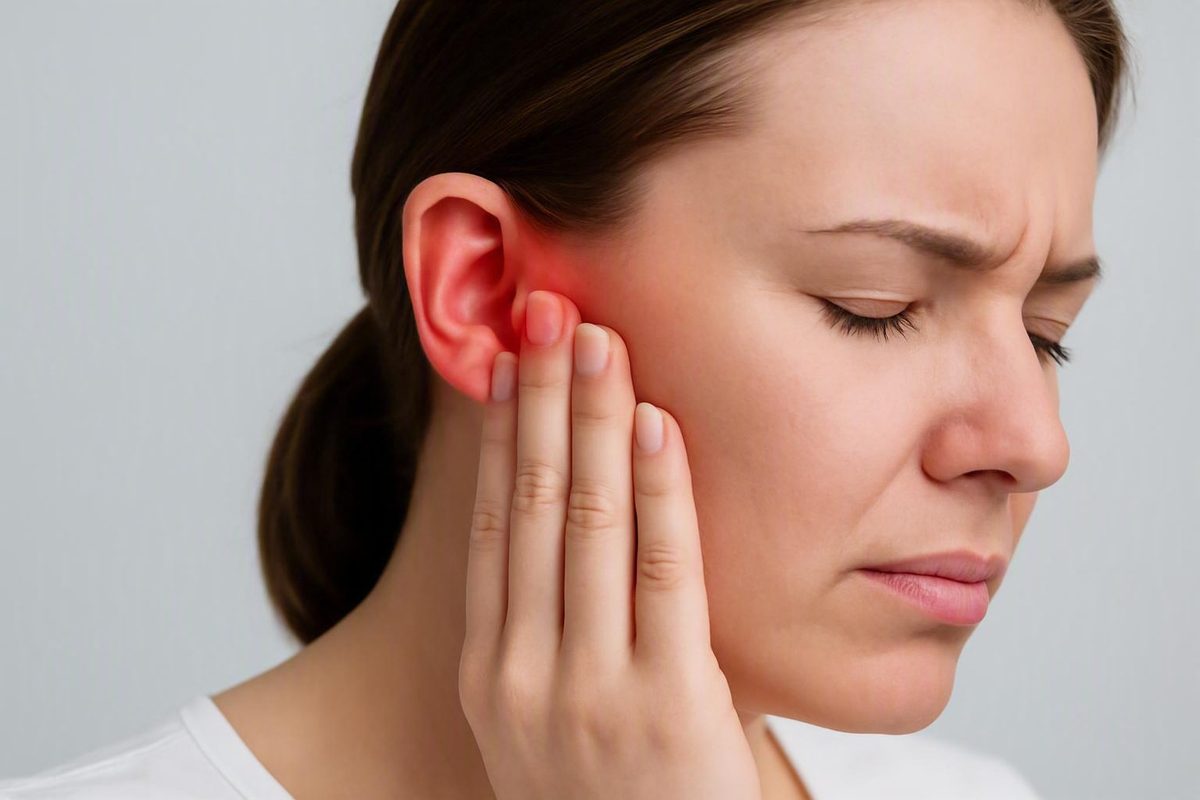
The short answer: a jaw disorder can feel like an earache
Yes. A temporomandibular disorder can cause or contribute to pain felt in or around the ear, even when the apparent source is the jaw joint or nearby chewing muscles rather than the ear itself. Ear-area discomfort, painful jaw movement, limited opening, and locking can occur together in a TMD pattern, according to Colgate’s patient overview of TMD and ear pain.
That does not mean every unexplained earache comes from the jaw. Ear pain is nonspecific, and its location alone cannot establish TMD. Ear disease, earwax, pressure-regulation problems, dental disease, sinus or allergy problems, trauma, and nerve-related conditions can produce overlapping symptoms.
The terminology is easy to confuse:
- TMJ means the temporomandibular joint, which connects the lower jaw to the skull.
- TMD means temporomandibular disorder, the broader term for problems involving the joint, nearby chewing muscles, or jaw movement.
People often use “TMJ” as the name of the disorder, but everyone has two temporomandibular joints. A disorder may affect one side, both sides, or the surrounding muscles.
Accordingly, jaw-related discomfort may be perceived near one ear or both. One-sided pain still could arise from the ear, a tooth, the sinuses, the jaw, or another nearby structure.
The available patient-education sources do not establish how often TMD causes ear pain in the general population. It is more useful to consider the overall pattern—what triggers the discomfort, which symptoms accompany it, and whether jaw function has changed—than to assume one cause is statistically most likely.
Why jaw pain can be perceived near the ear
The temporomandibular joints connect the lower jaw to the skull immediately in front of the ears. They move when you chew, speak, yawn, swallow, and open or close your mouth. The muscles involved in those movements occupy the jaw, cheek, and temple regions close to the ear.
This close anatomical relationship can make the source of discomfort difficult to locate. Irritation or strain in a jaw joint or nearby chewing muscle may produce referred pain: discomfort perceived somewhere other than its apparent source. Pain arising around the jaw hinge may therefore feel as though it is beside, beneath, or inside the ear. An ENT clinic similarly describes jaw strain or inflammation as a possible source of ear-area pressure, aching, or fullness while emphasizing that other disorders can produce the same symptoms. See Charleston ENT & Allergy’s explanation of TMD and chronic ear pain.
Anatomical proximity and referred pain offer the most cautious explanation supported by the supplied material. Some provider articles propose additional mechanisms involving shared nerve pathways or pressure regulation in the ear, but the evidence supplied here does not establish those mechanisms firmly. It also does not establish that TMD directly causes hearing loss, vertigo, balance disorders, or Eustachian-tube dysfunction.
Possible contributors to jaw-joint or muscle symptoms include:
- Clenching the jaw or grinding the teeth
- Arthritis affecting the joint
- A blow or other injury to the jaw
- Repetitive chewing, including frequent gum use
- Prolonged or unusually wide mouth opening
- Stress-related muscle tension
These are possibilities, not findings that everyone with jaw and ear discomfort will have. Some people notice clenching or grinding; others do not. Symptoms also may arise without an obvious trigger.
Bite alignment appears in some dental and clinic sources as another possible consideration. The supplied evidence does not establish an uneven bite as a common or proven cause of TMD-related ear pain. It therefore should not be used, by itself, to justify irreversible bite alteration, orthodontic treatment, or another corrective procedure.
The most useful initial question is whether the ear discomfort behaves like pain from a moving jaw structure. If it changes consistently when the jaw is loaded, moved, or rested, a jaw contribution becomes more plausible—but not certain.
Clues that the pain may be linked to jaw function
No single symptom diagnoses TMD. A jaw source becomes more plausible when several related observations occur together, particularly movement-related ear discomfort accompanied by jaw tenderness, stiffness, painful noise, or impaired function.
Notice whether the discomfort consistently begins or becomes worse when you:
- Chew firm or chewy food
- Yawn
- Talk for an extended period
- Clench your teeth
- Bite down
- Open your mouth widely
- Move the lower jaw from side to side
An ENT practice’s comparison of TMD and ear infection identifies pain aggravated by eating, jaw noises, morning discomfort, and pain extending toward the temple or neck as possible parts of a jaw-related pattern. These features can support suspicion of TMD, but they cannot confirm it. Review the Florida Otolaryngology Group’s symptom comparison.
Other potentially relevant jaw findings include:
- Tenderness immediately in front of the ear or along the chewing muscles
- Jaw or facial soreness
- Clicking or popping that is painful
- Stiffness or difficulty opening fully
- A noticeable shift during opening
- Catching or locking
- Pain or fatigue while chewing
Discomfort may extend toward the temple, cheek, lower jaw, teeth, or neck. That distribution is compatible with jaw or muscle pain, but radiation does not identify the cause. Dental and other conditions can also produce pain felt beyond its source.
Morning symptoms and possible clenching
Jaw and ear soreness that is worse after waking can be compatible with nighttime clenching or grinding. Morning jaw fatigue or known nighttime grinding may add context, but none of these observations is diagnostic.
Morning pain can also have causes unrelated to the jaw.
During the day, notice whether you press your teeth together while concentrating, driving, exercising, or feeling tense. If you repeatedly catch yourself clenching, gently releasing that tension may reduce unnecessary jaw loading. This observation does not prove that clenching explains the ear pain.
Clicking is not the same as painful dysfunction
A click or pop by itself should not be treated as proof that the jaw is causing the ear discomfort.
Noise becomes more relevant to an assessment when it occurs with pain, catching, limited opening, or another change in jaw function. The important distinction is between an isolated sound and painful or impaired movement.
Avoid repeatedly opening and closing your mouth merely to test the noise.
Ear pressure, fullness, and ringing can overlap
Some people with jaw symptoms also report ear pressure, a clogged or full sensation, or tinnitus. Dental-practice patient education lists earache and tinnitus among symptoms reported with TMD, while recommending professional care when symptoms recur or when the jaw locks or becomes difficult to open or close. Read the practice’s TMD symptom overview.
These sensations are not specific to TMD. Fullness or ringing should not be used to dismiss a possible ear condition, especially when it is new, persistent, worsening, or accompanied by an apparent hearing change or dizziness.
Observations to record before an appointment
A short symptom record can help a clinician understand the pattern. Consider noting:
- Timing: When did the pain begin? Is it constant or intermittent?
- Side: Is it on the right, left, or both sides?
- Triggers: Does chewing, yawning, talking, biting, or clenching affect it?
- Jaw movement: Is opening painful, limited, uneven, or associated with catching?
- Morning pattern: Is discomfort worse after waking?
- Locking: Has the jaw become stuck or difficult to open or close?
- Ear symptoms: Is there pressure, tinnitus, drainage, or an apparent hearing change?
- Illness signs: Is there fever, congestion, or a recent acute illness?
- Trauma: Was there a recent blow, fall, dental procedure, or prolonged mouth opening?
- Function: Is the problem interfering with eating, speaking, sleeping, or ordinary activities?
If symptoms ease when you reduce chewing or rest the jaw, that observation may support a jaw connection. It does not prove one.
TMJ-related pain, an ear infection, or something else?
It is rarely possible to distinguish a jaw disorder from an ear condition using one symptom. The patterns below are general comparisons drawn from clinic patient education, not validated diagnostic criteria. The table is not a diagnostic test and cannot rule a condition in or out. A dental-practice comparison similarly associates movement-related pain and jaw dysfunction with TMD while linking fever, drainage, acute illness, and hearing changes more closely with ear disease. See the comparison of overlapping TMD and ear-infection symptoms.
| More suggestive of a jaw source | More suggestive of primary ear disease | Can overlap |
|---|---|---|
| Pain changes with chewing, yawning, clenching, or wide opening | Fever or an acute illness accompanying the ear pain | Aching in or around the ear |
| Tenderness at the jaw hinge or in the chewing muscles | Fluid or discharge from the ear | Pressure or fullness |
| Painful clicking or popping | A significant or fluid-related hearing change | Tinnitus |
| Jaw stiffness or fatigue | Ear findings identified during a clinical examination | Headache |
| Suspected clenching or grinding | Ear symptoms occurring during a clear acute ear illness | Facial discomfort |
| Restricted, catching, deviated, or locked movement | — | Symptoms that vary over time or have no clear relationship to jaw use |
Fever, drainage, acute illness, and hearing changes call for medical assessment rather than diagnosis from a checklist. Pain linked to chewing does not automatically establish TMD, particularly if an ear, dental, or sinus condition is also present.
The absence of fever or drainage does not prove that the jaw is responsible. Ear disorders can occur without either feature. Likewise, a normal-looking ear would not independently identify TMD; the symptom history, jaw function, muscles, teeth, and other possible sources would still matter.
Unsuccessful antibiotics or allergy treatment would not confirm a jaw disorder either.
Other possible causes of pain near the ear
Alternatives described in the supplied patient-education material include:
- Outer- or middle-ear disease: Inflammation or infection may cause ear pain, sometimes with illness, drainage, or hearing symptoms.
- Earwax impaction: Blocked wax may contribute to discomfort, fullness, or altered hearing.
- Eustachian-tube dysfunction: A pressure-regulation problem may produce fullness, popping, or muffled sensations.
- Sinus or allergy problems: Congestion and facial pressure can be perceived around the ear, cheek, or upper jaw.
- Dental disease: Tooth or supporting-tissue problems can refer pain toward the jaw and ear.
- Trauma: Injury to the jaw, face, head, or ear may produce overlapping symptoms.
- Nerve-related conditions: Some nerve disorders can cause pain in the face, jaw, or ear region.
Dental causes deserve particular consideration because pain from a tooth can be felt near the jaw hinge or ear. Pain associated with biting, a specific tooth, recent dental work, or localized dental swelling is useful information to report, but it does not establish the cause without an examination.
For broader context, Pain Catalog also has a guide to possible causes of a jaw that hurts on one side, including TMJ, dental, and sinus categories. That article provides general jaw-pain context; it is not evidence that a particular earache originates in the jaw.
The practical lesson is not to force the symptoms into a binary choice between “TMJ” and “ear infection.” Pain near the ear can arise from the ear, jaw, teeth, sinuses, nerves, or more than one structure.
Low-risk steps for mild, uncomplicated symptoms
If the discomfort is mild, jaw movement remains comfortable and functional, and no concerning symptoms are present, a brief period of conservative care may be reasonable. These measures are temporary comfort strategies, not treatment for a confirmed diagnosis.
Temporarily reduce jaw strain
For a short period, consider:
- Choosing foods that require less forceful chewing
- Cutting food into smaller pieces
- Avoiding gum
- Limiting hard, tough, or very chewy foods
- Reducing unnecessary repetitive chewing
- Avoiding forced or unusually wide mouth opening
- Avoiding deliberate jaw popping and repeated self-testing
- Noticing and releasing unconscious clenching
The goal is relative rest rather than complete immobilization. Hospital patient education includes soft foods, heat or cold, stress reduction, and physical therapy among conservative approaches while advising professional care for chronic or severe symptoms. See San Antonio Regional Hospital’s TMD guidance.
Try comfortable warmth
A comfortably warm compress over the jaw area is an optional soothing measure. Keep the temperature moderate, place fabric between the heat source and skin, and discontinue it if it feels uncomfortable or appears to aggravate the symptoms.
The supplied evidence does not establish that heat is better than cold or that either method resolves TMD-related ear pain. Treat warmth as a comfort option rather than a cure.
Let the jaw relax without forcing a position
When you are not eating, allow the jaw to remain loose rather than deliberately clenching or bracing it. Do not push the lower jaw into a supposedly corrective position.
This is an awareness strategy, not an attempt to realign the joint. A reminder near your desk or phone may help you notice habitual tension during concentrated tasks.
Use relaxation to address tension, not to “cure” TMD
Slow breathing, short breaks, a walk, or another familiar relaxation practice may help reduce stress-related tension or clenching. Stress reduction should not be presented as a cure, and jaw symptoms do not mean the problem is “all in your head.”
If symptoms worsen during demanding periods, several factors may be involved, including clenching, altered sleep, fewer breaks, or prolonged muscle tension.
Be cautious with exercises
Different jaw problems may require different approaches, and the supplied sources do not establish that one exercise program is suitable for every reader.
If you try gentle movement, keep it comfortable and do not force the mouth farther open. Stop if movement produces sharp pain, dizziness, locking, or worsening symptoms. Persistent restriction or catching should be assessed rather than worked through.
A clinician who has examined the jaw can decide whether guided mobility, coordination, relaxation, or strengthening work is appropriate.
Do not assume a mouthguard is the answer
A mouthguard or oral appliance is not a universal solution for ear pain that might involve the jaw. An appliance may be considered after an individualized assessment when clenching or grinding is suspected, but its purpose and suitability depend on the person’s symptoms, teeth, and jaw function.
Do not assume that a guard will realign the jaw, provide immediate relief, or work for everyone.
Medication choices are similarly individual. A pharmacist or clinician can advise on appropriate options.
There is no dependable fixed period in which mild symptoms must resolve. Decisions about seeking care should consider persistence, recurrence, worsening pain, impaired movement, and interference with ordinary activities rather than the number of days alone.
When ear and jaw pain need professional attention
Arrange an evaluation when pain persists, repeatedly returns, worsens, becomes severe, restricts jaw movement, or interferes with eating, speaking, sleeping, or ordinary activities. Clinic patient education also recommends assessment for persistent or severe symptoms, restricted movement, difficulty eating or speaking, and balance problems. See the ENT practice’s guidance on overlapping symptoms.
Jaw locking deserves prompt clinical attention, particularly if the mouth becomes stuck open or closed or cannot move normally. Pain following a blow, fall, or other jaw or facial trauma also should not be treated as an ordinary TMD flare. Pain Catalog’s own educational safety notice likewise identifies jaw locking, trauma, and pain with fever as reasons to contact a clinician promptly.
Contact a medical professional for assessment if ear or jaw discomfort occurs with:
- Ear drainage
- A significant or sudden apparent hearing change
- Marked dizziness or balance difficulty
-
Severe or progressively worsening pain
-
An acute illness
- Persistent or worsening tinnitus, fullness, or muffling
The supplied sources do not establish one reliable urgency threshold for all of these symptoms. A clinician can advise how quickly evaluation is needed based on severity, onset, associated symptoms, and medical history. If symptoms appear severe or immediately dangerous, contact emergency services rather than relying on an online checklist.
A simple triage guide
- Mild symptoms without warning signs: A brief reduction in jaw strain and other conservative comfort measures may be reasonable.
- Persistent, recurrent, worsening, or function-limiting symptoms: Arrange an appointment for an examination.
- Fever, recent trauma, or jaw locking: Seek prompt clinical advice.
- Drainage, a significant hearing change, marked dizziness, swelling, or severe progressive pain: Contact a medical professional for assessment and guidance about urgency.
Tinnitus, pressure, fullness, and muffled sensations should not automatically be attributed to the jaw, particularly when they are new, persistent, worsening, or accompanied by other ear symptoms.
This guidance is educational. It cannot determine whether an individual earache comes from the jaw, ear, teeth, sinuses, nerves, or another source.
Who can evaluate the problem and what an assessment may involve
There is no single correct starting point for everyone. Provider choice is a practical decision based on the dominant symptoms, access to care, and whether the problem appears primarily medical, dental, or jaw-related.
Primary care or ENT
Primary care is a reasonable starting point when the cause is unclear, several explanations need consideration, or you need help deciding what type of evaluation is appropriate.
An ENT clinician may be a practical option when symptoms prominently involve:
- Hearing changes
- Ear drainage
- Persistent pressure or fullness
- Dizziness or balance difficulty
- Recurrent apparent ear infections
- Ear pain with no clear relationship to jaw use
An ear examination can assess the ear canal and eardrum. Hearing may also be evaluated when appropriate. Such an examination can identify some primary ear conditions, but a normal ear examination alone does not diagnose TMD.
Dentist or a clinician experienced in TMD
A dental or TMD-focused assessment may be a practical starting point when pain closely tracks with jaw movement and occurs with:
- Jaw-hinge or chewing-muscle tenderness
- Suspected clenching or grinding
- Painful clicking or popping
- Restricted opening
- Catching or locking
- Pain while chewing
- Dental symptoms or recent dental work
A dental examination may also help identify whether a tooth or supporting tissue could be referring pain toward the ear. Pain located near the jaw joint does not necessarily originate inside the joint.
When ear and jaw features overlap, coordinated assessment may be useful. One examination may identify an ear condition, another may identify painful jaw dysfunction, or separate problems may be present at the same time.
What the assessment may include
A clinician may ask about:
- When the pain began and how it has changed
- Whether chewing, yawning, talking, or clenching affects it
- Grinding or clenching during sleep or waking hours
- Recent illness, congestion, ear symptoms, or dental treatment
- Injury to the head, face, or jaw
- Jaw locking, limited movement, or altered function
- Hearing changes, drainage, tinnitus, dizziness, or balance trouble
- Tooth pain or symptoms associated with biting
Colgate’s patient guide notes that an ENT clinician can examine hearing and the eardrum when evaluating whether an earache may be associated with the jaw. See its overview of professional evaluation.
Imaging may sometimes be considered as part of an individualized evaluation. The supplied evidence does not support treating imaging as either routinely required or never useful.
Professionally guided management depends on the cause and severity. It may involve continued conservative care, dental assessment, or physical therapy. Diagnosis should come before an appliance, invasive procedure, irreversible bite alteration, or another targeted treatment.
The decision framework is straightforward:
- Ear pain that consistently changes with chewing, yawning, clenching, or wide opening—and occurs with jaw tenderness, painful clicking, stiffness, restricted movement, or locking—may have a TMD component.
- That pattern cannot rule out ear, dental, sinus, nerve-related, or other causes.
- Mild symptoms without warning signs may justify a brief reduction in jaw strain.
- Persistent, recurrent, worsening, severe, or function-limiting pain should be examined.
- Fever, trauma, or jaw locking warrants prompt clinical advice. Ear drainage, a significant hearing change, marked dizziness, swelling, or severe progressive pain warrants medical assessment and individualized guidance about urgency.
Can TMJ-related ear pain affect only one ear?
Yes. Pain associated with a temporomandibular disorder may be perceived on one side or both sides. One-sided pain does not, by itself, establish where the problem originates.
The more useful questions are whether the pain changes consistently with jaw movement and whether it occurs with jaw tenderness, painful clicking, stiffness, restricted opening, or locking.
Does ear pain that worsens with chewing or yawning suggest TMD?
It can. Chewing and yawning move and load the jaw joints and chewing muscles, so pain that reliably worsens during those activities makes a jaw contribution more plausible.
It remains only one clue. The pattern is more suggestive when movement-related pain occurs with tenderness near the jaw hinge, jaw or facial soreness, painful noise, stiffness, limited opening, or locking. Ear, dental, sinus, and other conditions still may need consideration.
Can TMD cause ear pressure, fullness, or ringing?
Pressure, fullness, or tinnitus may occur alongside TMD symptoms, but these sensations are nonspecific. They should not automatically be attributed to the jaw, and the supplied evidence does not establish that TMD directly causes every reported ear symptom.
Arrange an examination when these symptoms persist, worsen, or occur with an apparent hearing change, drainage, marked dizziness, balance difficulty, or severe pain.
Can an ear examination help distinguish an ear condition from jaw-related pain?
Yes. Examination of the ear canal and eardrum—and hearing assessment when appropriate—can help determine whether a primary ear condition is present.
The history and jaw examination still matter because a normal-looking ear does not independently prove TMD. When the source remains unclear, evaluating both the ear and jaw is more useful than relying on pain location alone.
Should I use a mouthguard for suspected TMJ-related ear pain?
Not automatically. An oral appliance may be considered after an individualized assessment, particularly when clenching or grinding is suspected, but it is not a universal treatment for unexplained ear pain.
Do not assume that a mouthguard will realign the jaw, provide rapid relief, or work for everyone. A dentist or clinician familiar with TMD can assess whether an appliance is appropriate and whether dental, ear-related, or other causes need attention first.