
Morning Jaw Pain: How to Read the Clues and Decide What to Do
Use timing, tooth or joint symptoms, sleep factors and warning signs to compare clenching, TMD, dental disease, sinus pressure and sleep-position strain.
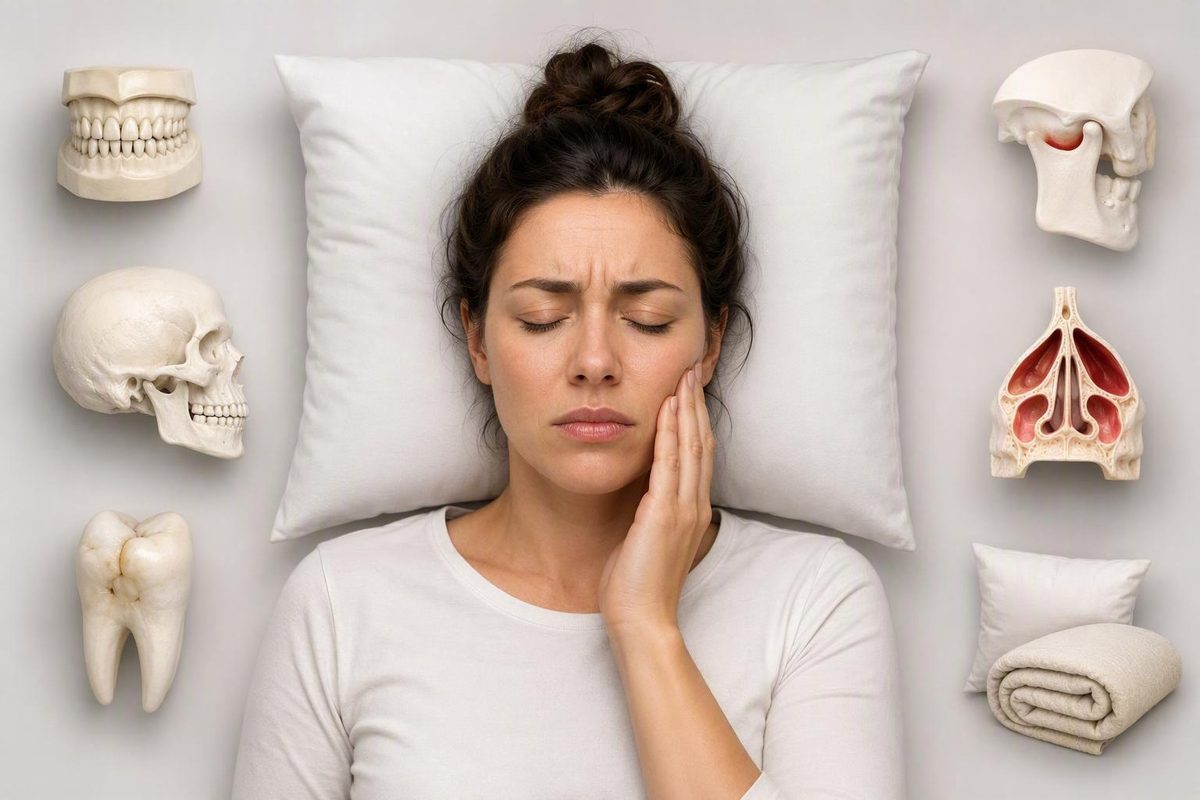
The short answer: your jaw may be working or under pressure while you sleep
If you are wondering, “Why does my jaw ache when I wake up?”, nighttime clenching or grinding is one plausible explanation. Unconscious jaw activity can overwork the chewing muscles and place force on the jaw joints, leaving your jaw sore, tight, or tired in the morning. But timing alone does not prove that you grind your teeth.
A few definitions help separate the possibilities:
- TMJ means temporomandibular joint—the joint on each side that connects the lower jaw to the skull.
- TMD means temporomandibular disorder, a group of conditions affecting a TMJ, the chewing muscles, or related structures.
- Bruxism means clenching, grinding, or gnashing the teeth. It can happen while awake or asleep, often without conscious awareness.
TMJ and TMD are not interchangeable: the TMJ is an anatomical structure, while TMD describes a category of disorders. Bruxism is also distinct from TMD. The conditions can overlap, but someone can have bruxism without a diagnosed TMD or TMD symptoms without evidence of sleep bruxism. Bruxism may cause jaw soreness, facial pain, morning headaches, tooth sensitivity, or dental damage, according to Cleveland Clinic’s medically reviewed bruxism overview.
Other possible explanations include a muscle or joint disorder, a damaged or infected tooth, sinus-related upper-jaw pressure, heavy daytime jaw use, recent injury, or pressure placed on the jaw during sleep. Dental pain may also spread or be difficult to localize, making one tooth problem feel like a broader jaw ache.
The relationship between measured sleep bruxism and TMD pain is not straightforward. Research findings are mixed, and an association does not establish that grinding caused a particular person’s muscle or joint pain. In one selected clinical sample, myofascial pain occurred more often among participants classified as sleep bruxers, but psychological symptoms—not bruxism—were the significant correlate after adjustment. The authors also described the wider evidence as contradictory, and the selected study population limits how broadly the result can be applied. The peer-reviewed study explains these findings and limitations.
The practical takeaway is that morning pain makes overnight muscle loading worth investigating. The location of the pain, associated tooth or joint symptoms, sleep factors, dental findings, and warning signs are more informative than the clock alone.
A morning self-check: note the pattern before guessing the cause
A short symptom log can show whether the problem is occasional, recurring, worsening, or connected to a particular habit. For several mornings, record:
- Side: left, right, both sides, or centered under the chin
- Location: cheek muscle, temple, directly in front of the ear, upper jaw, lower jaw, or one tooth
- Severity: mild, moderate, or severe—or the same personal rating scale each day
- Duration: minutes, hours, or most of the day
- Course: strongest immediately after waking, easing with time, worsening with chewing, or unchanged
- Function: whether it interferes with eating, speaking, yawning, sleeping, or opening your mouth
- Recent changes: dental work, injury, illness, medication changes, stress, or changes in caffeine, alcohol, nicotine, or sleep
Pain that is strongest on waking and gradually improves is compatible with overnight muscle strain. It still does not confirm sleep bruxism.
Look for supporting clues rather than relying on timing alone. Features compatible with clenching or grinding include:
- Tight, fatigued, or tender chewing muscles
- A headache around the temples on waking
- Facial, ear-area, or neck soreness
- Tooth pain or sensitivity
- Flattened wear surfaces, chips, or cracks
- Impressions along the cheeks or tongue
- A sense that the jaw has been “working” overnight
- A partner noticing grinding sounds
Audible grinding can support the suspicion, but its absence does not rule bruxism out. Sustained clenching may be quiet. These signs are compatible with bruxism rather than diagnostic by themselves.
Joint-focused clues include:
- Tenderness directly in front of an ear
- Clicking or popping that hurts
- Stiff or restricted opening
A jaw sound alone does not identify its cause. Painful noise, reduced movement, or locking matters more than repeatedly checking whether the jaw clicks. Symptoms such as painful clicking, restricted movement, chewing discomfort, or locking can occur with TMD and justify professional assessment; a dental evaluation may include examination of jaw movement, muscle and joint tenderness, tooth wear, and localized dental disease. This overview of TMD and bruxism describes the overlapping symptoms and assessment process.
Also note symptoms that may point to another source:
- One clearly painful tooth
- Pain when biting
- New sensitivity, a visible crack, or a broken filling
- Gum, facial, or jaw swelling
- Fever or feeling generally unwell
- A bad taste associated with dental pain
- Nasal congestion with upper-cheek, upper-jaw, or upper-molar pressure
- Recent facial or jaw trauma
- Sleeping with the painful side pressed into a hand or pillow
- Stomach sleeping with the head rotated for a prolonged period
Finally, consider sleep quality. Loud snoring, witnessed pauses in breathing, gasping, unrefreshing sleep, or substantial daytime sleepiness should be discussed with a clinician. Sleep apnea and bruxism have been observed together, but the direction and cause of that relationship remain uncertain. A standard mouth guard may protect teeth, but it does not evaluate obstructed breathing during sleep.
How the main causes differ
Symptoms overlap, so the table below is a pattern-matching aid—not a diagnostic test.
| Possible cause | Typical clues | What makes it more plausible | Appropriate next step |
|---|---|---|---|
| Sleep bruxism | Tired or tight jaw muscles, morning temple headache, facial or neck soreness, tooth sensitivity, wear, chips, or cheek and tongue impressions | Symptoms are strongest on waking; a partner notices grinding; a dentist finds wear or muscle tenderness | Track the pattern and arrange a dental assessment if it recurs, affects function, or involves tooth damage |
| TMD | Pain around a jaw joint or chewing muscles, painful clicking or popping, stiffness, chewing discomfort, restricted movement, deviation, catching, or locking | Pain is reproduced by jaw movement or pressure near the joint; opening is limited or mechanically disrupted | See a dentist or clinician familiar with jaw disorders, especially for painful noise, reduced opening, or locking |
| Dental injury or disease | Localized tooth pain, sensitivity, pain on biting, a chipped or cracked tooth, bad taste, gum swelling, or pain spreading into the jaw | One tooth is clearly involved; there is visible damage, swelling, fever, or recent dental trouble | Seek dental care; swelling, fever, severe pain, or suspected infection needs prompt attention |
| Sinus-related discomfort | Pressure in the upper jaw or upper molars with congestion or facial pressure | Several upper teeth feel pressured at once and symptoms accompany nasal or facial symptoms | Consider medical or dental evaluation if persistent, severe, or unclear |
| Sleep-position strain | Soreness on the side pressed into the pillow or symptoms following prolonged head rotation | The pattern changes when direct pressure or sustained rotation is avoided | Try comfortable, neutral support as a low-risk experiment; seek assessment if pain persists |
| Daytime jaw overuse | General muscle fatigue or pain after prolonged chewing or repetitive jaw habits | Recent gum chewing, hard foods, ice chewing, nail biting, or resting the chin on a hand | Reduce unnecessary loading temporarily and reassess; recurring or limiting pain warrants evaluation |
Sleep bruxism
Grinding involves movement between the teeth, but bruxism also includes sustained clenching. No one needs to hear scraping or grinding for nighttime jaw activity to remain plausible. Quiet clenching can keep the muscles contracted and place force through the teeth and jaw joints.
Tooth wear, chips, sensitivity, morning headaches, cheek or tongue impressions, and muscle tenderness strengthen the pattern. None confirms the diagnosis alone, and similar symptoms can occur for other reasons.
TMD
TMD is an umbrella term rather than one disease. Symptoms may arise from a jaw joint, the chewing muscles, or related structures.
Painful clicking, restricted movement, chewing difficulty, deviation, catching, or locking deserves assessment because these features suggest more than uncomplicated temporary soreness. Painless noise without movement problems is less informative, but a sound alone cannot establish whether a joint is healthy or unhealthy.
Dental causes
An injured tooth, cracked restoration, damaged tissue inside a tooth, or dental infection may be perceived as jaw pain. Dental pain can initially be difficult to localize.
Concern increases when there is one-tooth sensitivity, pain on biting, visible damage, swelling, fever, or a bad taste. Tooth injury, damaged tooth tissue, and infection are among the dental problems that can be felt more broadly in the jaw, as explained in Cleveland Clinic’s discussion of morning jaw pain.
Sinus-related discomfort
Sinus inflammation or pressure may be felt near the upper jaw and upper molars, particularly when congestion or facial pressure is present. This pattern generally fits the upper jaw better than isolated lower-jaw pain.
Do not make sinus pressure the default explanation for tooth pain. A dental problem can resemble sinus discomfort, and dental and sinus symptoms may occur at the same time. Persistent, severe, or unclear upper-jaw pain should be evaluated rather than self-diagnosed.
Sleep position and daytime strain
Stomach sleeping, prolonged head rotation, inadequate head or neck support, or placing a hand between the jaw and pillow may load one side overnight. This is a plausible mechanical explanation, but it is less firmly established than the direct rationale that repeated clenching can fatigue muscles. Treat a position change as a low-risk experiment, not proof of the cause or a guaranteed cure.
Daytime habits can add to overnight strain. Frequent gum chewing, hard or chewy foods, chewing ice, biting nails, and leaning the chin into a hand can increase or prolong jaw loading. If morning pain starts during a period of heavy daytime use, temporarily reducing that load may help clarify the pattern.
One-sided versus two-sided pain cannot settle the diagnosis. A joint, muscle, tooth, sinus, injury, or sleep posture can all produce symptoms on one side.
Why clenching may happen—and why the cause is not always clear
Healthcare professionals cannot always identify one specific cause of bruxism. Several contributors may coincide, and the relevant combination can differ from person to person.
Stress and anxiety may increase jaw tension or clenching in some people, but that does not mean the pain is imagined or “only psychological.” Pain is real, and biological, behavioral, sleep-related, and emotional factors can interact. Psychological distress may also influence muscle pain independently of objectively measured grinding, which is one reason a simple “stress causes grinding, and grinding causes pain” explanation may be incomplete.
Potential contributors or aggravating factors include:
- Stress or anxiety
- Caffeine, particularly later in the day
- Alcohol
- Nicotine or smoking
- Disrupted or poor-quality sleep
- Certain medications
- Sleep disorders
Some selective serotonin reuptake inhibitors and other medications have been associated with bruxism. If symptoms began after starting a medication or changing its dose, record the timing and contact the prescriber. Do not stop, skip, or change a prescribed medication on your own. Stress, anxiety, smoking, heavier caffeine or alcohol use, certain medications, and sleep disorders are recognized as possible bruxism risk factors, although there is no single known cause. Cleveland Clinic summarizes these associations and the limits of current understanding.
Obstructive sleep apnea and bruxism have been correlated in some research, but that does not establish that either condition causes the other. Bruxism does not prove sleep apnea, and sleep apnea does not automatically explain jaw pain.
Loud snoring, witnessed breathing pauses, gasping, unrefreshing sleep, or substantial daytime sleepiness are reasons for medical discussion rather than reasons to rely solely on a dental appliance.
For a useful appointment, record recent changes in:
- Stress and bedtime routine
- Coffee, tea, energy drinks, alcohol, nicotine, or recreational substances
- Prescription and nonprescription medications
- Sleep schedule and sleep quality
- Snoring, breathing pauses, or gasping
- Morning headaches, tooth sensitivity, and jaw stiffness
The goal is not to identify one culprit by yourself. It is to give a dentist or medical clinician enough context to compare the possible explanations.
What you can do today for mild, temporary soreness
The following steps are temporary comfort measures for mild, short-lived soreness. They do not treat an established diagnosis or rule out a dental, joint, sinus, sleep, or medical problem.
Rest the jaw. Temporarily choose foods that require less chewing. Avoid gum, hard candy, ice, nail biting, and unnecessarily tough or chewy foods. Try not to clench repeatedly to check whether the pain is still present.
Use warmth or cold cautiously. Gentle warmth may feel soothing when muscles feel tight. A wrapped cold pack may be more comfortable for a newly sore or inflamed-feeling area. Protect the skin with fabric, avoid extreme temperatures, and remove the pack if the area becomes numb, irritated, or more painful. Neither option identifies or treats the underlying cause. Soft foods, reduced jaw use, and cautious heat or cold are presented as symptom-relief measures rather than definitive treatment in ENT patient guidance on jaw discomfort.
Reduce avoidable evening triggers. A calming bedtime routine is a reasonable experiment when tension seems relevant. If late-day caffeine or alcohol appears to coincide with worse mornings, reduce or move it earlier and observe the pattern. Improvement would suggest an association, not prove that either substance caused the problem.
Reduce direct pressure. Avoid sleeping with the jaw pressed firmly into a hand or pillow. Use comfortable head and neck support and try not to keep the neck sharply rotated for long periods. Consider this a low-risk trial rather than a proven correction for jaw pain.
Avoid forceful exercises. Do not aggressively stretch the jaw, force the mouth open, or repeatedly provoke a painful click. Stop any movement that clearly increases pain or causes catching.
Be cautious with pain medication. There is no universal dose or safe duration for every reader. A pharmacist, dentist, or medical clinician can advise based on your circumstances.
Do not let temporary home care become prolonged self-treatment. Arrange an evaluation if soreness keeps returning, becomes more intense, persists, damages teeth, or limits eating, speaking, sleeping, or opening the mouth.
What a night guard can—and cannot—do
A night guard, occlusal guard, or splint creates a barrier between the upper and lower teeth. Its clearest role is damage reduction: reducing direct tooth-to-tooth contact may help limit wear and related dental damage.
A professionally fitted appliance may also alter jaw loading or reduce muscle strain for some people. It does not necessarily stop the underlying clenching or grinding, and it cannot guarantee pain relief. A guard should be viewed as one possible part of a cause-specific plan—not as a cure for bruxism or every TMD.
Assessment is particularly important before assuming an appliance is the answer when there is:
- Recurring or severe pain
- A damaged or highly sensitive tooth
- Painful joint noise
- Restricted opening or locking
- Swelling or fever
- An uncertain source of pain
- Loud snoring, witnessed breathing pauses, gasping, or marked daytime sleepiness
It may protect teeth while another condition remains unaddressed.
Fit, dental condition, jaw symptoms, and the intended purpose matter. Rather than choosing a material or design based on pain alone, ask a dentist whether an appliance is appropriate and what result is realistic: tooth protection, altered loading, symptom monitoring, or another goal. Dental guidance describes guards as potentially protective while emphasizing that they do not cure grinding itself. This discussion of morning jaw pain outlines that limitation.
A broader plan may address dental damage, muscle or joint symptoms, sleep concerns, and modifiable contributors. The appropriate combination depends on the examination findings.
Who to see and what an evaluation may involve
For recurring morning soreness, suspected grinding, tooth sensitivity or damage, localized dental pain, or many jaw-joint symptoms, a dentist is often a sensible starting point. A dentist can examine both the teeth and jaw system and refer you when the pattern suggests a medical, sleep-related, or specialist issue.
Seek medical evaluation when symptoms point more toward:
- Sinus disease
- Fever or broader illness
- A possible medication effect
- Sleep-disordered breathing
- A non-dental source of facial or jaw pain
- Chest, breathing, faintness, or exertional symptoms
A dental assessment may include questions about when the pain begins, how long it lasts, what provokes it, and whether anyone has noticed grinding. The examination may look for:
- Tooth wear, chips, cracks, sensitivity, or localized disease
- Tenderness in the chewing muscles and jaw joints
- The range, path, and comfort of jaw opening
- Joint sounds, catching, or locking
- Bite relationships, while recognizing that a bite observation alone does not establish the cause
Bring a short symptom log and a list of medications, supplements, caffeine, alcohol, nicotine, and other substances. Mention snoring or breathing symptoms even if the visit is primarily about your teeth.
X-rays or other imaging may be used when examination findings justify them—for example, when a dental source, injury, or structural problem is suspected. Imaging is not automatically necessary for every mild morning ache. Professional assessment may begin with the history and physical examination, with imaging selected according to the suspected cause. This dental patient guide describes examination and diagnosis-dependent imaging.
Sleep bruxism is often assessed through symptom history and physical findings. Selected cases involving significant sleep symptoms or diagnostic uncertainty may need overnight testing or input from a sleep specialist; such testing is not routine for everyone who wakes with a sore jaw.
Treatment should follow the identified cause and severity. Procedures or prescription treatments—including injections, orthodontic or bite changes, dental restoration, muscle relaxants, or surgery—require individualized assessment rather than a recommendation based solely on morning timing.
When morning jaw pain needs routine, prompt, or emergency care
Routine evaluation
Book a dental or medical appointment when you have:
- Recurring or persistent morning pain
- Progressive tooth sensitivity, wear, chips, or cracks
- Repeated morning or temple headaches
- Painful clicking or popping
- Symptoms that interfere with eating, speaking, sleeping, or normal jaw opening
- A pattern that is not improving after reducing obvious jaw strain
“Routine” does not mean unimportant. Mild pain may coexist with tooth wear or a developing joint, muscle, or dental problem.
Prompt professional care
Seek prompt dental or medical care for:
- Worsening or severe pain
- Facial, gum, or jaw swelling
- Fever or feeling systemically unwell
- A suspected dental infection
- Restricted mouth opening
- Jaw locking
- Difficulty eating or swallowing while you are still breathing normally
- Pain following jaw or facial trauma
These symptoms should not be managed through prolonged home observation. Swelling, fever, locking, restricted opening, and difficulty eating or swallowing are among the warning signs identified in dental patient guidance as needing timely professional attention. See the warning-sign guidance for morning jaw pain.
Emergency assessment
Call emergency services or seek emergency assessment when jaw pain occurs with:
- Chest discomfort, pressure, or pain
- Shortness of breath
- Faintness or near-fainting
- Symptoms that begin or worsen with exertion
- Swelling or swallowing difficulty accompanied by any breathing difficulty
Cleveland Clinic advises emergency assessment when jaw pain may represent referred cardiac pain.
Frequently asked questions
Why does only one side of my jaw ache when I wake up?
One-sided pain does not identify one particular cause. It may reflect pressure on that side during sleep, uneven muscle loading, irritation in one jaw joint, or a problem involving one tooth. Sinus-related upper-jaw pressure or a previous injury can also be asymmetric.
Notice whether the pain is in the cheek muscle, directly in front of the ear, or centered around a specific tooth. Pain on biting, swelling, painful clicking, reduced opening, congestion, or direct pillow pressure can help guide the evaluation. Persistent or recurring unilateral pain warrants dental assessment rather than an assumption based on side alone.
Can I grind or clench my teeth even if nobody hears it?
Yes. Grinding can create sound, but sustained clenching may be quiet. Other clues include tight or tender jaw muscles, a morning temple headache, facial or neck soreness, sensitive teeth, tooth wear, chips, or impressions along the cheeks or tongue.
A partner’s report can support the suspicion, but silence neither confirms nor rules out bruxism.
Does pain that fades after I get up mean I have sleep bruxism?
No. Pain that is strongest on waking and fades later is compatible with overnight muscle loading, including clenching or grinding, but it is not diagnostic.
Tooth wear, sensitivity, morning headaches, muscle tenderness, or cheek and tongue impressions may strengthen the pattern. A professional examination may still be needed to distinguish bruxism from TMD, dental disease, or another source.
Should I buy a mouth guard for morning jaw pain?
Not automatically. A guard may protect teeth from direct contact and may reduce loading for some people, but it may not stop clenching or relieve pain. It also cannot treat a cracked or infected tooth, sinus problem, medication effect, or sleep apnea.
Recurring pain, tooth damage, painful clicking, restricted opening, locking, or an uncertain diagnosis are reasons to consult a dentist before selecting an appliance.
Can sleep apnea be related to nighttime clenching and morning jaw pain?
Sleep apnea and bruxism have been observed together, but the relationship is not fully understood and does not prove that either condition causes the other. Jaw soreness alone cannot diagnose sleep apnea.
Tell a dentist or medical clinician if jaw symptoms occur alongside loud snoring, witnessed breathing pauses, gasping, unrefreshing sleep, or substantial daytime sleepiness. Those features may justify medical or sleep-focused evaluation. A standard night guard does not assess or treat obstructed breathing during sleep.
The bottom line
Morning jaw pain is a pattern to investigate, not a diagnosis. Mild, temporary soreness may improve with jaw rest, softer foods, reduced daytime loading, and less direct pressure during sleep. Recurring pain, tooth damage, painful joint symptoms, swelling, fever, locking, restricted opening, or impaired function deserves professional evaluation.
Seek emergency care when jaw pain occurs with chest discomfort, breathing difficulty, faintness, or exertional symptoms. This article provides general educational information and cannot diagnose the cause of jaw pain for an individual reader.