
Is Your Jaw Pain From Nighttime Grinding, a Jaw Disorder, or Both?
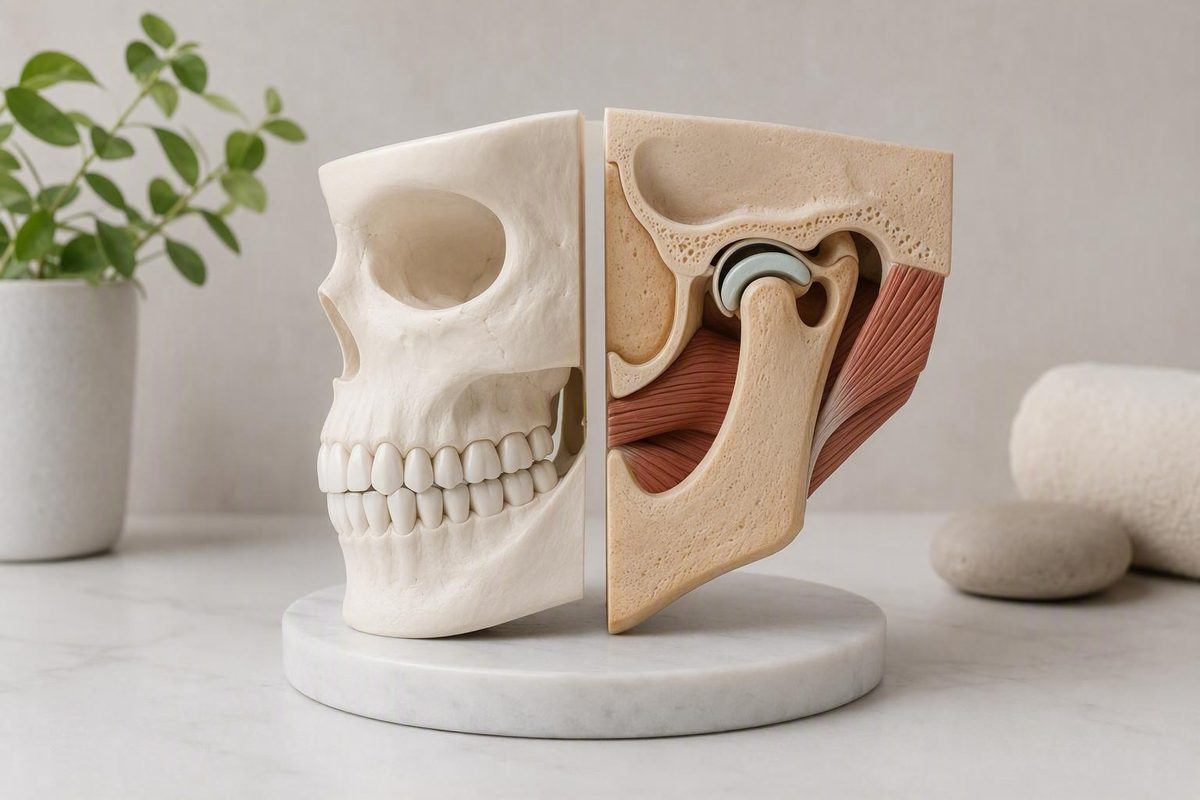
Waking with a tired jaw does not automatically mean you grind your teeth, and hearing a click does not automatically mean something is wrong with the joint. Sleep bruxism and temporomandibular disorders can produce similar symptoms, but they are not the same problem.
The practical distinction is this: sleep bruxism is sleep-related jaw-muscle activity, while TMD is a family of conditions involving the jaw joints, chewing muscles, or associated structures. Dental damage and morning muscle fatigue may raise suspicion of bruxism. Painful locking, restricted motion, and movement-related joint pain point more directly toward TMD. Some people have both, while others have a dental, medical, headache, neurological, or sleep condition that resembles either one.
This article can help you organize the clues and prepare for an appointment. It cannot determine the cause of an individual case; Pain Catalog’s health content is educational rather than diagnostic.
Sleep bruxism and TMD are different problems
Sleep bruxism is involuntary, repeated jaw-muscle activity during sleep. It can involve grinding or clenching the teeth, but it may also involve bracing or thrusting the jaw without obvious grinding sounds. Sleep bruxism is therefore an activity—not a diagnosis of a damaged or painful jaw joint. Johns Hopkins Medicine describes these defining features of bruxism.
TMD, short for temporomandibular disorder, refers to a broad group of conditions affecting the jaw joints, chewing muscles, or associated structures. TMD can include muscle pain, pain arising from the joint, problems involving the cushioning disc within the joint, and degenerative joint disease.
The terminology is often confusing:
- TMJ means the temporomandibular joint itself. You have one on each side of the jaw, just in front of the ears.
- TMD means a disorder involving a TMJ, the muscles that move the jaw, or associated structures.
- People commonly say they “have TMJ” when they mean they have a temporomandibular disorder.
TMD is not one uniform disease. The National Institute of Dental and Craniofacial Research describes TMDs as a broad group of conditions and notes that their symptoms, causes, and appropriate treatments can differ substantially (NIDCR overview of temporomandibular disorders).
A person may have detectable sleep-related jaw-muscle activity without pain or meaningful tooth damage. Another person may have TMD without convincing evidence of current sleep bruxism.
That creates four realistic possibilities:
- Sleep bruxism without TMD.
- TMD without sleep bruxism.
- Sleep bruxism and TMD at the same time.
- Another condition producing similar symptoms.
| Comparison point | Sleep bruxism | TMD |
|---|---|---|
| Defining feature | Sleep-related jaw-muscle activity, including grinding, clenching, bracing, or thrusting | A disorder affecting a jaw joint, chewing muscles, or related structures |
| Timing clue | Grinding reports during sleep; muscle fatigue or stiffness may be most noticeable on waking | Pain may appear or worsen with chewing, opening, yawning, or other jaw movement |
| More suggestive signs | Worn, flattened, chipped, or cracked teeth; damaged restorations; partner-reported grinding | Painful joint noises, locking, restricted opening, joint-centered pain, impaired chewing |
| Overlapping symptoms | Jaw pain, facial soreness, temple headache, stiffness, tired muscles, ear-area discomfort | The same symptoms can occur, especially in muscle-related TMD |
| Evaluation focus | Sleep history, partner observations, dental damage, medicines, awake habits, and selected testing | Jaw movement, tenderness, joint function, locking, pain location, dental causes, and selective imaging |
| Treatment goals | Protect teeth, address relevant contributors, manage awake habits, and investigate associated sleep concerns | Reduce pain, restore function, improve movement, and treat the particular muscle or joint disorder |
These are practical distinctions, not diagnostic criteria. Symptoms overlap, and one visible sign may not explain the whole problem.
Symptom comparison: clues that favor grinding, TMD, or both
No isolated symptom proves current sleep bruxism or TMD. A more useful approach is to look for a pattern involving dental changes, symptom timing, joint function, and provoking movements.
| More suggestive of sleep bruxism | More suggestive of TMD | Common to both |
|---|---|---|
| A partner hears grinding during sleep | Painful clicking, popping, or grating | Jaw or facial pain |
| Flattened or unusually worn teeth | Intermittent or persistent locking | Temple headaches |
| Chipped, cracked, or fractured teeth | Restricted mouth opening | Jaw stiffness |
| Repeated damage to fillings or crowns | Difficulty closing the jaw normally | Tired chewing muscles |
| Tooth sensitivity associated with wear or cracks | Pain centered immediately in front of the ear | Ear-area discomfort |
| Ridges or impressions along the cheeks or tongue | Pain reliably provoked by jaw movement | Tooth pain |
| Facial-muscle fatigue or stiffness on waking | Pain or difficulty with chewing | Neck discomfort |
The bruxism features in this table are supported by dental findings and symptom patterns described in Johns Hopkins Medicine’s bruxism guidance. The TMD features—including painful joint sounds, locking, stiffness, and limited movement—are consistent with NIDCR guidance.
Clues that favor sleep bruxism
A report of audible nighttime grinding is useful, especially when it occurs alongside new tooth damage or morning muscle fatigue. Flattened tooth surfaces, enamel loss, sensitivity, chips, cracks, damaged restorations, and cheek or tongue impressions can support suspicion of bruxism.
These findings are not conclusive. Tooth wear can have other causes and may record past activity rather than prove that significant grinding is happening now. A partner may also hear occasional grinding without that activity fully explaining persistent pain.
Morning timing is another clue rather than proof. If stiffness is strongest immediately after waking and then eases, sleep-related muscle activity becomes more plausible. Morning soreness can nevertheless occur with muscle-based TMD or other nighttime jaw-muscle activity.
Clues that favor TMD
Jaw function carries more weight when assessing TMD. Symptoms that direct attention toward the joint or jaw mechanics include:
- The jaw locks open or closed.
- Opening is restricted or progressively becoming more difficult.
- The jaw deviates or moves irregularly.
- Joint-area pain appears when chewing, yawning, or opening widely.
- Clicking, popping, or grating is painful.
- Chewing becomes difficult or reliably provokes pain.
These findings do not identify a precise TMD subtype, but they make it less appropriate to assume that every symptom comes from nighttime grinding. TMD commonly involves pain, stiffness, impaired movement, locking, and chewing difficulty, although the presentation varies (Cleveland Clinic’s medically reviewed TMD overview).
A click by itself is different. Painless clicking or popping with normal jaw movement is common and generally does not require treatment. It becomes more relevant when accompanied by pain, catching, locking, restricted motion, or a meaningful change in function.
Symptoms shared by both
Jaw pain, facial soreness, temple headaches, tired chewing muscles, stiffness, ear-area discomfort, tooth pain, and neck discomfort do not reliably separate the conditions. Their meaning depends on context.
Consider two simplified patterns:
- Morning fatigue plus new tooth cracks and partner-reported grinding makes a bruxism-focused dental and sleep history reasonable.
- Pain in front of the ear that worsens with chewing, accompanied by locking or reduced opening, places more emphasis on TMD and joint function.
Real cases are often less tidy. Keep four pathways open: likely bruxism, likely TMD, both conditions, or another dental, medical, headache, neurological, or sleep-related problem.
Does sleep bruxism cause TMD? What the evidence actually shows
Repeated clenching or grinding may contribute to muscle fatigue or aggravate symptoms in some people. That does not establish sleep bruxism as the universal—or primary—cause of TMD.
Several issues make the relationship difficult to study:
- TMD includes multiple muscle and joint subtypes that should not be treated as one outcome.
- Researchers use different definitions of probable, clinical, and objectively recorded bruxism.
- Self-reported grinding may not match activity measured during sleep.
- Tooth wear can record past rather than current activity.
- Pain, sleep quality, and awareness of symptoms can influence self-reporting.
- An association between two findings does not establish that one caused the other.
A 2020 observational study illustrates this complexity. It compared 58 adults classified as sleep bruxers with 52 classified as nonbruxers. Myofascial pain occurred in 10 bruxers and none of the nonbruxers, but somatization—not sleep bruxism—was the significant predictor of myofascial pain in the multivariable analysis. The study found no significant group differences in disc displacement or in diagnoses grouped as arthralgia, arthritis, and arthrosis (full peer-reviewed study).
Those findings do not prove that bruxism causes muscle pain—or that bruxism never matters. The study was observational, so it could identify associations but not causation. Participants came from a population needing a posterior dental crown, portable EMG/ECG was used instead of full laboratory polysomnography, and people whose questionnaire, examination, and device results disagreed were excluded. That produced clearly classified groups but omitted ambiguous cases common in clinical practice.
A finding about myofascial pain also cannot be generalized automatically to disc displacement, arthritis, arthralgia, or every other TMD subtype. A muscle-pain question and a structural joint-disease question are not interchangeable.
One alternative hypothesis concerns sustained low-level chewing-muscle activity during sleep. A research summary from the TMJ Association describes a reanalysis in which background muscle activity was higher in some people with myofascial TMD, particularly among those reporting more pain on waking. The proposal is that prolonged low-level activity—not necessarily distinct grinding episodes—might help explain morning muscle pain in some patients (TMJ Association discussion of nighttime muscle activity). This remains a limited, subtype-specific hypothesis rather than an established cause.
Myth versus evidence
Myth: “Grinding always causes TMD.” Evidence: Bruxism may contribute to or aggravate symptoms in some people, but TMD includes multiple subtypes and often has unclear or multifactorial causes.
Myth: “Morning jaw pain proves I grind at night.” Evidence: Morning timing raises suspicion, but muscle-based TMD and other nighttime muscle activity can produce similar pain.
Myth: “If I stop grinding, chronic jaw pain will necessarily disappear.” Evidence: Tooth protection and management of bruxism may be appropriate, but persistent pain can require separate evaluation for TMD or another condition.
The practical conclusion is not that sleep bruxism never affects the jaw. It is that clinicians should avoid using it as an automatic explanation for every painful, clicking, or restricted jaw.
Possible causes and contributors without overstating certainty
Neither sleep bruxism nor TMD usually has one simple cause. It helps to distinguish an identified mechanism—such as an acute injury—from a possible contributor or statistical association.
Possible contributors to sleep bruxism
Johns Hopkins Medicine states that experts do not know one definitive cause of bruxism. Reported risk factors or associations include:
- Stress or anxiety.
- Certain prescription medicines.
- Sleep disorders.
- Tobacco use.
- Heavy alcohol use.
- Caffeine.
- Gastroesophageal reflux.
- Some neurological conditions.
- Stimulant or recreational drug use.
An association does not mean that one factor explains every case. Someone who drinks coffee may have sleep bruxism for an unrelated reason, while someone under substantial stress may not grind at all.
Fluoxetine, sertraline, and paroxetine are examples of medicines identified as being associated with bruxism in some people. A prescriber can review timing, dose, alternatives, other explanations, and the risks of changing treatment.
Sleep bruxism should also be separated from awake bruxism. Daytime clenching can involve tooth contact, while jaw bracing can occur without the teeth touching. If tension builds during work, driving, concentration, exercise, or stressful conversations, daytime awareness and habit-focused strategies may be more relevant than interventions directed only at sleep.
Possible contributors to TMD
For many TMD cases, the exact cause remains unclear. Some have a more identifiable mechanism, such as an acute jaw injury or arthritis affecting the joint. Others may involve several interacting factors, including:
- Repetitive clenching, jaw bracing, gum chewing, or nail biting.
- Joint-disc problems.
- Muscle strain or spasm.
- Stressors and their effects on muscle tension or pain.
- Differences in pain processing or sensitivity.
- Other painful conditions occurring alongside jaw symptoms.
- Connective-tissue or inflammatory joint disease in selected cases.
Bruxism belongs on the list of possible contributors, not at the top of every person’s diagnosis. Even when grinding and TMD coexist, the direction and importance of the relationship may remain uncertain.
What about a “bad bite”?
It is common to blame TMD on bite alignment, wisdom teeth, or previous orthodontic treatment. NIDCR guidance does not support presenting a “bad bite” or prior orthodontics as a routine cause of TMD. That distinction matters because an unsupported causal assumption can lead to permanent dental work that does not address the pain.
That is different from claiming that ordinary variation in tooth alignment explains chronic TMD.
The safest summary is:
- Injury can cause some TMD cases.
- Arthritis or structural joint disease can be relevant in selected cases.
- Repetitive habits, stressors, and pain-related factors may contribute.
- Sleep bruxism may aggravate some symptoms.
- No single factor—stress, caffeine, apnea, medicine, bite alignment, or grinding—explains every case.
How clinicians evaluate overlapping jaw and sleep symptoms
Because symptoms overlap, evaluation usually works best as a sequence rather than as one decisive test.
1. Establish the symptom pattern
A clinician may ask:
- Is the pain worst on waking, later in the day, or after meals?
- Does opening, chewing, yawning, or speaking provoke it?
- Has the jaw ever locked open or closed?
- Is mouth opening limited all the time or only during flares?
- Has anyone heard grinding during sleep?
- Are symptoms new, intermittent, or persistent?
- Was there a recent injury, dental procedure, illness, or medication change?
- How well do you sleep?
- Are there snoring, gasping, breathing pauses, or daytime sleepiness?
- Do you clench or brace the jaw while awake?
Location also matters. Pain over the broad cheek or temple muscles may suggest a muscular component. Pain immediately in front of the ear, especially when movement provokes it, may direct more attention to the joint. Neither location is perfectly specific.
2. Examine the teeth and mouth
A dental examination can look for:
- Flattened or worn tooth surfaces.
- Chipped or fractured teeth.
- Enamel loss and exposed dentin.
- Tooth sensitivity.
- Cracked or damaged fillings, crowns, and other restorations.
- Cheek or tongue impressions.
- Localized decay, infection, gum disease, or pain on biting.
- Another explanation for wear or pain.
Dental wear can support a history of bruxism, but it cannot establish by itself that significant grinding is happening now.
3. Examine jaw movement and function
The clinician may assess:
- How far the mouth opens.
- Whether the jaw deviates during opening.
- Whether movement is smooth or interrupted.
- Tenderness in the chewing muscles.
- Pain over the joint.
- Stiffness or guarding.
- Reproducible clicking, popping, or grating.
- Whether a joint sound is painful.
- Whether the sound accompanies catching, locking, or restricted movement.
- Whether chewing or resisted movement reproduces the pain.
The goal is not simply to notice a noise. It is to determine whether pain and dysfunction suggest a muscle disorder, joint disorder, dental problem, or another cause.
4. Interpret reports and recordings cautiously
Self-report, partner observations, morning symptoms, and tooth wear can support suspicion of sleep bruxism. None confirms active nighttime grinding by itself.
Objective recording may add information in selected cases. The choice and type of testing should be determined by a qualified clinician. Portable electromyography can measure aspects of jaw-muscle activity, but it should not be treated as equivalent to full laboratory polysomnography. Sleep testing may be considered when breathing symptoms or another sleep disorder is suspected.
5. Use imaging selectively
TMD has no single universally accepted diagnostic test. Many cases can initially be assessed through history and examination while dental and medical causes of jaw or facial pain are considered.
Imaging is not necessary for every click or episode of soreness. Depending on the clinical findings, it may be considered when there is:
- Significant trauma.
- Severe or worsening restriction.
- Suspected structural joint disease.
- Persistent locking.
- Concern about arthritis, bone change, or another diagnosis.
- A symptom pattern that does not fit the initial examination.
Different imaging methods show different tissues, so imaging should address a defined clinical question rather than serve as a general search for abnormalities.
Preparing for an appointment
Bring a short record that includes:
- When symptoms occur and what makes them better or worse.
- Any episodes of locking or reduced opening.
- A list of medicines and recent dose or medication changes.
- Reports from a partner about grinding, snoring, gasping, or breathing pauses.
- Photographs or notes documenting visible tooth damage.
- Recent dental treatment, facial injury, infection, or change in how the teeth meet.
- Treatments you have tried and how the symptoms responded.
This information can be more useful than trying to decide in advance whether the label must be bruxism or TMD.
First-line treatment: match the care plan to the actual goal
Treatment should address the problem being treated. Tooth protection, pain relief, movement restoration, sleep evaluation, and dental repair are different goals.
Goal 1: Protect teeth
When active bruxism is suspected and the teeth or restorations are at risk, a professionally fitted guard may help absorb or distribute force. It is protective equipment, not proof that grinding caused every symptom.
Existing cracks, fractures, sensitivity, and restoration failure require their own dental assessment. A guard cannot repair damage that has already occurred.
Goal 2: Reduce an acute TMD flare
Reasonable short-term measures may include:
- Temporarily choosing softer foods.
- Avoiding hard, chewy, or very large bites.
- Using heat or cold according to comfort and clinical advice.
- Performing gentle, clinician-directed exercises.
- Reducing gum chewing, nail biting, pen chewing, and use of teeth as tools.
- Avoiding unnecessary clenching and extreme opening.
The aim is temporary load reduction, not permanent avoidance of normal jaw movement.
Over-the-counter nonsteroidal anti-inflammatory medicines may be an option for some people, but they are not appropriate for everyone.
Goal 3: Restore comfortable movement
Physical therapy may help selected people with muscle pain, stiffness, movement limitations, or impaired coordination.
Physical therapy is not a universal cure. Exercises should be selected according to the person’s diagnosis, movement limits, and symptom response.
Goal 4: Address awake clenching and bracing
If symptoms accumulate during the day, consider the resting jaw position and situations in which tension appears. Behavioral approaches may include:
- Scheduled tension checks.
- Relaxing the tongue, jaw, and shoulders.
- Keeping the teeth apart when not chewing or swallowing.
- Adjusting workstation posture.
- Avoiding sustained chin-resting or phone cradling.
- Using reminders during concentrated tasks.
- Stress-management or psychological support when relevant.
These strategies are aimed more directly at awake habits than involuntary sleep activity.
Goal 5: Review sleep and medication factors
Regular sleep timing and moderation of potentially relevant factors such as caffeine and alcohol may be reasonable, particularly when personal patterns suggest a connection. These measures should not be presented as a cure for sleep bruxism.
A recent medication change deserves discussion with the prescriber, not abrupt discontinuation. Snoring, witnessed breathing pauses, gasping, or substantial daytime sleepiness may justify a sleep-focused evaluation rather than treatment directed only at the teeth.
Goal 6: Reassess persistent pain
If pain continues despite tooth protection or basic self-care, the assumption that “it is just grinding” should be revisited. Persistent symptoms may reflect a TMD subtype, dental disease, headache disorder, arthritis, infection, neuropathic pain, or another condition.
Initial TMD care should generally remain conservative and reversible because many TMDs improve without invasive treatment and evidence for numerous interventions is limited. NIDCR recommends starting with simple approaches and avoiding treatments that permanently change the teeth, bite, or joint unless clearly indicated (NIDCR treatment guidance).
Mouthguards, medicines, injections, and surgery: benefits and limits
Mouthguards and splints
A fitted night guard creates a physical barrier between the teeth and may absorb or distribute force. Its clearest role in sleep bruxism is helping protect teeth and restorations from further damage.
A guard should not be promised to:
- Stop all sleep-bruxism episodes.
- Prevent the jaw muscles from activating.
- Cure the underlying cause of bruxism.
- Reliably eliminate chronic TMD pain.
- Treat obstructive sleep apnea unless it is a specifically selected apnea appliance used within an appropriate care pathway.
Intraoral appliances are also used in some TMD care, but evidence that they relieve TMD pain is limited.
Restorative dental treatment
Bonding, crowns, and other restorative work may repair teeth already damaged by wear or fracture. This is separate from controlling jaw-muscle activity. Restoring a cracked tooth does not show that sleep bruxism has stopped, just as wearing a guard does not repair an existing fracture.
Extensive reconstruction should not be justified solely by an unsupported claim that permanently changing the bite will cure TMD.
Medicines
Medicines may sometimes be considered for pain, inflammation, or muscle symptoms. There is no single best medication for every TMD presentation. Selection depends on the suspected diagnosis, other health conditions, interactions, expected duration, and potential adverse effects.
Medication should support a defined treatment goal. Repeated courses without reassessing the diagnosis can delay recognition of a dental problem, structural joint disorder, or chronic pain condition requiring another approach.
Botulinum toxin injections
Botulinum toxin type A is sometimes offered for jaw-muscle pain or severe bruxism-related symptoms. It is not FDA-approved for TMD, and study findings for symptom relief are mixed. NIDCR also notes uncertainty about its effectiveness and appropriate use for these disorders.
It should therefore be considered an individualized option rather than routine first-line care.
Permanent bite-changing treatment
Routine irreversible procedures should be approached cautiously when proposed primarily as TMD treatment. These can include:
- Grinding down teeth to change the bite.
- Building up multiple teeth.
- Crowns or extensive reconstruction intended to reposition the jaw.
- Orthodontic movement offered as a general TMD cure.
- Appliances designed to create a permanent bite change.
The concern is not that dental or orthodontic treatment is never appropriate. It is that evidence does not support routine permanent bite alteration as treatment for nonspecific TMD, and some approaches can worsen symptoms or create new functional problems.
Procedures and surgery
The decision should be based on a defined diagnosis, realistic goals, available alternatives, and a careful discussion of uncertainty and risk. More invasive treatment is not automatically more effective.
Sleep-apnea clues and symptoms that need prompt care
Sleep bruxism can occur alongside a sleep disorder, but grinding alone does not diagnose obstructive sleep apnea.
A sleep-focused assessment becomes more reasonable when grinding or morning jaw symptoms occur with:
- Loud or persistent snoring.
- Gasping or choking during sleep.
- Witnessed breathing interruptions.
- Dry mouth on waking.
- Morning headaches.
- Unrefreshing sleep.
- Excessive daytime sleepiness.
These features do not confirm apnea, but they justify discussing sleep evaluation with an appropriate clinician. A dental appliance for sleep apnea should not be selected solely because someone grinds. Diagnosis and treatment selection need to account for the breathing disorder, oral health, jaw function, and suitability of the device.
Call emergency services now for:
- Difficulty breathing.
- Inability to swallow, especially with rapidly increasing throat or facial swelling.
Seek prompt dental or medical assessment for:
- Inability to open or close the jaw normally.
- A jaw that remains locked.
- Acute facial or jaw trauma.
- Fever with facial swelling or spreading redness.
- Severe or sudden jaw pain.
- Rapidly worsening restriction.
- A suspected dental infection.
- A cracked or fractured tooth.
These warning signs are different from a painless click with normal movement. Persistent pain, painful clicking, stiffness, recurrent locking, or functional limitation still merits professional evaluation. Mayo Clinic similarly distinguishes painless clicking from symptoms accompanied by pain or limited movement and advises medical attention for significant pain or inability to move the jaw normally (Mayo Clinic guidance on TMJ symptoms).
Jaw, dental, medical, headache, and sleep problems can overlap. If conservative care does not help—or if the symptom pattern changes—reassessment is more useful than repeatedly treating presumed grinding.
Dental wear and morning muscle fatigue may raise suspicion of sleep bruxism. Painful locking, restricted motion, and movement-related joint pain point more toward TMD. Neither pattern is perfect, and both conditions can occur together.
The most useful care plan matches treatment to the goal: protect vulnerable teeth, relieve pain, restore jaw movement, address awake clenching, repair established damage, or investigate relevant sleep symptoms. Favor conservative, reversible treatment, and seek timely assessment for locking, trauma, fever or swelling, severe sudden pain, suspected infection, or a fractured tooth.
Frequently asked questions
Can you have sleep bruxism without having TMD?
Yes. Sleep bruxism is jaw-muscle activity during sleep, while TMD is a group of disorders involving the jaw joints, chewing muscles, or associated structures. A person can grind or clench during sleep without developing joint pain, muscle pain, locking, or restricted movement.
The reverse is also possible: someone can have muscle-based or joint-based TMD without convincing evidence of sleep bruxism. The two conditions can also coexist.
Does worn tooth enamel prove that I currently grind my teeth at night?
No. Tooth wear may support a history of bruxism, but it does not prove that active sleep grinding is occurring now. Wear can remain visible after earlier activity has decreased or stopped, and other processes can affect tooth surfaces.
Assessment should consider the broader pattern, including new tooth damage, partner observations, morning symptoms, and the dental and sleep histories.
Does a night guard stop sleep bruxism or mainly protect the teeth?
Its clearest role is protecting the teeth. A fitted guard may absorb or distribute force and reduce further wear, fractures, or damage to restorations.
It should not be assumed to stop the underlying sleep-related muscle activity or cure TMD pain. If pain continues or worsens while using a guard, the appliance fit, diagnosis, bite, and jaw function should be reassessed.
Is painless jaw clicking a sign that I need TMD treatment?
Usually not.
Arrange an evaluation if the sound becomes painful, the jaw catches or locks, opening becomes restricted, chewing becomes difficult, or jaw function changes substantially.
Can teeth grinding be a sign of sleep apnea?
Sleep bruxism can occur alongside obstructive sleep apnea, but grinding does not prove apnea. Sleep evaluation is more relevant when grinding occurs with snoring, gasping, witnessed breathing pauses, dry mouth, morning headaches, unrefreshing sleep, or daytime sleepiness.
An apnea oral appliance should be considered only after appropriate sleep evaluation and individualized clinical selection—not simply because tooth grinding has been reported.