
Axl Rose’s Exact TMJ Treatment Remains Undisclosed
Axl Rose called it a TMJ procedure and “a tube,” but no medical name was disclosed. See what arthrocentesis, arthroscopy and numbness evidence shows.
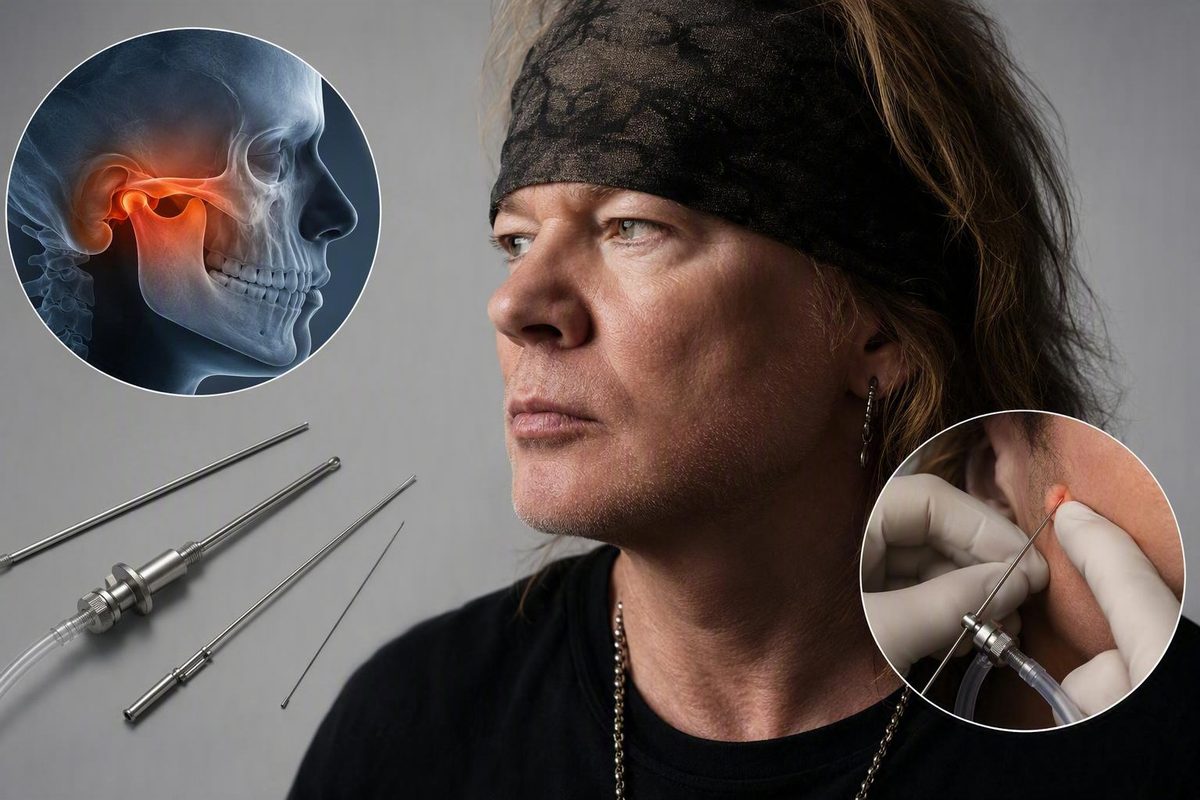
Axl Rose’s exact TMJ procedure is unknown. He reportedly called it treatment for “really crazy TMJ” and said, “I had to do a tube,” but neither Rose nor the available reporting named arthrocentesis, arthroscopy, an injection or open-joint surgery. The most accurate description is an unspecified TMJ-related procedure or dental treatment.
Billboard reported that the left side of Rose’s mouth had been worked on two days before Guns N’ Roses’ August 12, 2026 concert at MetLife Stadium. His mouth was still numb during the approximately three-hour performance. The report calls the intervention dental work but provides no medical documentation or procedure name.
Choose the procedural clue and symptoms; the matcher separates plausible interpretations from what the evidence can establish.
Select what was said about the equipment, then add the symptoms. The result shows which procedure the clue fits—not which procedure Axl Rose actually had.
“A tube” alone does not distinguish lavage, arthroscopy, an injection system, a drain, an airway device or other dental equipment.
Numbness and popping do not identify the procedure. The supplied evidence gives no universal day cutoff for either symptom.
Follow-up point: use the treating clinician’s procedure-specific instructions. The supplied research does not provide a general numbness deadline.
| Clue | Best Fit | Published Findings | Timeline Limit |
|---|---|---|---|
| Only “a tube” | Unspecified | No procedure name or clinical record was reported. | Numbness was present about 2 days later; resolution is —. |
| Needle/tube lavage | Arthrocentesis | Review: 46 studies; 23 supplied numerical data; 13 entered meta-analysis. Pooled complications ~11%, or ~9% excluding isolated pain; clinically significant events under 1%. | Most reported events were minor and temporary; a precise day cutoff is —. |
| Camera or scope | Arthroscopy | Series: 81 patients; 24 had sensory or motor dysfunction, 19 transient auriculotemporal numbness, and 2 facial nerve dysfunction cases. | Most dysfunction was temporary; mild facial dysfunction persisted at 1 year in 1 patient. |
| Injection only | Injection | No injection-specific complication figure appears in the supplied evidence. | Expected numbness or popping duration: —. |
| Incision/open access | Open surgery | No supplied evidence connects Rose to open-joint surgery, discectomy or replacement. | Procedure-specific recovery timeline: —. |
Static reading: Rose supplied only the first clue. The remaining rows show how additional wording would change the interpretation.
Compatible with more than one dental or TMJ intervention. It cannot distinguish arthrocentesis from arthroscopy or other care.
A reported sound or sensation is not a procedural record and does not prove instability, displacement or surgery.
This may matter clinically, but it still does not reveal which prior procedure occurred. Pain Catalog advises prompt attention for jaw locking.
Sources: Billboard’s account of Rose’s remarks; systematic reviews of TMJ arthrocentesis and arthroscopy complications; an 81-patient arthroscopy nerve-function series. Estimates are marked ~; unavailable figures are marked —.
“Do A Tube” Does Not Name A Procedure
Rose’s reported phrase is compatible with several pieces of medical equipment, but it does not identify one. A tube-like item could be a scope, cannula, drain, airway device or part of another treatment. The remark does not specify its location, purpose or the anatomy being treated.
A report quoting the “do a tube” remark supplies no formal procedure name. There is also no operative report, medical record, treating-clinician statement or disclosure from Rose’s representative in the cited coverage.
The distinction between compatibility and identification matters here. Needle or tube lavage would be compatible with arthrocentesis. A scope would point toward arthroscopy. Neither interpretation is confirmed because Rose did not say “lavage,” “needle,” “cannula,” “scope” or either procedure’s name.
The available evidence does not establish that he had:
- TMJ arthrocentesis or joint lavage
- TMJ arthroscopy
- A joint injection
- Open-joint surgery or discectomy
- Joint replacement
- Drainage or intubation
His remark could be clarified only by a formal procedure name from Rose, an authorized representative, a treating clinician or reliable medical documentation.
Rose Reported Numbness And Popping Two Days Later
Rose discussed the issue during the August 12 concert in East Rutherford, New Jersey. According to the reporting, he said the left side of his mouth had been worked on two days earlier, placing the treatment around August 10 if his timeframe was exact.
He said that side of his mouth remained numb. He also described popping sounds and disturbing sensations while singing, including a feeling that his jaw might shift, become stuck or “fall off.” He nevertheless completed the roughly three-hour show.
Those comments support only a limited account:
- Rose associated recent treatment with what he called a TMJ problem.
- He referred to having to “do a tube.”
- The left side of his mouth was reportedly still numb two days later.
- He experienced popping and unsettling jaw sensations while singing.
- He did not disclose the procedure’s medical name.
The remarks are descriptions of his experience, not anatomical findings. They do not demonstrate that the joint was displaced, unstable or damaged. They also do not show whether the numb area involved a local anesthetic effect, a particular nerve or a postoperative complication.
Media Reports Do Not Agree On Whether It Was Surgery
Coverage used several labels for the same episode. Billboard described dental work. Other entertainment reports called it a procedure, operation or jaw surgery. The more dramatic labels were not accompanied by a named operation or independent clinical evidence.
These terms make different claims:
| Reported Label | What It Establishes |
|---|---|
| Procedure | Broad; may be surgical or nonsurgical |
| Dental work | Suggests dental care, but not a technique |
| Operation or surgery | Implies an invasive treatment |
| Jaw surgery | Implies a target not established by the quote |
When an article’s label is more specific than the underlying attributed statement, the statement is the safer evidence. Rose reportedly mentioned TMJ, a tube, recent work, numbness and difficulty performing. He did not name an operation.
Repeating the story across entertainment sites does not create separate medical confirmation. The reports largely trace back to the same onstage remarks. They also do not establish whether treatment occurred inside the temporomandibular joint, elsewhere in the jaw or in another dental area.
Arthrocentesis Fits A Lavage Clue, But It Is Not Confirmed
Arthrocentesis is a minimally invasive TMJ treatment. A description involving needles, cannulas or tube-like access for joint lavage could fit it better than open surgery. Rose’s wording, however, did not include enough of those details to make that identification.
A systematic review of arthrocentesis complications examined 46 studies, obtained numerical data from 23 and included 13 in its meta-analysis. It estimated a pooled complication rate of approximately 11%, or approximately 9% when isolated post-procedural pain was excluded. Clinically significant complications were reported at under 1%, and most reported events were minor and temporary. The analysis had substantial heterogeneity, meaning results varied considerably across the evidence base. The arthrocentesis review reports the estimates and limitations.
Those figures describe study populations with confirmed procedures. They are not Rose’s personal risk, do not explain his numbness and cannot establish that he underwent arthrocentesis.
The cited evidence also supplies no specific number of days by which numbness or popping should resolve after arthrocentesis. “Most were temporary” is not a patient-level recovery deadline.
Arthroscopy Fits A Scope Clue, Not The Word “Tube” Alone
TMJ arthroscopy is distinct from arthrocentesis and involves a scope. If Rose had specifically mentioned a camera or scope entering the joint, arthroscopy would be a stronger interpretation. He did not.
A systematic review comparing complications from TMJ arthroscopy and arthrocentesis included five eligible studies covering 194 joints in 104 patients. It found no statistically significant difference in complication risk, and the complications reported in that comparison were temporary. The evidence base was limited to five qualifying studies. The systematic review describes the included patients and comparative result.
A separate series assessed facial and trigeminal nerve function after confirmed unilateral TMJ arthroscopic surgery. Of 81 patients, 24 had some degree of sensory or motor nerve dysfunction. Transient auriculotemporal-nerve numbness occurred in 19 patients, while facial nerve dysfunction occurred in two. Most observed dysfunction was temporary, although mild facial nerve dysfunction persisted at one year in one patient. The arthroscopy patient series reports those postoperative findings.
This shows that temporary sensory changes have been documented after arthroscopy. It does not show that Rose had arthroscopy, that his numbness involved the same nerve or that his symptom was a surgical complication.
It also does not provide a universal cutoff for recovery. One persistent finding in one patient cannot be converted into an expected timeline for Rose or another individual.
Numbness Cannot Reverse-Engineer The Treatment
Mouth numbness can follow different forms of dental or medical care. Its presence two days later does not function as a procedure code.
The arthroscopy series cannot bridge that evidence gap because its patients were known to have undergone arthroscopy. Rose’s procedure is the missing fact. Reasoning backward from one symptom would assume the conclusion that needs to be established.
The same applies to popping. Jaw sounds can be relevant during an examination, but a sound reported while singing cannot distinguish arthrocentesis from arthroscopy, injection, dental treatment or no direct joint intervention. A sensation that the jaw might move unexpectedly also does not prove instability or disc displacement.
The supplied literature does not give a general follow-up deadline for Rose’s pattern of numbness and popping. For someone recovering from a known procedure, the applicable threshold comes from the treating clinician’s instructions and the actual treatment performed. Pain Catalog separately advises prompt clinical attention for jaw locking, trauma or jaw pain accompanied by fever; that caution is not a diagnosis of Rose’s symptoms.
TMD Guidelines Cannot Identify Or Judge Rose’s Treatment
Temporomandibular disorders are a group of conditions, not one uniform diagnosis. Rose’s diagnosis, examination findings, symptom duration and previous treatment have not been disclosed.
An international clinical practice guideline addressed chronic pain lasting at least three months associated with TMD. Using the GRADE approach and a linked systematic review and network meta-analysis, its panel strongly favored several conservative approaches, including therapist-assisted mobilization, supervised exercises, usual care and cognitive behavioral therapy. It conditionally recommended against arthrocentesis and strongly recommended against discectomy for the chronic-pain population it considered. The guideline explains its scope, methods and recommendations.
That scope cannot automatically be applied to Rose. The public account does not establish whether his symptoms were acute or chronic, whether conservative care had been attempted, or what diagnosis and treatment goals he discussed with clinicians.
A recommendation against a procedure for a defined patient group does not mean the procedure is never used. It also cannot be used to criticize or endorse an undisclosed treatment.
The Evidence Supports “Unspecified,” Not A Best Guess
The closest medically plausible interpretations of “do a tube” are not equivalent to a factual answer. Arthrocentesis becomes plausible if the missing detail was needle or cannula lavage. Arthroscopy becomes plausible if the missing detail was a scope. An injection, airway device, drain or unrelated dental equipment remains possible because the anatomical context was never supplied.
Rose’s numbness and popping do not narrow the list reliably. Neither does his ability to perform for approximately three hours. None of those details identifies what was inserted, where it was placed or what therapeutic action occurred.
The answer should therefore remain an unspecified TMJ-related procedure or dental treatment unless a formal name is disclosed. It should not be upgraded to arthrocentesis, arthroscopy or confirmed jaw surgery based on the word “tube.”
Frequently Asked Questions
Did Axl Rose Have TMJ Arthroscopy?
There is no reliable evidence that he did. Arthroscopy is a recognized form of TMJ surgery, but no cited report, clinician statement, medical record or attributed quotation from Rose names it. Inferring it from numbness or “a tube” would be unsupported.
Did Axl Rose Have TMJ Arthrocentesis?
It has not been confirmed. Arthrocentesis is compatible with a needle or tube lavage description, but Rose did not publicly provide those details or use the procedure’s name.
Was It Definitely Jaw Surgery?
No. Some entertainment coverage called it surgery or an operation, while Billboard used the broader description of dental work. The underlying remarks did not identify a surgical technique, so “unspecified TMJ-related procedure or dental treatment” is more accurate.
How Long Did Rose’s Numbness Last?
The reporting establishes that the left side of his mouth was still numb about two days after the reported treatment. The supplied sources do not say when it resolved or whether it continued after the concert. They also do not establish its cause.
How Long Should Numbness Or Popping Last After A TMJ Procedure?
No single timeline can be taken from the supplied evidence. The studies describe most reported complications as temporary, but they do not provide a universal day-by-day cutoff for numbness or popping across arthrocentesis, arthroscopy, injections and other dental treatment. The procedure performed and the treating clinician’s recovery instructions are necessary to interpret persistence.
When Did The Reported Procedure Occur?
Rose discussed it at the August 12, 2026 concert and reportedly said the left side of his mouth had been worked on two days earlier. That places it around August 10 if the onstage timeframe was exact, but the formal procedure and exact treatment date remain undisclosed.