
A Conservative Guide to Managing Jaw Pain Without Rushing Into Invasive Care
Reversibility, risk, supervision and evidence separate the options. Jaw locking, trauma or fever call for prompt clinical care, not more home treatment.
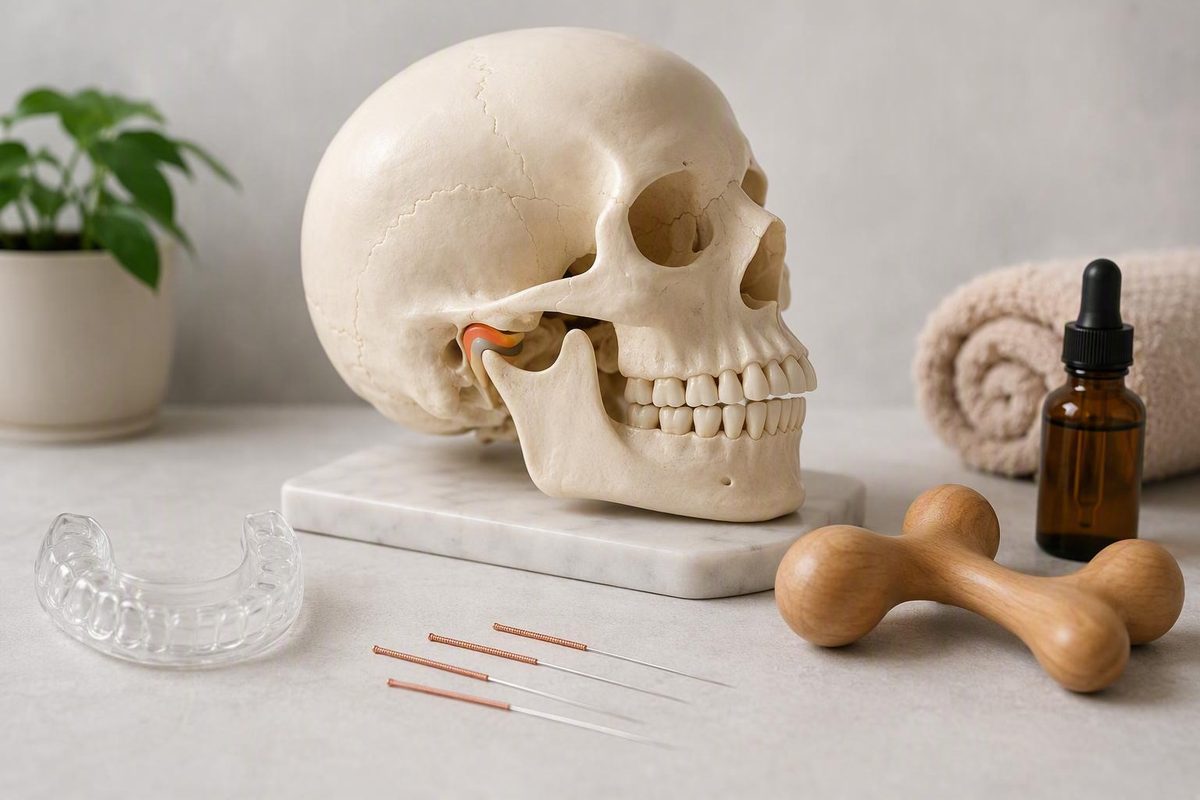
Jaw pain invites simple explanations and quick fixes: a mouth guard, massage tool, exercise routine, acupuncture, supplement, or procedure intended to “realign” the bite. The difficulty is that similar symptoms can arise from different joint, muscle, dental, inflammatory, or mechanical problems.
A safer approach to TMJ alternative treatment is not to search for a universal cure. It is to compare options by their intended goal, reversibility, risks, need for supervision, and strength of supporting evidence. That usually means beginning with temporary ways to reduce jaw strain, adding complementary or clinician-directed care when appropriate, and avoiding permanent changes without a clear diagnosis and an informed discussion of alternatives.
What “alternative TMJ treatment” includes—and what it cannot promise
The temporomandibular joint, abbreviated TMJ, connects the lower jaw to the skull and enables jaw movement. Temporomandibular disorders, or TMD, is a broader term for pain and dysfunction affecting the jaw joints, the muscles controlling jaw movement, or both. People often say they “have TMJ,” but the joint itself is not a diagnosis.
“Alternative treatment” is also search language rather than one defined medical category. It can refer to substantially different types of care:
- Home self-management: temporary soft foods, smaller bites, reduced jaw use, protected heat or cold, and changes to habits such as gum chewing or clenching.
- Complementary pain-management approaches: acupuncture, relaxation practices, biofeedback, and gentle massage.
- Clinician-directed conservative care: individualized physical therapy, medication, counseling, habit modification, and oral splints.
- Procedures and invasive care: injections, arthrocentesis, arthroscopy, open-joint surgery, or treatments that permanently alter teeth or bite relationships.
These approaches do not have the same purpose. Some aim to reduce muscle tension. Others try to lower joint irritation, limit excessive loading, support pain coping, or improve comfortable movement.
The available evidence does not support a dependable ranking of one universally best option. The TMJ Association cites a 2020 National Academy of Medicine assessment that described the evidence for many TMD treatments as sparse and affected by methodological limitations. That assessment applies to evidence reviewed at the time; it does not prove that no research or guidance has appeared since 2020. It does reinforce the need to distinguish plausible treatment ideas from demonstrated benefits (TMJ Association treatment overview).
The following matrix provides a practical comparison framework:
| Treatment | Intended goal | Reversibility | Need for supervision | Principal risk or concern | Important evidence limitation |
|---|---|---|---|---|---|
| Temporary soft foods and reduced jaw use | Lower chewing load and irritation | High | Usually low for a short trial | Staying unnecessarily restrictive for too long | Does not identify or correct the cause |
| Protected heat or cold | Temporary relief of muscular ache or recent irritation | High | Usually low | Burns or cold injury if misused | No established optimal protocol for every presentation |
| Habit modification | Reduce clenching and repetitive loading | High | Low to moderate | Delaying assessment when symptoms persist | Benefit depends on whether the habit is relevant |
| Relaxation or biofeedback | Recognize tension and support pain coping | High | Biofeedback generally needs instruction or equipment | Treating all pain as stress-related | No reliable effect estimate for all TMD presentations |
| Acupuncture | Complementary pain management | Generally high | Practitioner required | Using symptom relief as a substitute for diagnosis | Unclear who benefits and by how much |
| Gentle massage or movement | Address muscular soreness or movement difficulty | High if stopped when worse | Supervision is preferable for persistent symptoms | Aggravated pain, locking, or reduced movement | No universal routine or progression |
| Physical therapy | Individualized mobility, strength, and symptom management | Usually high | Yes | Loading that is poorly matched to the condition | Protocols and suitability vary |
| Oral splint | Manage selected pain or loading patterns | Usually reversible | Yes | Continuing despite worsening pain or function | Mechanism and overall effectiveness remain uncertain |
| Supplements | Proposed pain or joint-symptom support | Usually reversible | Clinician discussion is advisable | Uncertain benefit and suitability | Evidence is small, indirect, or condition-specific |
| Low-level laser therapy | Possible analgesic or anti-inflammatory effect | High | Trained clinician needed | Misplaced confidence in an unproven protocol | No established optimal dose or schedule |
| Clinician-performed joint procedures | Treat selected structural or mechanical problems | Varies | Specialist care required | Procedure-related risks | Appropriate only for selected diagnoses |
| Permanent bite or dental alteration | Change tooth contacts or bite relationships | Low | Yes | Permanent change without symptom relief | Comparative benefits and long-term outcomes are uncertain |
| Open-joint surgery | Treat carefully selected joint problems | Low | Specialist care required | Greater procedural risk | Not a routine treatment for nonspecific jaw pain |
This framework cannot generate a personalized recommendation or dependable effect size. It can clarify what a therapy is intended to accomplish, what could go wrong, and whether improvement should be expected in pain, movement, function, or an underlying structural condition.
Why conservative and reversible care usually comes first
Conservative care does not invade the tissues of the face, jaw, or joint and does not involve surgery. Reversible care does not permanently change the structure or position of the teeth or jaw. A treatment can be nonsurgical but still irreversible—for example, reshaping teeth to alter the bite.
Mild or intermittent symptoms may improve over weeks or months with simple measures, but that possibility is not a promise about any one person. Persistent pain, locking, or functional impairment deserves assessment rather than increasingly elaborate home treatment.
A sensible staged pathway is:
- Reduce aggravating load. Temporarily decrease hard chewing, wide opening, gum use, clenching, and repetitive jaw movements.
- Try a bounded period of low-risk self-care. Use simple measures with a defined purpose and clear stop rules.
- Assess the trend. Consider pain, movement, locking, chewing, speech, and whether symptoms are improving, stable, or worsening.
- Obtain an evaluation if symptoms persist or interfere with function. The goal is not merely to receive the label “TMJ,” but to identify the likely joint, muscle, dental, or other source.
- Choose supervised conservative care based on the assessment. This may include physical therapy, an oral appliance, behavioral support, or another targeted measure.
- Reserve procedures for appropriately selected cases. Invasive care should follow a diagnosis and an informed comparison with reasonable conservative alternatives.
This sequence reflects caution, not passivity. A short trial of reduced jaw loading is different from postponing evaluation indefinitely. More aggressive care is not automatically more effective when pain is severe or long-lasting, and permanent treatment does not become appropriate simply because temporary measures did not work.
Treatment decisions should follow symptoms and clinical findings rather than the word “TMJ” alone. Muscular soreness associated with frequent clenching may require a different plan from inflammatory joint pain, osteoarthritis, recent trauma, or mechanical locking.
Joint sounds also require context. Painless clicking or popping without restricted movement often does not require treatment. Painful clicking, catching, locking, or progressively reduced opening is different and deserves professional attention (TMJ Association guidance on conservative care and joint sounds).
Low-risk home measures for reducing jaw strain
For mild or occasional discomfort without warning signs, a practical first step is a temporary reduction in chewing and movement load. This does not require eliminating normal jaw movement or remaining on a liquid diet.
For a limited period, consider:
- Softer or blended foods that require less forceful chewing.
- Smaller bites rather than foods requiring wide opening.
- Cutting firm foods into manageable pieces.
- Avoiding hard, crunchy, sticky, or chewy foods.
- Pausing gum chewing.
- Reducing nail biting, cheek or lip chewing, and chewing on objects.
- Noticing daytime clenching and allowing the teeth to remain apart when not eating.
- Avoiding unusually wide yawning, loud singing, or repetitive extreme movement.
- Avoiding prolonged pressure from resting the jaw or head heavily in a hand.
These measures do not cure a joint disorder, prove that TMD is the correct diagnosis, or treat tooth decay, infection, arthritis, fracture, or another cause of facial pain.
Choosing between heat and cold
Heat and cold recommendations vary, and the supplied evidence does not establish one optimal protocol for every presentation. A practical distinction is:
- Protected moist heat: commonly suggested for a dull, steady muscular ache or tightness.
- Wrapped cold pack: commonly suggested for occasional sharp joint pain or recent irritation.
Use heat at a comfortable—not scalding—temperature with a protective layer for approximately 15 to 20 minutes. Wrap a cold pack in a clean, thin cloth and apply it for roughly 10 to 15 minutes, never longer than 20 minutes. Do not place a frozen pack directly on the skin. Stop if the skin becomes painfully hot, very numb, discolored, or irritated; heat can burn, while excessive or direct cold exposure can cause cold injury (TMJ Association self-care guidance).
That guidance also reports that 65% of respondents in a patient survey used thermal therapy and that 74% of compress users reported reduced symptoms. These are self-reported survey findings, not results from a controlled clinical trial. They show that patients commonly use compresses but do not establish how much benefit the treatments cause or which patients are most likely to respond.
If heat clearly increases throbbing or discomfort, stop. If cold makes the area more painful or causes persistent skin changes, stop. Neither method should be used to push through severe pain or postpone assessment of trauma, locking, fever, or worsening function.
Keep a simple symptom record
A short record can make self-care more deliberate. It might include:
- Pain location and character: dull, sharp, burning, or throbbing.
- Whether symptoms occur at rest or mainly with chewing.
- Comfortable jaw opening and whether movement is becoming more limited.
- Clicking, catching, or locking.
- Recent dental work, injury, illness, or changes in chewing habits.
- Clenching, grinding, gum chewing, nail biting, or unusually wide opening.
- What was tried, for how long, and whether it helped or worsened symptoms.
- Effects on eating, speaking, sleeping, and everyday activity.
This tracker is an organizational tool, not a validated diagnostic test. Its value is in revealing trends and giving a clinician a clearer history if evaluation becomes necessary.
Acupuncture, relaxation, and biofeedback: realistic goals and evidence limits
Acupuncture involves inserting hair-thin needles at selected locations on the body. For TMD, it is best viewed as a complementary pain-management option rather than a method for repositioning the joint, repairing damaged tissue, or correcting the bite.
Some people may find acupuncture helpful for ongoing pain, but the available evidence here does not provide a reliable effect size, identify responsive TMD subtypes, or show that the treatment corrects an underlying joint problem.
Relaxation training commonly involves slow, regular breathing or a related practice intended to reduce muscle tension and support pain coping. It may be especially relevant when someone notices clenching, guarding, or tightening during concentration or emotional strain. That does not mean stress causes every TMD presentation.
Biofeedback adds information. A device monitors a bodily signal, such as muscle tightness, so the person can practice recognizing and reducing tension. The purpose is to develop awareness and control, not to prove that symptoms are psychological. Mayo Clinic lists acupuncture, relaxation techniques, and biofeedback as complementary approaches that may help manage ongoing TMJ-related pain, without presenting them as cures (Mayo Clinic TMJ diagnosis and treatment guide).
| Option | Intended purpose | Invasiveness | Typical supervision | What the source supports | What remains unknown |
|---|---|---|---|---|---|
| Acupuncture | Complementary management of ongoing pain | Minimally invasive | Practitioner required | May help some people manage pain | Effect size, ideal protocol, responsive groups, and structural effects |
| Relaxation training | Reduce tension and support pain coping | Noninvasive | Can be learned independently or with guidance | May support symptom management when tension accompanies pain | How much benefit it adds for different causes |
| Biofeedback | Make muscle tightening visible or measurable so it can be reduced | Noninvasive | Initial instruction or equipment is generally needed | May support relaxation and tension awareness | Long-term benefit, ideal protocol, and who benefits most |
There is no reliable head-to-head comparison here showing that one of these options is superior. Selection may depend on the symptom target, availability, cost, personal preference, and willingness to practice.
Complementary care should remain complementary. It should not replace assessment for a jaw that locks, progressively loses movement, becomes severely painful after trauma, or interferes with chewing or speech. Pain accompanied by fever also calls for prompt clinical attention rather than another home or wellness treatment.
Physical therapy, gentle exercise, and massage
Physical therapy is broader than being handed a generic sheet of jaw exercises. Depending on the assessment, it may combine individualized stretching or strengthening with movement retraining, heat, massage, ultrasound, or transcutaneous electrical nerve stimulation.
Commonly published movement categories include:
- Relaxed or controlled jaw opening.
- Partial opening.
- Chin tucks.
- Side-to-side jaw movement.
- Gentle stretching.
- Strengthening or resisted movement.
Their appearance on an exercise list does not make them a universal routine. The supplied sources do not establish standardized repetitions, progression, contraindications, or suitability for every muscular, joint, inflammatory, or mechanical cause of jaw pain. A hospital rehabilitation guide lists these categories while also noting that a physical therapist can provide an individualized stretching and strengthening program (hospital jaw-exercise overview).
This distinction matters because different movements serve different purposes. Relaxed opening may be used to practice smooth motion, while resisted opening loads muscles. Someone with progressive locking or recent trauma should not assume that forcing the jaw farther open will restore normal mechanics.
A safer way to approach movement
If symptoms are mild and movement does not provoke sharp pain, gentle motion within a comfortable range may be reasonable. Avoid forcing symmetry, trying to achieve a dramatic stretch, or using resistance tools without individualized guidance.
Stop an exercise or massage technique if it causes:
- Sharp or intense pain.
- Increased catching or locking.
- Reduced opening afterward.
- A meaningful increase in pain that persists.
- Worsening ability to chew, speak, or perform normal jaw movements.
Dental-practice guidance also advises stopping exercises that cause sharp or intense pain and seeking care for severe pain or locking, although that source does not provide comparative clinical evidence for its exercise program (home-treatment safety guidance).
What about self-massage?
Gentle self-massage may be considered when discomfort feels muscular—for example, a broad ache or tenderness in the cheek or temple muscles. Use light, tolerable pressure rather than digging deeply into a painful area.
Stop if massage produces sharp pain, increases joint symptoms, triggers locking, reduces opening, or worsens function. Avoid forceful pressure over an acutely injured, swollen, or severely painful joint.
Some practice websites also suggest posture changes, special sleep positions, pillows, rollers, pressure tools, or stretching devices. These ideas may be supportive in some circumstances, but the supplied promotional material does not establish them as effective TMD treatments. A plausible mechanism, testimonial, or clinician’s experience with a branded tool is not the same as comparative clinical evidence.
Physical therapy, massage, and selected exercises may improve symptoms or movement for some people. They should not be presented as ways to correct every joint, muscular, dental, or facial-pain condition.
Splints, supplements, and low-level laser therapy
Oral splints—sometimes called mouth guards or oral appliances—may benefit selected people with jaw pain. Exactly why they help is not always understood, and benefit is not universal.
Before using an appliance, ask:
- What symptom or behavior is it intended to address?
- What diagnosis supports its use?
- When and for how long is it intended to be worn?
- How will pain, jaw movement, and function be monitored?
- Does the proposed treatment make any permanent changes?
- What should happen if pain increases, function worsens, or the bite feels different?
- When will the need for continued use be reassessed?
A splint should not become an automatic bridge to irreversible dental work. Perceived changes in the bite, worsening pain, or reduced function should prompt reassessment rather than continued unsupervised use.
Glucosamine and avocado-soybean unsaponifiables
The evidence for glucosamine should be interpreted narrowly. A randomized double-blind study discussed in a 2018 review included 45 people with TMJ osteoarthritis. In that study, 71% of participants receiving glucosamine and 61% receiving ibuprofen met the defined response threshold, but the difference between the response rates was not statistically significant. The study reported some pain outcomes favoring glucosamine, but one small trial in a specific osteoarthritis population does not establish glucosamine as superior to ibuprofen or broadly effective for TMD (2018 review of noninvasive TMD treatments).
The same older narrative review discusses avocado-soybean unsaponifiables and proposed biological effects. A proposed anti-inflammatory or cartilage-related mechanism does not by itself prove meaningful clinical benefit for people with TMD.
Supplements are best treated as clinician-discussion topics rather than do-it-yourself prescriptions. The evidence summarized here does not support dosing instructions or establish that these products are appropriate for every person or type of jaw pain.
Low-level laser therapy
Low-level laser therapy, also called photobiomodulation, has been studied for possible analgesic and anti-inflammatory effects. Small studies cited in the 2018 review reported improvements in pain, and one reported improvement in clicking. However, the studies involved small samples, used different wavelengths and energy doses, and did not establish an optimal protocol.
No reliable recommendation can therefore be made for the best wavelength, dose, treatment schedule, or number of sessions. Favorable findings from small studies justify further investigation; they do not prove broad effectiveness.
Before paying for laser treatment, ask what diagnosis is being treated, what outcome will be measured, how many sessions are proposed, what happens if there is no improvement, and what evidence supports that specific protocol. Laser therapy should be a clinician-discussion topic, not a home-device prescription.
Treatments that deserve extra caution
Treatment options are easier to assess when divided into three categories:
- Reversible, nonprocedural care: temporary dietary changes, relaxation, gentle movement, massage, physical therapy, and most carefully monitored appliances.
- Clinician-performed procedures: injections, arthrocentesis, and arthroscopy. These may not permanently alter anatomy, but they still carry procedural risks and require a diagnosis.
- Irreversible structural or dental interventions: open-joint surgery, tooth reshaping, bite alteration, orthodontics, extensive restorative dentistry, and full-mouth reconstruction.
Procedures and surgery are generally presented as later options for appropriately selected cases when conservative care has not provided adequate relief. Open-joint surgery carries more risk than less invasive approaches and is intended for carefully selected situations. Benefits, risks, and alternatives should be discussed with a healthcare professional before proceeding (Mayo Clinic overview of TMJ procedures).
“Conservative treatment failed” is not, by itself, a diagnosis. The clinician should be able to explain what structural or mechanical problem a procedure is intended to address and why the proposed intervention is reasonably matched to it.
Extra caution is appropriate when a clinic recommends services it also sells. Some dental-practice pages promote bite orthotics, bite adjustment, orthodontics, restorations, or full-mouth reconstruction without supplying comparative evidence, success rates, or detailed risk discussions. That commercial context does not prove a recommendation is wrong, but it increases the importance of requesting evidence and considering an independent opinion.
Do not infer effectiveness merely because:
- A clinic offers the procedure.
- A tool has a brand name or polished testimonials.
- A before-and-after story sounds compelling.
- A proposed mechanism seems biologically plausible.
- A treatment is described as advanced, holistic, natural, or corrective.
- The treatment costs more or is more aggressive.
Before agreeing to a permanent alteration of the teeth or bite, ask for:
- The specific diagnosis.
- The treatment goal.
- The expected benefit and how it will be measured.
- Material short- and long-term risks.
- Reversible alternatives.
- The evidence supporting the recommendation for that diagnosis.
- The plan if symptoms do not improve.
- Whether an independent second opinion is reasonable.
Botulinum toxin, commonly known by the brand name Botox, is not a natural or routine self-care treatment. It has been described as a rarely used, clinician-selected option that may reduce pain in some people, but that does not establish predictable or lasting benefit for TMD generally.
The central principle is simple: aggressive and irreversible treatment does not guarantee improvement. The greater the permanence and risk, the stronger the diagnosis, evidence, and informed-consent process should be.
When self-care is not enough
Prompt professional care is appropriate for:
- Jaw locking.
- Symptoms beginning after trauma.
- Jaw pain accompanied by fever.
- Severe pain.
- Difficulty chewing or speaking.
- Rapidly or progressively reduced jaw movement.
- Persistent symptoms that do not improve with conservative care.
- Worsening function despite stopping aggravating activities.
Hospital patient guidance identifies chronic or severe pain, locking, and difficulty chewing or speaking as reasons for professional evaluation. Pain Catalog’s educational notice separately advises prompt clinical attention for jaw locking, trauma, or pain accompanied by fever (Pain Catalog urgent-care notice).
Other symptoms require diagnostic caution. Ear discomfort, headache, tooth pain, sinus pressure, facial pain, and pain on only one side of the jaw should not automatically be attributed to TMD. Pain in the same region can come from different structures and may require dental, medical, or other evaluation.
Pain Catalog’s listed article on one-sided jaw pain and possible causes describes coverage of TMJ dysfunction, dental causes, sinus pressure, and signs that may call for same-day care. That listing can help readers organize questions, but it cannot determine the cause of an individual person’s pain.
A basic professional assessment may include:
- A symptom and health history.
- Questions about onset, injury, locking, chewing, clenching, and dental symptoms.
- Observation and palpation of the jaw and surrounding muscles.
- Assessment of the range and quality of movement.
- Evaluation of teeth and other relevant structures.
- Imaging when a healthcare professional believes it is needed to answer a clinical question.
Evaluation may begin with a healthcare professional or dentist familiar with jaw disorders. Depending on the findings, care may involve a physical therapist, an orofacial-pain clinician, or another appropriate professional. A physical therapist may provide an individualized movement program when mobility or muscle function is a suitable treatment target.
Routine painless clicking without limited movement is different from painful clicking, catching, locking, or progressive functional loss. The sound itself should not be treated in isolation from pain and function.
A conservative decision framework is more useful than a ranked remedy list:
- Begin with temporary, reversible ways to reduce jaw strain.
- Set realistic goals such as less pain, less clenching, or more comfortable movement.
- Use acupuncture, relaxation, biofeedback, massage, or supervised movement as possible adjuncts—not guaranteed cures.
- Judge commercial and research claims by study quality, applicability, risks, and conflicts of interest.
- Stop any exercise, massage, appliance, or other treatment that clearly worsens pain, locking, movement, or function.
- Avoid permanent dental changes without a clear diagnosis and an informed discussion of reversible alternatives.
- Move from self-care to prompt assessment when locking, trauma, fever, severe pain, impaired chewing or speech, or worsening movement appears.
This article can support informed questions and safer comparisons. It cannot diagnose the cause of an individual reader’s jaw or facial pain.
Frequently asked questions
What is the most evidence-supported alternative treatment for TMJ pain?
There is no single alternative treatment shown here to be best for every TMD presentation. The most defensible starting point is a conservative process: temporarily reduce jaw strain, use bounded low-risk self-care, monitor pain and function, and seek assessment if symptoms persist or worsen.
Physical therapy, relaxation, biofeedback, acupuncture, massage, and splints may help selected people, but their relevance depends on the likely source of symptoms. Muscle-dominant pain, inflammatory joint pain, osteoarthritis, trauma, and mechanical locking should not be treated as interchangeable problems.
Should I use heat or ice for TMJ pain?
Protected moist heat is commonly suggested for a dull, steady muscular ache or tightness. A wrapped cold pack is commonly suggested for occasional sharp joint pain or recent irritation.
As a bounded guide, use heat for about 15 to 20 minutes and cold for roughly 10 to 15 minutes, with cold never exceeding 20 minutes. Use a cloth barrier, never place a frozen pack directly on the skin, and stop if either method worsens pain or causes concerning skin changes. These are practical ranges, not proven optimal protocols for every person (TMJ Association heat and cold guidance).
Can acupuncture cure a TMJ disorder?
No evidence presented here establishes acupuncture as a cure. It may help some people manage ongoing TMD-related pain, but it has not been shown here to repair joint damage, permanently reposition the joint, correct dental disease, or treat every cause of facial pain.
Consider it an adjunct with a realistic symptom-management goal. It should not delay evaluation for locking, trauma, fever, severe pain, progressive movement loss, or impaired chewing and speech.
Does jaw clicking need treatment?
Painless clicking or popping without restricted movement often does not require treatment. Treating a sound alone may expose someone to unnecessary cost or risk without improving function.
Clicking deserves more attention when it is painful, follows trauma, occurs with catching or locking, or accompanies progressively limited movement. Assessment is then more appropriate than attempting to force, stretch, or manipulate the jaw.
When should I stop home treatment and see a clinician?
Stop relying on home treatment and seek prompt clinical care if the jaw locks, symptoms follow trauma, or jaw pain occurs with fever. Evaluation is also appropriate for severe or persistent pain, difficulty chewing or speaking, worsening limitation of movement, or symptoms that do not improve with a reasonable trial of conservative care.
Stop a particular exercise, massage technique, appliance, heat or cold application, or other therapy if it causes sharp pain, increased locking, reduced opening, skin injury, or worsening function. The safest overall strategy is to begin with reversible measures and escalate to professional assessment—not automatically to aggressive treatment—when symptoms become persistent, severe, or function-limiting.