
What a Clicking Jaw May Mean—and the Signs That Matter More Than the Sound
If the sound is painless, your mouth opens and closes fully, and you can eat comfortably, it is often something to monitor rather than treat.
The short answer: judge the pain and function, not just the pop
If your jaw pops when you chew but the sound is painless, your mouth opens and closes fully, and you can eat comfortably, it is often something to monitor rather than treat. Painless clicking or popping without limited movement is common and is unlikely to require treatment, according to the National Institute of Dental and Craniofacial Research.
Jaw popping is a symptom, not a diagnosis. A sound alone cannot establish that you have a temporomandibular disorder (TMD), a displaced joint disc, arthritis, joint damage, or a problem with your bite.
Pay closer attention to what happens with the sound. Arrange an assessment if popping is accompanied by:
- Pain or tenderness in the jaw, face, temple, or chewing muscles
- Stiffness or increasing tightness
- Catching or locking
- Reduced, difficult, or uneven opening
- Painful or tiring chewing
- Swelling
- A new change in how the teeth meet
- Symptoms that are worsening or interfering with eating or speaking
Timing can offer context, but it does not identify the cause. A painless click only near maximum opening—during a very wide yawn, for example—may be related to overextension. Popping during ordinary chewing is worth tracking if it persists, but pain and impaired function remain more informative than timing alone.
A practical response has three levels:
- Monitor and reduce strain if the pop is painless and jaw function is normal.
- Arrange a routine evaluation if pain, locking, restricted movement, a changed bite, or eating difficulty develops.
- Seek prompt care if you cannot open or close your mouth, the jaw appears stuck out of place, symptoms follow significant trauma, or jaw pain occurs with fever or major swelling. Inability to open or close the jaw completely is a reason to seek medical attention, according to Mayo Clinic.
This article is educational. It can help you judge the level of care that may be appropriate, but it cannot determine why your particular jaw is clicking.
How the jaw joint can make a clicking or popping sound
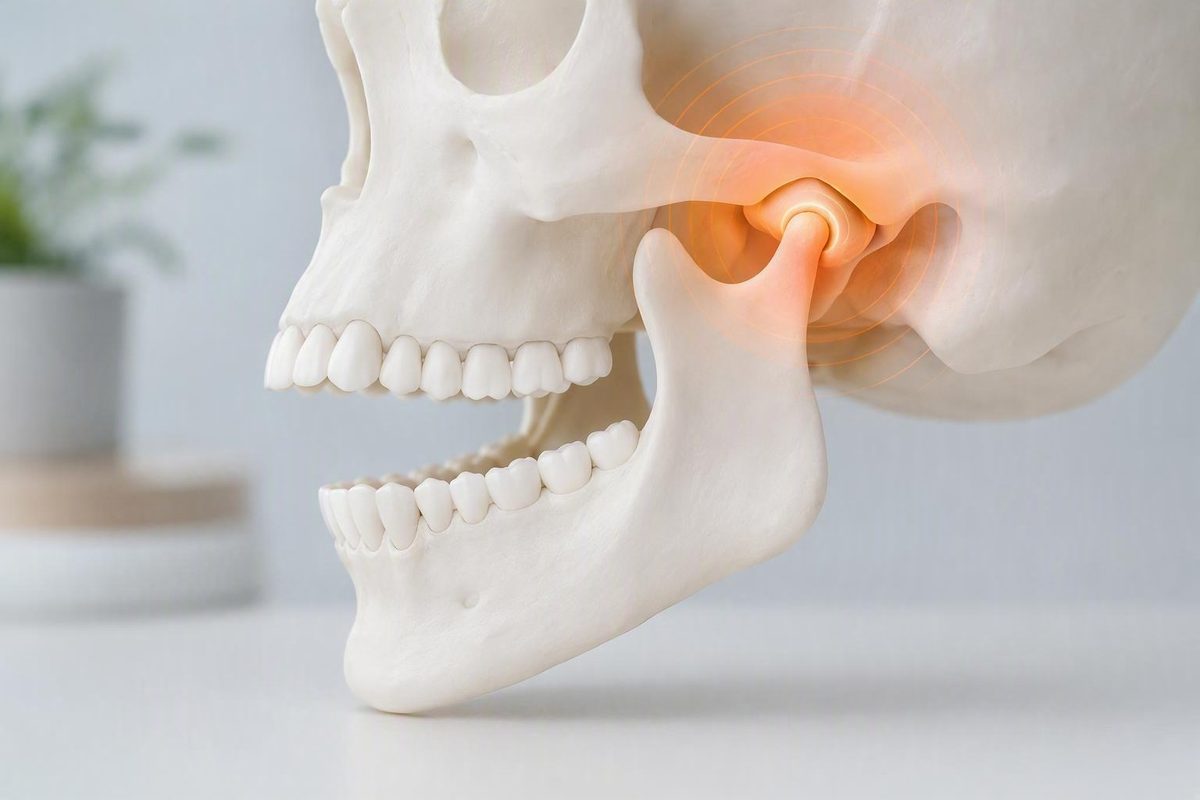
There is a temporomandibular joint—usually shortened to TMJ—on each side of the jaw, just in front of the ears. Each joint connects the lower jawbone to the skull and functions as a sliding hinge. A soft cartilage disc cushions the joint and helps the surfaces move smoothly.
Opening your mouth involves more than a simple hinge movement. The lower jaw rotates and then slides forward; closing reverses that sequence. This combination supports biting, chewing, speaking, and yawning.
One possible explanation for a distinct click is that the disc and joint surfaces shift relative to one another as the jaw moves. The sound may occur as those structures move into or out of a particular position. That mechanism cannot be confirmed from the sound alone, however. The anatomy and possible mechanisms are described in Mayo Clinic’s overview of the temporomandibular joint.
These descriptions can help a clinician understand what you notice, but sound quality by itself does not diagnose arthritis, disc displacement, or another joint condition.
It is also important not to use “TMJ” and “TMD” interchangeably:
- TMJ refers to the joint itself.
- TMD is an umbrella term for more than 30 conditions involving the jaw joints, chewing muscles, or associated symptoms, according to the NIDCR’s TMD overview.
Not every TMJ noise is a TMD.
Anatomy at a glance
Skull
  ↕
Cushioning disc
  ↕
Lower jawbone → rotates and slides during opening
A full anatomy illustration would show both jaw joints, the skull, the lower jawbone, the cushioning discs, and arrows indicating rotation and forward sliding.
Possible reasons your jaw pops during meals
There is no single explanation for every clicking jaw. Joint mechanics, muscle load, repetitive habits, injuries, and inflammatory conditions may contribute, and more than one factor may be present.
Joint-related factors
The cushioning disc and bony surfaces of the joint follow a coordinated path. A click may occur when these structures shift during movement, but listening to the click cannot establish exactly what is happening inside the joint.
A painless sound may occur without meaningful dysfunction. An examination becomes more useful when the sound is accompanied by pain, catching, locking, reduced movement, or a change in how the teeth meet.
Arthritis can affect the jaw joint, but popping alone does not prove arthritis. Pain, stiffness, swelling, reduced movement, other affected joints, or an established inflammatory condition would provide more relevant clinical context.
Muscle and habit factors
Clenching and grinding can load the chewing muscles and jaw joints. Either can happen while awake or asleep.
Repetitive or forceful habits may aggravate an already sensitive jaw, including:
- Frequent gum chewing
- Hard or very chewy foods
- Crunching ice
- Biting nails or pens
- Taking unusually large bites
- Opening very wide
- Repeatedly testing the click
Stress can increase muscle tension or make clenching more likely. That does not mean jaw symptoms are imaginary or “just psychological.” Muscle soreness and mechanical strain remain physical symptoms regardless of what prompts the habit.
Clenching, grinding, gum chewing, nail biting, arthritis, injury, and stress-related factors are among the possible contributors described in Mayo Clinic’s review of TMJ disorders. The exact cause can be difficult to determine and may involve several factors.
Injury and inflammatory factors
A blow to the face, sudden forced opening, or another jaw injury can precede popping. New symptoms after trauma deserve individualized assessment, particularly when there is pain, swelling, bruising, numbness, an altered bite, or difficulty moving the jaw.
Osteoarthritis, rheumatoid arthritis, and other joint conditions may contribute to painful or restricted movement. They cannot be distinguished reliably from other causes based only on whether the jaw clicks.
What about a “bad bite”?
Some dental-practice materials identify bite misalignment as a possible cause of TMD. Stronger government guidance is more cautious: research does not support a bad bite or orthodontic treatment as established causes of TMD.
A click therefore does not prove that your bite needs permanent correction. Be cautious about recommendations to reshape teeth, undertake extensive restorative work, or reposition the bite solely to stop a jaw sound.
Symptoms may come from somewhere else
Ear-area pain, headaches, facial discomfort, and tooth pain can occur alongside jaw-joint or chewing-muscle problems, but none is automatically caused by the TMJ.
If pain is clearly one-sided or you also have tooth sensitivity, pain when biting, gum swelling, or facial swelling, Pain Catalog’s related guide, “Jaw Hurts on One Side? Causes From TMJ to Teeth & When to Worry,” may help you organize the symptoms to discuss with a clinician. Do not use the pattern to diagnose the cause yourself.
A three-level guide to monitoring, booking care, or getting urgent help
Use pain, movement, and your ability to eat normally as the main triage criteria.
| Symptom pattern | Suggested action | Rationale |
|---|---|---|
| Occasional painless pop; mouth opens and closes fully and smoothly; no locking; chewing remains normal | Monitor and reduce strain | An isolated painless joint sound with normal function often does not need treatment. |
| Popping with pain, tenderness, stiffness, chewing fatigue, catching, reduced or uneven opening, a changed bite, or persistent difficulty eating or speaking | Book a dentist or medical evaluation | Pain and impaired function provide more clinically useful information than the sound alone. Headaches or ear-area discomfort may also be relevant, although they can have causes unrelated to TMD. |
| Inability to open or close the mouth; jaw stuck out of place; significant facial or jaw trauma; jaw pain with fever; major swelling; or sudden severe deterioration | Seek prompt or urgent clinical care | These patterns may involve dislocation, significant injury, infection, or another condition that should not be managed as routine jaw clicking. |
There is no universal number of days that everyone should wait before having a painless click assessed. If the sound remains painless and does not affect movement or eating, it can often be monitored. Progression, pain, locking, and loss of function matter more than a rigid deadline.
A clinician should assess symptoms when the jaw begins catching, meals become uncomfortable, opening becomes reduced or uneven, or the teeth suddenly meet differently. Persistent headaches or ear-area symptoms may also justify evaluation, but they should not automatically be attributed to the jaw joint.
Do not force or manipulate a stuck or apparently displaced jaw back into place. Cleveland Clinic advises obtaining immediate medical care if the jaw has popped out of place rather than attempting to reposition it yourself in its jaw-popping guidance.
Trauma, fever, major swelling, or prominent tooth symptoms may indicate an injury, infection, or dental problem rather than routine TMD. Pain Catalog’s published safety notice likewise advises prompt clinical attention for jaw locking, trauma, or jaw pain with fever.
What to do for the next few days without over-treating the joint
Think of home care as temporary load reduction, not a guaranteed way to eliminate the sound. The goal is to let an irritated joint or muscle system settle while preserving comfortable function.
Make chewing easier temporarily
If chewing is uncomfortable, choose softer, balanced foods temporarily and cut food into smaller pieces. Options may include eggs, yogurt, oatmeal, soup, cooked vegetables, fish, soft rice, pasta, or finely cut tender foods.
Temporarily reduce or avoid:
- Gum
- Ice crunching
- Hard candy
- Tough or chewy foods
- Nail or pen biting
- Oversized bites
- Deliberately opening as wide as possible
Return toward your usual balanced diet as comfort allows. If symptoms continue when you try to resume normal eating, contact a healthcare professional.
Check your resting jaw position
At rest, try keeping your lips together and teeth apart, without forcing your jaw into a particular position. Use ordinary moments—reading email, driving, cooking, or scrolling—as occasional reminders to notice whether you are clenching.
A relaxed, teeth-apart resting position and temporary reduction in jaw use are among the practical measures discussed in the University of Utah Health guide to jaw popping.
The aim is awareness, not constant monitoring.
Use heat or cold cautiously
Comfortable heat may relax sore muscles for some people, while cold may feel better when an area is newly irritated. The better choice depends on the type of problem, and neither method works for everyone.
Protect your skin, use a comfortable temperature, and stop if the application increases pain or irritation. Penn Medicine recommends temporary soft foods and reducing repetitive strain while noting that the choice between heat and cold depends on the condition in its TMJ pain-management guidance.
Keep massage and movement gentle
Light massage of sore cheek or temple muscles may be reasonable if it feels soothing. Gentle, comfortable jaw movement may also help prevent guarding, but stop if it increases pain, popping, catching, locking, or restriction.
Avoid:
- Forceful stretching
- Resisted exercises selected without an assessment
- Repeatedly opening and closing your mouth to test the click
- Trying to “put the disc back”
- Attempting to realign or manipulate a locked jaw
If pain or limited movement persists, ask a clinician or physical therapist which movements are appropriate.
Be careful with nonprescription pain medicine
Over-the-counter pain medicines are not equally safe for everyone.
Ask a clinician or pharmacist what is appropriate for you rather than treating medication as a universal solution.
Most importantly, do not measure progress only by whether the sound disappears. A jaw that opens smoothly and handles normal meals comfortably is a more meaningful goal than silence at all costs.
What a dentist or medical clinician may check
A dentist or primary care clinician is a reasonable first contact when popping is painful, worsening, or interfering with function. The best starting point may depend on whether dental symptoms, an injury, joint symptoms, or a broader health condition is most prominent.
The history
Expect questions about:
- When the popping started
- Whether it occurs during chewing, speaking, yawning, or several activities
- How often it happens and whether it is changing
- Whether there is pain, tenderness, stiffness, or fatigue
- Any catching or locking
- Whether opening has become difficult or uneven
- Any recent injury
- Recent dental work or prolonged mouth opening
- Daytime clenching or suspected sleep grinding
- Food and habit triggers
- Headache, ear-area, tooth, or facial symptoms
- Effects on eating, speaking, sleep, or daily activities
The examination
A clinician may observe you opening and closing your mouth, assess whether movement is smooth and symmetrical, and check the jaw joints and chewing muscles for tenderness. A dental examination may look for tooth disease, signs associated with grinding, or a genuine change in how the teeth meet.
There is no single widely accepted test that diagnoses every TMD. Evaluation generally relies on the history, physical and dental examination, and selective testing when the findings justify it.
X-rays, MRI, or CT imaging may be selected if the examination suggests a problem involving bone, the joint disc or other soft tissue, significant injury, arthritis, or another condition that imaging could clarify. An uncomplicated painless click does not automatically require a scan.
A simple symptom diary
A short record may be more useful than relying on memory:
| Field | What to record |
|---|---|
| Date and time | When it happened |
| Trigger | Chewing, yawning, speaking, waking, dental treatment, or injury |
| Side | Left, right, both, or uncertain |
| Pain | A consistent personal rating and where it was felt |
| Sound | Click, pop, crackle, or grate |
| Catching or locking | What happened and how long it lasted |
| Opening difficulty | Normal, reduced, uneven, or painful |
| Chewing impact | None, fatigue, avoided foods, or inability to eat normally |
| Trauma | Any recent blow, fall, or forced opening |
| Clenching | Suspected awake or sleep clenching and the circumstances |
Referral does not necessarily imply a severe condition; it may simply match the symptom to the appropriate expertise.
Treatment usually starts with conservative, reversible care
Treatment should follow the diagnosed problem, symptom severity, and effect on function. A pop by itself does not dictate a treatment plan.
Habit and load modification
Common first steps include reducing clenching, gum chewing, nail biting, very wide opening, and other aggravating habits. A softer diet may be useful temporarily during a painful period, followed by a return toward normal food as comfort permits.
These measures are reversible. They also allow you and your clinician to see whether reducing strain changes pain, fatigue, or movement.
Physical therapy
Clinician-guided physical therapy may be considered when pain, muscle tenderness, restricted movement, or poor movement control persists. Possible goals include improving comfortable function, coordinating movement, reducing muscle sensitivity, and identifying habits that overload the jaw.
This differs from forcefully stretching the jaw or following a generic exercise routine without an assessment. Exercises should be selected for the actual movement problem and adjusted if they worsen symptoms. Penn Medicine describes conservative physical therapy as a possible option when home measures are insufficient.
Oral appliances
An oral appliance or splint may be considered when clenching or grinding is relevant, but a click alone is not enough reason to buy one. Evidence that intraoral appliances improve TMD pain is limited.
If an appliance is used, it should be reversible and professionally monitored.
Do not choose a mouth guard solely because your jaw makes a sound. An evaluation should first consider whether clenching or grinding is actually relevant and whether an appliance fits the suspected problem.
Medication
Medication choices require an individual safety review. Different causes of jaw pain may call for different approaches, and potential benefits must be weighed against pregnancy, other health conditions, allergies, interactions, and adverse effects.
Medication should not substitute for assessment of significant locking, swelling, trauma, dental disease, or worsening loss of movement.
Be cautious with irreversible or invasive “fixes”
Evidence does not establish a “bad bite” as a general cause of TMD or support permanently altering the bite as standard treatment.
Invasive procedures and surgery are generally reserved for severe, diagnosed disease or joint destruction after simpler approaches have failed. Many TMD treatments have limited or mixed evidence, so a second opinion is sensible before an intervention that permanently changes the teeth, bite, or joint.
The NIDCR recommends conservative, reversible care first and cautions against treatments that permanently alter the jaw joint, teeth, or bite unless they are clearly indicated.
How to monitor the symptom without assuming the worst
Many TMD symptoms are temporary or improve with conservative care, but there is no guaranteed recovery timeline for an individual jaw click.
Eliminating every sound is therefore not always a necessary treatment goal. Monitor function instead:
- Can you open and close your mouth fully?
- Is the movement smooth?
- Can you eat normal meals comfortably?
- Is pain absent or improving?
- Is there catching or locking?
- Has your bite changed?
- Is the symptom worsening or becoming disruptive?
Notice whether reducing gum, hard foods, oversized bites, very wide opening, and clenching makes the jaw feel better. A brief symptom diary can reveal patterns without encouraging repeated testing.
Move from monitoring to assessment if new pain develops, the symptom worsens, the jaw catches or locks, opening becomes reduced or uneven, the bite changes, or eating becomes difficult. Recurrence or persistence alone can be recorded and discussed routinely if it concerns you, but pain and loss of function are clearer reasons to seek evaluation.
The decision pathway is:
- Painless sound with normal function: monitor and reduce strain.
- Painful, worsening, locking, restricted, or function-limiting symptoms: book an assessment.
- Stuck jaw, significant trauma, fever with jaw pain, major swelling, or sudden severe deterioration: seek prompt clinical care.
A painless click with normal movement is often something to observe rather than fear. Use temporary, reversible measures and obtain an evaluation before choosing an appliance or pursuing permanent treatment solely because the jaw makes a sound.
Frequently asked questions
Is painless jaw popping while chewing normal?
It can be. Painless popping with full, comfortable movement and no difficulty chewing is common and often does not require treatment.
Monitor for changes rather than assuming the sound proves joint damage. Arrange an assessment if pain, tenderness, catching, locking, reduced opening, a bite change, or difficulty eating develops.
How long should I wait before seeing someone about a clicking jaw?
There is no universal evidence-based waiting period for an isolated painless click. If movement and chewing remain normal, you can monitor the symptom while reducing avoidable strain.
Persistence or recurrence alone is a reason to track the pattern or mention it routinely if you are concerned. Seek an evaluation sooner if the symptom is worsening or is accompanied by pain, stiffness, catching, locking, reduced movement, a bite change, or difficulty eating or speaking.
Do not wait if the jaw becomes stuck, symptoms follow significant trauma, or jaw pain occurs with fever or major swelling.
Can grinding or clenching make my jaw pop?
Grinding and clenching can strain the chewing muscles and load the jaw joints, so they may contribute to popping or accompanying soreness. They can occur during sleep or while awake.
Possible clues include morning fatigue, tender cheek or temple muscles, tooth wear, or catching yourself holding your teeth together during concentration. These clues do not prove the cause, so persistent painful or function-limiting symptoms still warrant an examination.
Do I need an X-ray or MRI for jaw popping?
Not necessarily. Evaluation usually starts with a symptom history and physical and dental examination.
Imaging may be useful when findings suggest injury, arthritis, bone changes, internal joint problems, or another condition that a scan could clarify. An uncomplicated painless click with normal movement does not automatically require an X-ray, MRI, or CT scan.
Should I use a mouth guard for a popping jaw?
Not solely because the jaw clicks. An appliance may be considered after evaluation when clenching or grinding is relevant, but it is not guaranteed to stop the sound, and evidence for improving TMD pain is limited.
If a clinician recommends an appliance, it should be reversible and monitored. Stop using it and seek reassessment if it causes pain or changes your bite. Consider a second opinion before accepting an appliance or dental procedure intended to reposition the jaw permanently or alter how the teeth meet.