
Why Does My Jaw Pop? When the Sound Matters
Jaw popping often relates to disc movement. Pain, locking, swelling or a sudden bite change matters more than the sound itself.
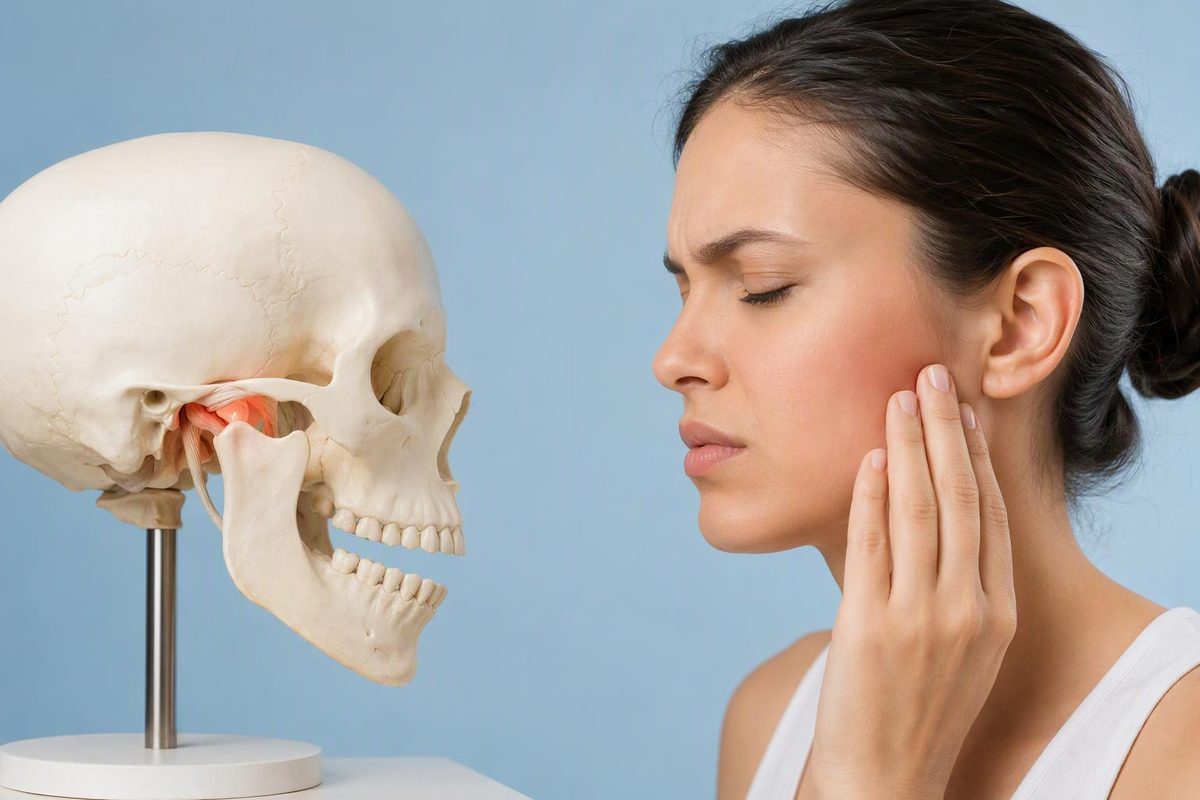
One common reason for jaw popping is movement of the small cartilage disc inside the temporomandibular joint (TMJ). If the disc sits forward of its usual position, it may click or pop back into place as the mouth opens. This pattern is called disc displacement with reduction.
A sound alone cannot confirm what is happening inside the joint, however. Jaw noises can have different causes, and the details that matter most are whether the pop hurts, whether movement has changed and whether the jaw catches or locks.
Painless popping usually does not need treatment
The National Institute of Dental and Craniofacial Research says clicking or popping without pain is common, considered normal and does not require treatment (NIDCR). A review of disc displacement with reduction found that it is usually painless, can remain stable for years and does not progress to locking in most people (Journal of Applied Oral Science).
Monitoring is reasonable when:
- the pop does not hurt;
- you can open and close your mouth normally;
- the jaw does not catch or lock;
- your teeth meet as usual; and
- you can chew comfortably.
You do not need to keep opening your mouth to test the noise. Avoid forcing, “realigning” or deliberately popping the joint. A sound by itself is not a reason to pursue treatment designed to change your bite or jaw.
Pain or restricted movement changes the picture
Popping is more relevant when it occurs with pain in front of the ear, jaw stiffness, reduced opening or locking. These can be features of a temporomandibular disorder (TMD)—the name for disorders affecting the jaw joint, chewing muscles or related structures. TMJ names the joint; TMD names a disorder.
A rough grinding or crackling sound, often called crepitus, is different from a single pop and can accompany changes in the joint surfaces. It cannot confirm arthritis by itself. Likewise, clenching may make the chewing muscles sore or aggravate symptoms, but waking with a click does not prove that you grind your teeth.
Arrange an assessment with a dentist or medical clinician if the popping is painful, is worsening, repeatedly catches, limits eating or opening, or comes with a new change in how your teeth meet. Jaw and facial symptoms can also come from dental, ear and other conditions. There is no single standard test for every TMD; evaluation usually begins with a symptom history and examination, and a clinician may recommend imaging when appropriate (NIDCR).
If catching is becoming common, see why repeated jaw locking needs attention.
What to do when the pop is sore
For a mild, recent flare without warning signs, temporarily reduce the load on the joint:
- Choose softer foods and cut food into small pieces.
- Avoid gum, chewy foods, nail biting and very wide bites.
- Avoid opening your mouth especially wide when yawning.
- Use wrapped heat or cold—whichever feels better—on the painful area.
- Let your teeth remain slightly apart when you are not eating instead of holding a clench.
These measures are consistent with conservative self-care recommended by NIDCR and the NHS. Over-the-counter pain medicine may be an option if it is normally safe for you; follow the label and ask a pharmacist or clinician if you have medical conditions, take other medicines, are pregnant or are unsure.
Do not use forceful stretches or internet techniques intended to “put the disc back.” If pain or restricted movement persists, ask a dentist, clinician or appropriately trained physical therapist for advice suited to the problem.
Get prompt help for locking, trauma, fever or swelling
Seek urgent care if your jaw becomes stuck open or closed, you cannot eat or drink, or the problem follows a significant blow to the face. A jaw that is stuck open and cannot close may be dislocated. This is a medical emergency, and you should not try to push it back into place yourself (Cleveland Clinic, healthdirect).
Prompt assessment is also appropriate for facial or jaw swelling, fever, a sudden bite change, numbness, marked facial asymmetry or rapidly worsening pain. These are not typical features of an isolated painless click and may point to infection, injury, inflammation or another condition (British Journal of General Practice).
If your jaw pops when you eat but remains comfortable and moves normally, use this chewing-specific checklist. The practical dividing line is not how loud the pop sounds inside your head; it is whether pain, locking or loss of function accompanies it.