
Can You Close Your Mouth? What a Yawn-Triggered Jaw Pop May Mean
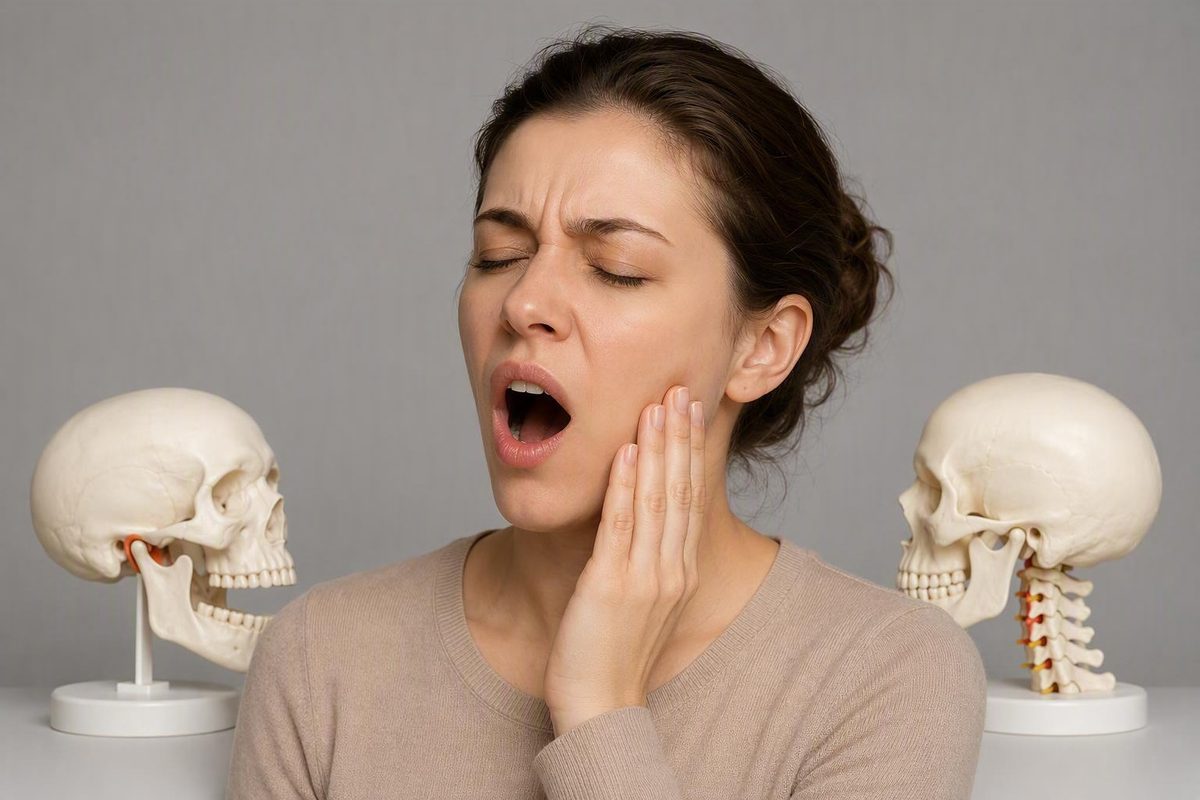
Start Here: Can You Close Your Mouth and Does Your Bite Feel Normal?
If your jaw popped while yawning, start with three questions:
- Can you close your mouth fully?
- Do your upper and lower teeth meet the way they normally do?
- Was there a major blow to the face—or are there severe symptoms such as trouble breathing, heavy bleeding, confusion, or numbness?
A single painless pop followed by normal opening, closing, speech, and bite is often not an emergency. Avoid repeatedly opening wide to reproduce the sound. Instead, monitor for pain, locking, stiffness, restricted movement, or recurrence.
Get prompt professional care if:
- Your jaw is stuck open or cannot close properly.
- It looks shifted, crooked, or visibly out of position.
- You cannot move it normally.
- Your teeth suddenly meet differently.
- You have severe pain or substantial swelling.
- You are drooling because you cannot close or control your mouth.
- Speaking or chewing has become difficult.
Wide opening during a yawn can trigger a jaw dislocation, although the pop itself does not prove that one occurred. Inability to close or move the jaw, visible displacement, drooling, pain, swelling, and difficulty speaking or chewing are recognized warning signs of possible dislocation requiring prompt medical attention (Healthdirect jaw-dislocation guidance).
Do not force your mouth shut. Do not push, massage, or manipulate a jaw that may be dislocated back into place. Jaw reduction is a healthcare procedure.
Call your local emergency service or go to an emergency department if the problem involves:
- Breathing or swallowing difficulty
- Major facial trauma
- Heavy bleeding
- Loss of consciousness or confusion
- Facial numbness
- New weakness, vision disturbance, or another neurological symptom
- Obvious facial deformity after an impact
A strong impact may cause a fracture, nerve injury, head injury, or other facial damage rather than an ordinary jaw-joint problem. Confusion or facial numbness after a strong impact is particularly concerning, while breathing difficulty, heavy bleeding, loss of consciousness, and other neurological symptoms also favor emergency-department care (guidance on emergency assessment after suspected jaw dislocation).
The loudness of the pop is not a reliable measure of severity. A relatively harmless joint sound may be surprisingly loud, while a significant injury may occur without a dramatic crack. Function, alignment, bite changes, trauma, and the symptoms that follow matter more.
Why a Jaw Can Pop at the Widest Point of a Yawn
You have a temporomandibular joint on each side of your face, just in front of the ear. These joints connect the lower jaw to the skull and allow both hinge-like rotation and forward sliding. That combination makes speaking, chewing, and wide opening possible.
A yawn takes the jaw toward the far end of its opening range. As the lower jaw slides forward, a pop may occur near maximum opening. One possible explanation is temporary hyperextension or instability as the joint moves beyond its usual working range and then returns.
Recurring clicks may have a different explanation. Each joint contains a cartilage-like disc between its moving surfaces. If the disc and jaw do not move in coordination, a click may occur during opening or closing. The timing and sound can provide context, but they cannot confirm the exact mechanism in an individual case (University of Utah Health on maximum-opening and disc-related jaw pops).
Typical patterns include:
- One pop at the widest point of a yawn: May reflect joint translation or temporary hyperextension.
- Repeated clicking during ordinary chewing or speaking: May fit a recurring movement problem within the joint.
- A pop followed by pain, locking, or a changed bite: Deserves more attention because function or alignment may have been affected.
- A pop followed by an inability to close the mouth: Raises concern for dislocation.
These are clues, not diagnoses.
It also helps to distinguish two commonly confused terms:
- TMJ means the temporomandibular joint itself.
- TMD means temporomandibular disorder, a broad category of problems affecting jaw movement, the joint, chewing muscles, or related structures.
Popping can occur with TMD, but a sound alone does not establish TMD, disc displacement, partial dislocation, or complete dislocation. Jaw popping may occur while speaking, chewing, or yawning and can accompany symptoms such as jaw pain, headaches, or ear-area discomfort; popping during a wide yawn is often less concerning when there is no pain or loss of function (Cleveland Clinic’s overview of jaw popping).
Lack of pain is reassuring, particularly when movement and bite remain normal. It does not prove that the joint is completely healthy or exclude every form of dysfunction. Recurrence and functional changes matter more than a single sound.
Compare the Four Main Symptom Patterns
This comparison may help you choose a level of care, but it cannot diagnose the cause of your jaw pop.
| Typical pattern | Function | Associated symptoms | Immediate response | Follow-up |
|---|---|---|---|---|
| Isolated painless pop | Mouth closes normally; opening remains comfortable; bite is unchanged | No persistent pain, swelling, locking, or speech difficulty | Do not deliberately reproduce the sound; avoid extreme opening temporarily | Monitor for recurrence, pain, or movement changes |
| Recurring clicking during chewing, speaking, or yawning | Usually able to open and close, although movement may feel stiff or uneven | Tenderness, temple headaches, ear-area discomfort, chewing pain, or reduced opening may occur | Reduce provoking habits and use temporary conservative measures | Arrange routine dental or medical assessment if symptoms persist or interfere with daily life |
| Painful or recurrent locking that resolves | Jaw temporarily catches, shifts, or becomes difficult to move, then returns | Pain, restricted opening, muscle tightness, or bite uncertainty | Do not force or repeatedly test the movement | Arrange an evaluation, especially if episodes recur |
| Jaw stuck open or visibly displaced | Cannot close normally; movement is substantially impaired; bite may be altered | Severe pain, drooling, swelling, impaired speech, difficulty chewing, or asymmetry | Support the jaw gently, minimize movement, and seek prompt professional care | Treat as a possible dislocation |
| Pop or dysfunction after facial trauma | Opening, closing, or bite may be altered | Bruising, swelling, deformity, bleeding, numbness, confusion, dental injury, or severe pain | Treat it as an injury rather than routine TMD | Emergency assessment may be necessary depending on the force and symptoms |
Clicking, limited opening, locking, pain around the jaw or ear, and temple headaches can occur with TMD-type problems. Symptoms that prevent normal eating or drinking require more urgent advice (NHS guidance on temporomandibular disorder).
A true dislocation generally produces functional changes rather than sound alone. Inability to close the mouth, a lopsided jaw, and teeth that no longer meet normally are key warning signs; a dislocated jaw requires prompt professional treatment (Cleveland Clinic’s dislocated-jaw guidance).
Temporary recovery does not make every locking episode irrelevant.
What to Do Right Now
The correct response depends on whether your jaw functions normally or may be dislocated. Do not apply ordinary TMD self-care to a jaw that is visibly displaced or stuck open.
If your jaw closes normally and your bite is unchanged
After one painless pop:
- Do not repeatedly open wide to reproduce it.
- Avoid exaggerated yawning and oversized bites for now.
- Continue monitoring normal opening, closing, speech, and chewing.
- Note whether the sound returns during ordinary activity.
- Seek assessment if pain, locking, swelling, stiffness, restricted opening, or a changed bite develops.
Observing naturally occurring symptoms is more useful.
If there is mild soreness but movement and bite remain normal:
- Choose softer foods temporarily.
- Avoid gum, chewy sweets, ice, hard crusts, and other foods requiring forceful or prolonged chewing.
- Cut food into smaller pieces rather than taking wide bites.
- Limit extreme mouth opening.
- Notice and relax daytime clenching.
- Let the jaw rest instead of repeatedly checking its range.
A relaxed resting posture generally means that the lips can meet comfortably while the upper and lower teeth remain slightly apart. The teeth do not need to be held together when you are not chewing or swallowing.
Wrapped heat or cold may provide temporary comfort. Protect the skin with cloth, choose whichever feels better, and stop if it worsens the pain. Softer foods, avoiding gum and very wide yawning, keeping the teeth apart when not eating, and using wrapped heat or cold are among the conservative measures recommended for TMD-type symptoms (NHS self-care guidance).
Do not assume that a mouth guard is the immediate answer to a one-time pop. A clinician may consider an appliance if grinding, clenching, or another appropriate indication is found, but an appliance is not a universal treatment and should not be expected to reset a joint or reliably eliminate popping.
If the jaw may be dislocated
If your mouth is stuck open, your jaw looks shifted, or your bite has suddenly changed:
- Support the jaw gently with your hand.
- Keep movement and talking to a minimum.
- Apply a wrapped cold pack if practical.
- Obtain prompt professional care.
- Use emergency services if there was major trauma or if breathing, swallowing, consciousness, or neurological function is affected.
Do not:
- Force the mouth closed
- Perform jaw stretches
- Massage the joint in an attempt to move it
- Follow an online “jaw reset” demonstration
- Ask an untrained person to push it into place
A suspected dislocation should be repositioned by a trained healthcare professional. Supporting the jaw and applying a cold pack are appropriate while awaiting care, but self-reduction may worsen the injury.
When and Where to Seek Care
Emergency department or emergency services
Use an emergency department—or your locally appropriate emergency service—when:
- The jaw remains stuck open or visibly displaced.
- You cannot close your mouth.
- Severe pain, drooling, marked swelling, or impaired speech accompanies the displacement.
- You have breathing or swallowing difficulty.
- There has been major facial trauma.
- There is heavy bleeding, loss of consciousness, confusion, facial numbness, weakness, or another neurological symptom.
- A fracture or serious head injury is possible.
A suspected dislocation needs prompt assessment because professional reduction, pain control, imaging, sedation, or anesthesia may be required.
Urgent care
An urgent-care center may be able to assess a non-traumatic jaw problem, manage pain, or direct you to an appropriate facility. Capabilities vary, however.
If the jaw appears dislocated, call ahead when doing so will not delay necessary care. Ask whether the facility evaluates jaw dislocations and can arrange imaging and professional reduction. If it cannot—or if severe symptoms or trauma are involved—go to an emergency department instead. Some urgent-care facilities may need to transfer patients for imaging or specialist treatment.
Dentist or primary care clinician
Arrange a dental or medical appointment for:
- Recurring or painful popping
- Restricted opening
- Jaw stiffness or tenderness
- Headaches associated with jaw symptoms
- Ear-area discomfort without a clear ear problem
- Pain while chewing
- Episodes of locking, even if they resolve
- Symptoms affecting eating, speaking, sleeping, or ordinary activities
A dentist can assess the teeth, gums, bite, signs of grinding, localized dental pain, and jaw-joint movement.
Depending on the findings, either clinician may refer you to a physiotherapist with relevant jaw experience, an orofacial-pain clinician, an oral and maxillofacial clinician, or another joint specialist.
Do not rely on a universal “wait two weeks” or “wait three weeks” rule. A mild, improving symptom with normal function can often be monitored, but deformity, locking, restricted function, fever, swelling, trauma, or severe pain takes priority over elapsed time.
Jaw pain accompanied by fever, facial or gum swelling, drainage, pronounced dental sensitivity, or inability to move the jaw fully needs prompt assessment because dental disease or infection may need consideration (warning signs associated with jaw pain during yawning).
Pain Catalog provides general education rather than an individual diagnosis or substitute for clinical care, as explained in Pain Catalog’s terms and educational-use limitations.
Possible Contributors Beyond the Yawn Itself
The yawn may simply have been the moment when the joint reached its widest position. It does not necessarily explain why the pop occurred.
Clenching and grinding
Sustained clenching or nighttime grinding can load the jaw muscles and joints. Morning soreness, tired chewing muscles, tooth wear, or waking headaches may make grinding worth discussing with a clinician, but those signs do not confirm it by themselves.
Daytime clenching can be easy to miss. Some people hold their teeth together while concentrating, driving, working, or responding to stress. Periodically noticing whether your teeth are unnecessarily touching can help identify the habit without repeatedly moving the joint.
Stress-related muscle tension
Stress does not mean the symptoms are imaginary. It may coincide with jaw clenching, facial-muscle tension, or a braced posture, potentially making wide opening feel more abrupt or uncomfortable.
Repetitive loading
Prolonged gum chewing, nail biting, chewing ice, biting pen tops, and repeatedly provoking a click all add movement or load. Reducing these habits is reasonable while symptoms settle.
Arthritis or previous injury
Arthritis may affect the jaw joint as it affects other joints. A previous blow, fracture, strain, or other jaw injury may also be relevant. Recent trauma deserves particular attention when accompanied by bruising, swelling, numbness, an altered bite, or restricted movement.
Prolonged mouth opening
Long dental appointments, certain medical procedures, vomiting, or other episodes involving sustained wide opening may temporarily strain the jaw or precipitate instability. Tell the evaluating clinician if symptoms began after dental treatment or prolonged opening.
Hypermobility or previous dislocation
General joint hypermobility or a history of jaw instability may make over-opening episodes more significant. A previous jaw dislocation is associated with greater susceptibility to another, so follow-up is sensible even when a new episode appears to have returned to position.
Dental disease
A tooth infection, cracked tooth, gum problem, or abscess may cause localized pain, sensitivity, swelling, or pain when biting. Dental disease can coexist with a jaw-joint sound but does not explain every pop. Conversely, assuming all pain near the jaw is “TMJ” can delay treatment of a tooth problem.
Joint or anatomical variation
Disc movement, bite characteristics, skeletal variation, and individual joint anatomy may influence jaw movement. None should be declared the cause based on a sound alone. An uneven-feeling bite after the event is important, but it requires examination rather than self-diagnosis.
Clenching, grinding, stress, repetitive chewing, arthritis, trauma, and bite-related factors are all discussed as possible contributors to jaw popping. Treatment depends on the cause and associated symptoms, not simply on the presence of a sound (possible causes of jaw popping).
What an Evaluation and Treatment May Involve
A clinician will usually begin by clarifying:
- How wide your mouth was open
- Whether the jaw shifted or became stuck
- Whether you could close it immediately afterward
- Whether your bite changed
- Whether there was a blow, fall, dental procedure, or other trigger
- Whether the symptom is new or recurrent
- Where the pain is located
- Whether fever, swelling, drainage, numbness, bruising, or neurological symptoms are present
The examination may assess how far and how symmetrically the jaw opens, whether it deviates to one side, where tenderness occurs, whether sounds arise during ordinary movement, and whether the teeth meet normally. The clinician may also look for tooth damage, infection, muscle tenderness, trauma, or swelling.
If dislocation is suspected
Diagnosis is usually based on the history and physical examination. Imaging may be used when the jaw position is uncertain or a fracture or other injury needs to be excluded.
Jaw reduction is a healthcare procedure, not a home maneuver. Depending on the circumstances, a clinician may use pain relief, a muscle relaxant, sedation, local anesthesia, or general anesthesia before repositioning the jaw. Examination and an X-ray may be used before clinician-performed reduction when appropriate (diagnosis and treatment of a dislocated jaw).
After reduction, instructions depend on the injury, cause, and history of recurrence. Repeated instability may warrant specialist assessment. Feeling better immediately does not necessarily remove the need for follow-up, particularly after trauma or a previous dislocation.
If symptoms fit a TMD-type pattern
Initial treatment is commonly conservative and may include:
- Temporary activity modification
- Avoiding extreme opening and provoking chewing habits
- A short period of softer foods
- Physical therapy or guided movement work
- Relaxation and clenching-awareness measures
- Clinician-guided pain management
- Assessment and treatment of an underlying dental problem
A professionally selected oral appliance may be considered if grinding, clenching, or another appropriate indication is identified. It should not automatically be prescribed for a one-time pop or presented as a guaranteed way to correct alignment or stop clicking.
Surgery is generally not the first response to an isolated jaw pop; conservative or nonsurgical management is commonly considered first for TMD-type pain and dysfunction (overview of conservative and later-stage TMD treatment).
No single treatment works for every cause, and a precise recovery timeline cannot be promised. Treatment should address the identified source of pain, instability, dental disease, inflammation, or movement restriction.
How to Monitor Symptoms and Reduce Another Episode
Record:
- When it happened: Date, time, and activity
- Trigger: Yawning, chewing, speaking, clenching, dental treatment, or trauma
- Pain: None, mild, moderate, or severe
- Location: In front of one ear, both sides, cheek, temple, jaw muscle, or a particular tooth
- Movement: Normal, stiff, restricted, uneven, or locked
- Duration: Momentary or persistent
- Bite: Normal or suddenly different
- Other symptoms: Swelling, tenderness, headache, ear-area discomfort, dental sensitivity, drooling, or speech difficulty
Record naturally occurring episodes rather than opening to maximum range to obtain a more detailed entry.
Arrange an assessment if:
- A one-time event becomes recurrent.
- Popping begins to hurt.
- Opening becomes restricted.
- Eating or speaking is affected.
- The jaw locks, catches, or shifts.
- Stiffness, headaches, or ear-area discomfort develops.
- Your bite feels different.
- Symptoms follow trauma.
- A previously dislocated jaw feels unstable again.
While symptoms settle:
- Avoid deliberately extreme opening.
- Take smaller bites.
- Limit gum and prolonged chewing.
- Stop nail biting, ice chewing, and similar habits.
- Notice daytime clenching and let the teeth rest apart.
- Avoid forceful jaw stretches unless a clinician who has examined you recommends them.
When yawning, allow a comfortable, controlled movement rather than deliberately stretching as wide as possible. Do not rigidly strap, brace, or forcefully restrict a normally functioning jaw. If you have had a previous dislocation or repeated instability, seek individualized prevention advice rather than improvising a support technique.
The escalation rule is straightforward:
- Normal function, unchanged bite, and no pain: Monitoring without repeated testing is usually reasonable.
- Persistent pain, recurring clicking, stiffness, restricted opening, or locking: Arrange dental or medical assessment.
- Jaw cannot close, looks displaced, or is accompanied by severe symptoms: Obtain urgent professional care.
Frequently Asked Questions
Is a single painless jaw pop while yawning usually normal?
It is often not an emergency if your mouth closes fully afterward, opening remains comfortable, speech and chewing are unaffected, and your bite feels unchanged. A yawn takes the joint toward maximum opening, where a pop may occur during translation or temporary hyperextension (University of Utah Health explanation of maximum-opening jaw pops).
The sound does not prove that the joint is healthy. Monitor for recurrence, pain, locking, stiffness, restricted movement, or a changed bite, and do not repeatedly open wide to reproduce it.
How can I tell whether my jaw dislocated when I yawned?
A dislocation is more concerning when the jaw remains stuck open, looks shifted or lopsided, cannot move normally, or causes the upper and lower teeth to meet differently. Severe pain, swelling, drooling, impaired speech, and difficulty chewing add to the concern.
A loud pop by itself does not diagnose dislocation. Normal closing and an unchanged bite are reassuring signs, but they cannot exclude every injury or joint problem. Persistent pain, instability, or restricted movement still deserves assessment.
Can I push my jaw back into place if it is stuck open?
No. Do not force it closed or try to push, massage, or manipulate it back into position. Incorrect manipulation can worsen pain or injury, and proper reduction may require pain control, muscle relaxation, sedation, anesthesia, or imaging.
Support the jaw gently, minimize movement, use a wrapped cold pack if practical, and seek prompt professional care. Use emergency services if major trauma or severe neurological, breathing, or swallowing symptoms are present.
Who should I see for recurring jaw popping: a dentist or a doctor?
Either may be an appropriate starting point.
A dentist can assess your teeth, bite, signs of grinding, chewing pain, and jaw-joint movement. A primary care or other medical clinician can evaluate trauma, infection, arthritis, neurological symptoms, and non-dental causes. Depending on the findings, referral may involve a physiotherapist, orofacial-pain clinician, oral and maxillofacial clinician, or another joint specialist (clinical pathways for TMD-type symptoms).
If the jaw is stuck open or visibly displaced, do not wait for a routine dental appointment.
What if my jaw briefly shifted or locked but now feels normal?
The return of normal movement is reassuring, but document the episode. Note how long it lasted, whether it hurt, whether your bite changed, what triggered it, and whether it has happened before.
Arrange an assessment if the episode recurs, causes pain, limits opening, affects eating or speech, or follows a previous dislocation. Locking and reduced jaw movement are recognized reasons to seek professional advice even when movement later improves (guidance on jaw locking and restricted opening).
Bottom line: A one-time painless pop with normal closing and an unchanged bite can usually be monitored without repeatedly testing the joint. Recurring pain, clicking, stiffness, limited opening, or locking should be assessed by a dentist or medical clinician. A jaw that remains stuck open or displaced—or symptoms following a strong impact with numbness or confusion—needs prompt emergency evaluation. Never force or reset a suspected dislocation at home.