
Choosing the Right Clinician for a Jaw or Bite Alignment Concern
For nonurgent concerns, start with a general dentist when the cause is unclear, or an orthodontist for a longstanding bite or tooth-alignment problem.
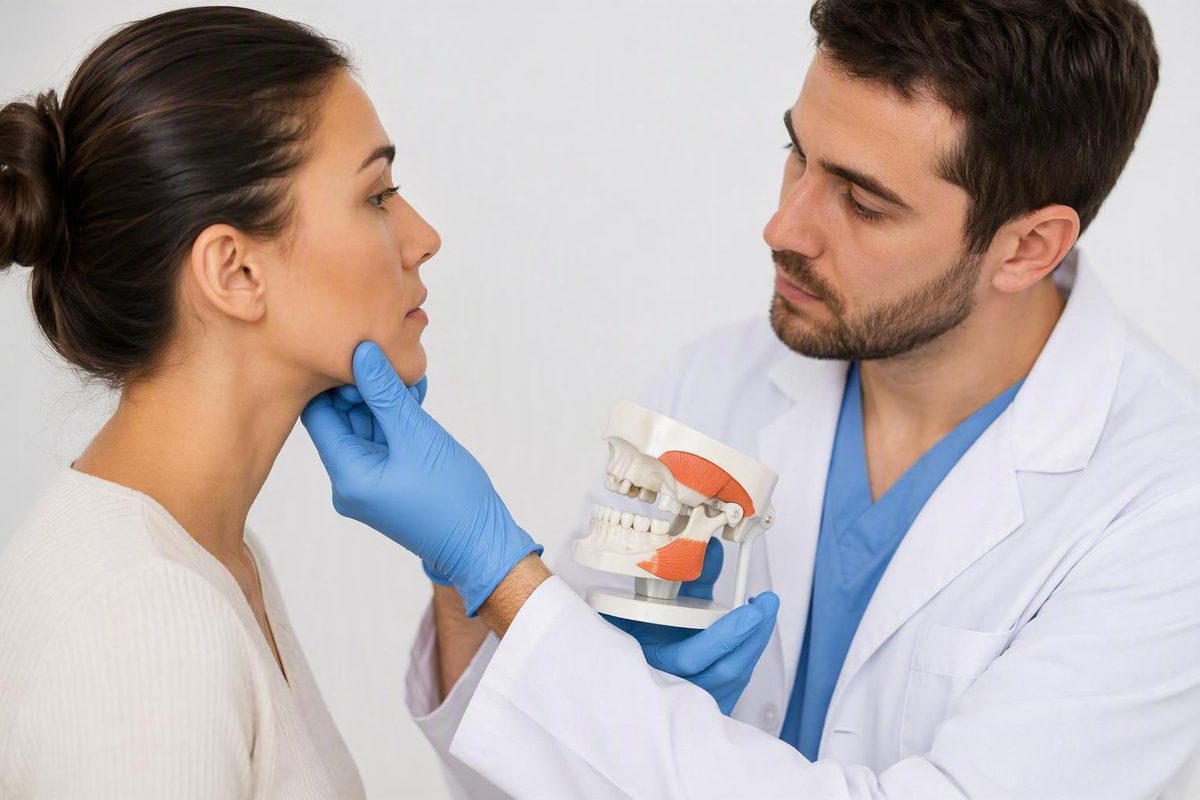
The short answer: start with a dentist or orthodontist in most nonurgent cases
If you are unsure why your jaw feels or looks misaligned, a general dentist is a practical first contact. A dentist can examine your teeth, oral health, bite, and jaw, consider common dental causes, and arrange a referral when specialist assessment is needed. Veranda Dentistry’s overview of dentists, orthodontists, and oral surgeons describes this general-dentist referral role.
You can also start directly with an orthodontist when your main concern is a longstanding overbite, underbite, crossbite, crowded teeth, uneven bite, or teeth that do not meet correctly. Orthodontists evaluate tooth position and bite relationships and may use braces, clear aligners, or other orthodontic appliances when nonsurgical treatment is appropriate.
An oral and maxillofacial surgeon may become involved if the examination suggests a substantial jawbone discrepancy, facial or jaw deformity, facial trauma, or a possible need for corrective jaw surgery. You do not have to determine by yourself whether the problem is “orthodontic” or “surgical.” An orthodontist can assess the bite and request a surgical consultation if moving the teeth alone is unlikely to address the underlying jaw relationship. Markham Orthodontics explains the distinction between nonsurgical orthodontic alignment and surgery involving the mouth, jaws, and face.
There is no mandatory first clinician for every jaw concern. The appropriate route depends on whether the change is longstanding or sudden, whether pain or locking is present, whether the concern appears dental or skeletal, and whether there has been an injury.
A useful starting guide is:
- Cause unclear or possible dental problem: general dentist.
- Longstanding bite or tooth-alignment concern: orthodontist or general dentist.
- Marked skeletal asymmetry or possible corrective surgery: orthodontist and oral and maxillofacial surgeon, often working together.
- Persistent or complex jaw-joint or facial pain: general dentist first if routine dental causes have not been assessed, followed when appropriate by a clinician experienced in orofacial pain or temporomandibular disorders.
- Recent trauma, locking, or another urgent concern: prompt clinical assessment rather than a routine alignment consultation.
- Suspected jaw dislocation: immediate medical attention.
This article is educational, not a diagnosis or a substitute for an examination. That limitation is also stated in the site’s educational-use notice.
First identify the type of problem—not just the word “misalignment”
“Misaligned jaw” is an everyday description, not a precise diagnosis. People may use it to describe crooked teeth, an underbite, facial asymmetry, clicking near the ear, pain while chewing, or a bite that suddenly feels different. Those concerns can involve different structures and may call for different clinicians.
Malocclusion means that the upper and lower teeth do not meet correctly when the jaws are closed. An uneven bite may arise from the position of individual teeth, the size or position of the upper and lower jawbones, or a combination of dental and skeletal factors. Examples include an underbite, crossbite, open bite, or another uneven bite relationship. Colgate’s oral-health overview explains the distinction between tooth-related malocclusion and an underlying jaw-alignment problem.
The distinction matters because moving teeth is not the same as repositioning adult jawbones:
- A dental alignment problem primarily involves the position or angle of the teeth. Crowded, crooked, rotated, or spaced teeth may affect how the bite fits together.
- A skeletal discrepancy primarily involves the size, shape, or relative position of the upper and lower jawbones. One jaw may sit substantially forward, backward, or to one side relative to the other.
- A mixed problem has both dental and skeletal components.
- A joint or muscular problem involves the temporomandibular joints, chewing muscles, or related tissues and may cause pain or restricted movement without establishing a skeletal discrepancy.
- A traumatic problem follows an injury and may involve the teeth, bone, joint, or surrounding tissues.
Orthodontic appliances can reposition teeth and improve many bite relationships. They should not be assumed to correct a substantial adult skeletal discrepancy. If jawbone size or position appears to be the main issue, an orthodontist may recommend evaluation by an oral and maxillofacial surgeon.
Jaw-joint symptoms require separate consideration. The temporomandibular joints are located near the ears and allow the lower jaw to move. Temporomandibular disorders can involve the joints and surrounding muscles. Pain, clicking, headaches, chewing difficulty, or limited movement may occur for several reasons; none of these symptoms alone proves that the upper and lower jawbones are structurally misaligned. Penn Dental Medicine’s patient guide likewise describes jaw and facial pain as requiring consideration of multiple possible causes. Its TMJ overview discusses symptoms and potential contributing factors.
Timing can help a clinician understand the problem, although timing alone does not establish a diagnosis:
- Longstanding concerns, such as an underbite present since adolescence, chronically crowded teeth, or gradually developed facial asymmetry, may be appropriate for an orthodontic evaluation.
- A sudden bite change after a blow, fall, sports injury, or other facial trauma requires prompt clinical attention rather than treatment as an ordinary elective orthodontic concern.
- Intermittent clicking without pain or restriction does not by itself establish a structural problem requiring correction.
- Persistent pain, locking, or limited movement may justify assessment beyond a routine tooth-and-bite examination.
Consider three examples:
- Someone whose lower teeth have always sat in front of the upper teeth may have an underbite involving the teeth, jawbones, or both. An orthodontist can assess the relationship and decide whether surgical input is appropriate.
- Someone with a normal-looking bite but pain and clicking near one ear may have a joint, muscular, dental, traumatic, or other pain problem. Those symptoms do not automatically mean the jawbones need realignment.
- Someone whose teeth stopped meeting normally immediately after being struck in the face may have an injury and needs timely clinical evaluation, not simply a consultation about braces.
The goal is not to diagnose yourself. It is to describe what you notice, when it began, whether it changed, and whether pain, locking, restricted movement, or trauma is involved.
What each type of clinician does
Several clinicians may participate in jaw and bite care. Their roles overlap, but they are not interchangeable.
General dentist
A general dentist is a reasonable first contact when the cause is uncertain. The dentist may:
- Examine the teeth, gums, mouth, bite, and jaw.
- Consider tooth decay, dental damage, infection, wear, or other oral explanations for pain.
- Ask about grinding, clenching, previous dental treatment, and facial injury.
- Observe jaw movement and check for tenderness or restriction.
- Determine whether the next step should involve orthodontics, oral and maxillofacial surgery, or pain- or joint-focused assessment.
Starting with a general dentist does not mean the dentist will personally provide every treatment. Their role may be to identify the likely category of problem and coordinate an appropriate referral.
Orthodontist
An orthodontist evaluates tooth position, bite relationships, and how the teeth and jaws relate. When appropriate, treatment may involve braces, clear aligners, or other orthodontic appliances.
An orthodontist is a particularly logical first choice when the main concern is:
- Crowded or crooked teeth.
- An overbite, underbite, crossbite, or open bite.
- A longstanding uneven bite.
- Teeth that do not contact as expected.
- Relapse after previous orthodontic treatment.
- Uncertainty about whether a visible jaw difference is dental, skeletal, or mixed.
Orthodontists may also help plan complex surgical cases. They can position the teeth so the bite can fit after surgical repositioning and refine tooth positions afterward.
Oral and maxillofacial surgeon
An oral and maxillofacial surgeon evaluates surgical conditions involving the jaws, mouth, face, and related structures. In the context of a suspected alignment problem, possible reasons for consultation include:
- A substantial skeletal jaw discrepancy.
- Facial or jaw deformity.
- Jaw or facial trauma.
- A suspected structural joint problem or persistent mechanical locking.
- Consideration of orthognathic, or corrective jaw, surgery.
A surgical consultation does not commit you to surgery. Its purpose may be to determine whether there is a surgically relevant structural problem, explain what surgery could and could not change, discuss alternatives, or conclude that nonsurgical care or observation is more appropriate.
Orofacial pain or temporomandibular-disorder clinician
For persistent or complex jaw-joint, facial, or chewing-muscle pain—particularly after routine dental causes have been assessed—a clinician experienced in orofacial pain or temporomandibular disorders may be appropriate. The evaluation may focus on pain, muscles, jaw function, and potential non-dental causes rather than on straightening teeth or repositioning jawbones.
“TMJ specialist” can be an imprecise label. Provider titles, postgraduate training, and the availability of clinicians with focused experience vary. Rather than relying on a title alone, ask:
- What postgraduate training do you have in orofacial pain or temporomandibular disorders?
- How often do you assess cases like mine?
- How do you distinguish dental, joint, muscular, traumatic, and skeletal causes?
- Which other clinicians do you coordinate with?
- Which proposed treatments are reversible?
- What findings would justify an irreversible procedure?
Avenue Dental Care’s provider-selection article also advises considering relevant education and experience because different kinds of professionals may participate in TMJ-related care. Its guide describes several possible provider backgrounds.
A symptom-based guide to where you should go
This guide can help you choose a first appointment without assuming that symptoms alone reveal the cause.
| What you notice | Reasonable first step | Possible next step |
|---|---|---|
| The cause is unclear or there may be tooth-related pain | General dentist | Orthodontist, oral and maxillofacial surgeon, or orofacial pain clinician, depending on findings |
| Longstanding overbite, underbite, crossbite, crowding, or uneven bite | Orthodontist or general dentist | Surgical consultation if a substantial skeletal problem is identified |
| Marked facial asymmetry or a jaw that appears substantially forward, backward, or uneven | Orthodontist | Oral and maxillofacial surgeon if the concern appears skeletal |
| Persistent pain, clicking, locking, or restricted movement after routine dental assessment | Clinician experienced in orofacial pain or temporomandibular disorders | Surgical assessment if a structural problem or persistent locking is suspected |
| Bite changed after facial trauma | Prompt medical, dental, or oral and maxillofacial assessment | Injury-specific care |
| Suspected jaw dislocation | Immediate medical attention | Emergency or specialist management |
When the problem is vague
If you cannot tell whether discomfort comes from a tooth, joint, or muscle, begin with a general dentist. This is particularly sensible if you have not had a recent dental examination or the pain seems concentrated around a particular tooth. A dental assessment can consider oral causes before the problem is attributed to “TMJ” or skeletal alignment.
When the bite has been uneven for years
An orthodontist is a reasonable direct starting point for a longstanding bite concern. The orthodontist can assess how the teeth contact, whether tooth positions contribute to the problem, and whether the discrepancy appears dental, skeletal, or mixed.
Do not assume that a noticeable underbite, overbite, or asymmetry automatically means surgery. Treatment depends on the individual anatomy, severity, functional effects, goals, and realistic limits of nonsurgical care.
When the jaw or face appears substantially asymmetrical
An orthodontic assessment can examine how facial symmetry, jaw position, tooth position, and the bite relate. If the difference appears to arise mainly from the jawbones, an oral and maxillofacial surgery consultation may follow. Complex skeletal cases may be evaluated collaboratively rather than by treating orthodontics and surgery as unrelated choices.
When pain, clicking, or restricted movement is the main concern
Start with a dental assessment if routine dental causes have not been considered. If pain, locking, or limited movement persists, a clinician experienced in orofacial pain or temporomandibular disorders may be appropriate. An oral and maxillofacial surgeon may also become involved when examination suggests trauma, deformity, a structural joint problem, or persistent mechanical locking. Gnathos Facial Surgery’s overview describes dental, pain-focused, imaging, and surgical roles in TMJ assessment.
A painless click alone is not necessarily an emergency, and occasional clicking does not automatically require bite correction. Its importance depends on the broader clinical picture, including pain, function, restriction, onset, trauma, and examination findings.
When prompt or immediate care is appropriate
Seek prompt clinical attention for:
- Jaw locking.
- A jaw or bite problem following trauma.
- Jaw pain accompanied by fever.
Because the evidence supplied for those prompt-care signs is an educational site notice rather than an independent clinical guideline, it should not be treated as an exhaustive triage rule. If you are uncertain about urgency, seek direct clinical advice rather than relying on an online list.
A suspected jaw dislocation warrants immediate medical attention, not a routine orthodontic appointment. Do not delay emergency assessment while trying to determine the precise diagnosis yourself. Lane & Associates’ jaw-problem overview advises immediate medical attention when dislocation is suspected.
This does not mean that every click, uneven bite, or painless asymmetry is urgent. The supported urgent distinctions concern locking, trauma, pain with fever, and suspected dislocation.
What to expect at a jaw and bite evaluation
A thoughtful assessment begins with the history of the concern. The clinician may ask:
- When did you first notice the bite or jaw difference?
- Has it always been present, developed gradually, or appeared suddenly?
- Did it begin after a fall, blow, dental procedure, or other injury?
- Has the way your teeth meet changed?
- Where is any pain located, and what triggers it?
- Does the jaw click, pop, catch, or lock?
- Is opening or closing restricted?
- Is chewing difficult or tiring?
- Have you previously had braces, aligners, extractions, crowns, dentures, or jaw treatment?
- Do you grind or clench your teeth?
- Are there speech or sleep concerns relevant to the history?
These questions help distinguish a stable alignment difference from a recent change and a primarily dental issue from a joint, muscular, skeletal, or traumatic concern.
The physical examination may include:
- Visual inspection of the face and mouth.
- Assessment of facial balance or asymmetry.
- Examination of the teeth and oral health.
- Observation of how the upper and lower teeth meet.
- Observation of jaw opening and side-to-side movement.
- Gentle palpation of the jaw joints and chewing muscles for tenderness.
- Observation of clicking, deviation, or restricted movement.
- Assessment of how the teeth, jaws, bite, and surrounding facial structures relate.
A dentist may emphasize oral and dental causes. An orthodontist may focus on tooth position and bite relationships. A pain-focused clinician may spend more time assessing tenderness, movement patterns, and symptom triggers. A surgeon may concentrate on skeletal relationships, trauma, deformity, or a suspected structural joint problem. A dental jaw examination can include visual inspection, palpation, range-of-motion testing, and imaging when appropriate. Lane & Associates describes these possible examination components.
Imaging is not automatic. Depending on the clinical question, possible options include dental X-rays, cone-beam computed tomography for bone detail, or magnetic resonance imaging for the joint disc and other soft tissues.
A straightforward tooth-position concern may not require the same imaging as trauma, persistent locking, or a suspected skeletal discrepancy.
Before treatment is proposed, the evaluation should answer—or at least narrow down—several questions:
- Is the concern primarily dental, skeletal, joint-related, muscular, traumatic, or mixed?
- Is it stable, progressing, or newly changed?
- Is treatment being considered for symptoms, function, dental health, appearance, or a combination?
- Would observation be reasonable?
- Which clinician is best suited to manage the identified problem?
- Would additional information meaningfully change the decision?
A careful clinician should acknowledge uncertainty. Jaw pain and bite concerns can involve overlapping structures, and a visible difference is not necessarily the source of the symptoms.
When orthodontics may be enough—and when surgery may enter the discussion
Braces, clear aligners, and other orthodontic appliances reposition teeth. They can correct many dental alignment problems and improve some bite relationships. If the discrepancy is primarily dental, orthodontic treatment may be sufficient.
A substantial skeletal discrepancy is different. Moving teeth does not necessarily correct the underlying position of adult jawbones. Orthodontics may sometimes change tooth positions to improve aspects of a skeletal bite, but whether that approach is appropriate depends on the anatomy, function, goals, and limits of tooth movement.
Corrective jaw surgery, also called orthognathic surgery, repositions one or both jaws. It may be considered when a skeletal discrepancy creates a significant bite, facial, or functional problem that orthodontics alone cannot adequately address. The Florida Center for Oral & Maxillofacial Surgery distinguishes orthodontic tooth movement from surgical repositioning for skeletal malocclusion.
For some surgical cases, care follows a coordinated sequence:
- Presurgical orthodontics: The orthodontist positions the teeth so they can fit appropriately after the jawbones are repositioned.
- Surgery: The oral and maxillofacial surgeon repositions the relevant jawbone or jawbones according to the shared plan.
- Postsurgical orthodontics: The orthodontist refines the bite and tooth positions as healing progresses.
This collaboration means orthodontics and surgery are not always competing alternatives. Each may address a different part of a mixed dental and skeletal problem.
Surgery is not inevitable simply because a jaw looks uneven or the bite is imperfect. Some mild or symptom-free differences may not require treatment. Others may be managed with orthodontics, dental care, symptom-focused care, or observation. A suspected skeletal discrepancy is a reason for assessment, not a conclusion about treatment.
Different interventions also have different goals:
- Orthodontics changes tooth position and may improve the bite.
- Corrective jaw surgery changes jawbone position.
- Pain-focused care may seek to reduce symptoms or improve movement without changing skeletal alignment.
- Cosmetic dental procedures may change the visible shape or appearance of teeth without correcting the underlying relationship between the jawbones.
Colgate’s treatment overview likewise notes that cosmetic changes to the teeth do not correct an underlying jaw-alignment problem and that some mild or symptom-free cases may not require treatment. Its patient guide outlines orthodontic, surgical, cosmetic, and observation considerations.
If surgery is proposed, ask what anatomical finding makes it worth considering, what orthodontics alone could and could not accomplish, what alternatives exist, and what risks and recovery demands apply to your case. Corrective jaw surgery should not be described as quick, routine, inevitable, or universally effective.
How to prepare for the appointment and make a careful treatment decision
Before the appointment, write down:
- When you first noticed the concern.
- Whether it developed gradually or appeared suddenly.
- Whether your bite changed.
- Any previous facial or jaw trauma.
- The location, timing, and triggers of pain.
- Clicking, popping, catching, or locking.
- Difficulty opening or closing the mouth.
- Changes in chewing or speech.
- Sleep concerns you believe may be relevant.
- Previous dental, orthodontic, or jaw treatment.
- Whether symptoms change with chewing, clenching, or stress.
- Which outcome matters most to you: comfort, function, dental health, appearance, or a combination.
If you have previous dental records, orthodontic records, photographs, or imaging, ask whether the clinic would like them transferred. Older information may help show whether a bite or facial difference has changed, but the new clinician must decide whether it is current enough and whether additional imaging would be useful.
During the consultation, ask the clinician to explain the evidence for the working diagnosis:
- Which findings suggest that the problem is dental, skeletal, joint-related, muscular, traumatic, or mixed?
- Is the visible asymmetry likely to be related to the symptoms, or could these be separate concerns?
- Does the condition appear stable?
- What would happen if I chose observation for now?
- What would additional imaging show?
- Would imaging change the treatment plan?
- Which parts of the proposed treatment are reversible?
- What exactly is each treatment intended to change?
- Is the goal symptom relief, tooth movement, jawbone repositioning, appearance, or several of these?
- What alternatives are reasonable?
When symptoms are mild or absent, ask whether observation is appropriate. A measurable bite difference does not automatically mean treatment is necessary. Any intervention should have a clear expected benefit that matters to you.
Be cautious when one treatment is presented as the answer to several loosely related symptoms without a clear explanation of cause.
If orthodontics and surgery are proposed together, clarify coordination:
- Who is leading the overall plan?
- Which orthodontist and surgeon will communicate with each other?
- What must happen before surgery?
- How will the bite be managed afterward?
- What happens if the plan changes during orthodontic treatment?
- Who will assess pain or joint symptoms that may not be explained by the skeletal discrepancy?
Coordinated orthodontic and surgical care may include tooth alignment before surgery, jaw repositioning by an oral and maxillofacial surgeon, and orthodontic refinement afterward. The Florida Center for Oral & Maxillofacial Surgery describes this collaborative pathway.
A second opinion is a prudent consideration before irreversible bite alteration, invasive joint treatment, or corrective jaw surgery. It is not required for every dental decision, but it can be useful when the diagnosis is uncertain, treatment is extensive, or clinicians offer conflicting explanations.
Be cautious about claims that a proprietary appliance can reliably remodel an adult jaw, cure unrelated symptoms, or guarantee that surgery will be avoided. Ask the provider to separate what the treatment can physically change from what it is hoped—but not guaranteed—to improve.
Should I see a dentist or orthodontist first for a misaligned jaw?
If the cause is unclear, a general dentist is a reasonable first contact. The dentist can examine your teeth, oral health, bite, and jaw and refer you if specialist assessment is needed.
If the main concern is a longstanding overbite, underbite, crossbite, crowded teeth, or uneven bite, you can book an orthodontist directly. If the examination suggests a significant skeletal discrepancy, an oral and maxillofacial surgeon may join the care team. Veranda Dentistry summarizes these general dentist, orthodontist, and oral-surgeon roles.
Does jaw clicking or pain mean my jaw is structurally misaligned?
No. Clicking or pain may involve the jaw joint, chewing muscles, teeth, trauma, or another cause. These symptoms alone do not prove that the jawbones are structurally misaligned.
Occasional clicking without pain or restricted movement is not automatically an emergency. Persistent pain, locking, or limited movement should be assessed. Depending on the findings, care may involve a dentist, an orofacial pain clinician, a provider experienced in temporomandibular disorders, or an oral and maxillofacial surgeon. Penn Dental Medicine describes the range of symptoms and possible contributors that may need consideration.
Can braces or clear aligners fix jaw misalignment without surgery?
They can reposition teeth and correct many dental bite problems. They may improve some bite relationships without surgery, but they do not necessarily reposition a substantial adult skeletal jaw discrepancy.
If jawbone size or position is the main problem, orthodontics alone may not fully correct it. Some cases require coordinated assessment by an orthodontist and oral and maxillofacial surgeon, while others may be treated nonsurgically or not treated at all. Markham Orthodontics explains the differing nonsurgical and surgical roles.
Can a mild or painless misalignment be left untreated?
Sometimes. A mild or symptom-free alignment difference may not require treatment, particularly when it is stable and is not creating a meaningful functional or dental problem.
When does a jaw problem need prompt or immediate attention?
Seek prompt clinical attention for jaw locking, a jaw or bite problem after trauma, or jaw pain accompanied by fever. A sudden bite change following facial trauma should not be treated as a routine orthodontic concern.
Seek immediate medical attention if you suspect a jaw dislocation.
For most nonurgent concerns, the practical route is straightforward: start with a general dentist when the cause is unclear or an orthodontist when the main issue is a longstanding bite or tooth-alignment problem. A substantial skeletal discrepancy, facial deformity, trauma, or possible need for corrective surgery may bring an oral and maxillofacial surgeon into the care team, while persistent complex joint or facial pain may warrant orofacial-pain or temporomandibular-disorder experience.