
8 Things That Can Make TMJ Pain Worse
Clenching, gum, tough food, wide opening and some appliances can aggravate TMJ pain. Learn what to change temporarily and when to seek care.
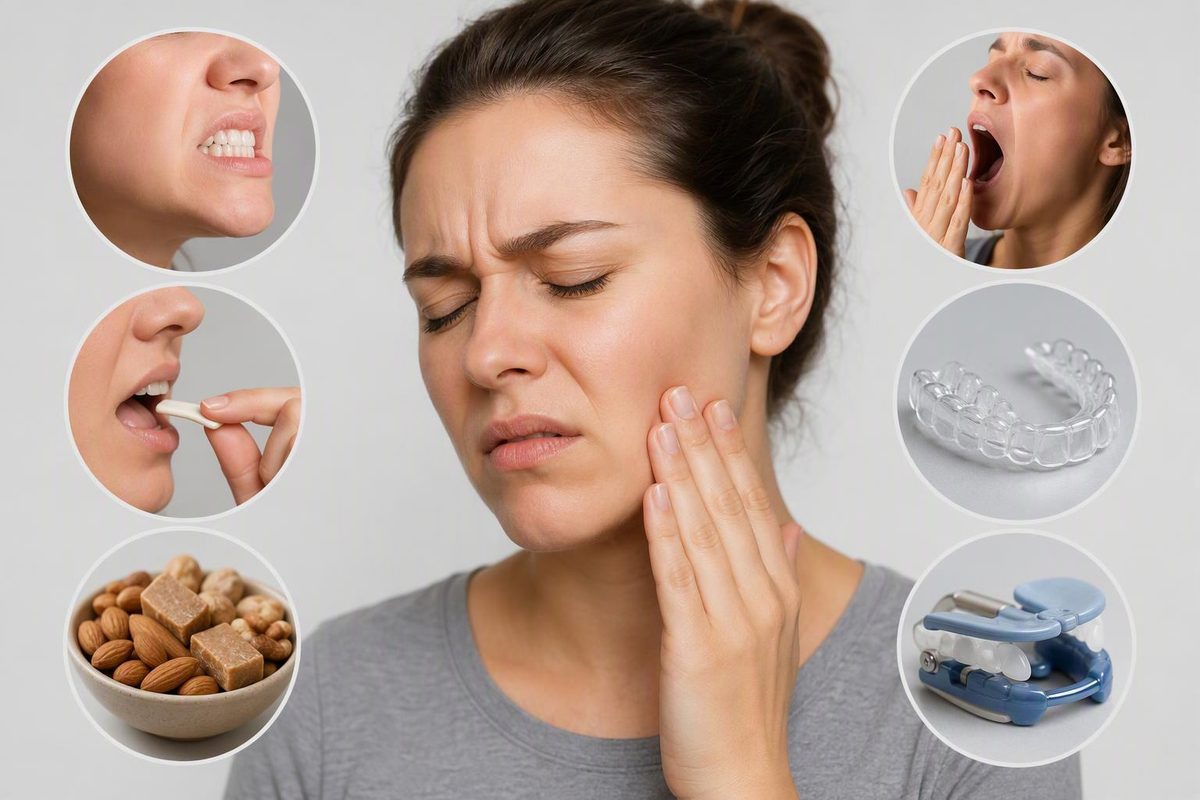
“TMJ” is the jaw joint; temporomandibular disorders (TMDs) are conditions affecting that joint, the chewing muscles or both. Everyday behaviors can aggravate TMD symptoms, but pain after an activity does not prove the joint is being damaged—or confirm that TMD is the cause. Dental, ear and other facial pain can feel similar.
1. Clenching, grinding or bracing your jaw
Clenching means pressing the teeth together. Jaw bracing is subtler: holding the jaw muscles tense even when the teeth do not touch. Both can keep already-sensitive chewing muscles working.
Clenching or grinding does not explain every case of TMD, but it can aggravate symptoms. Leeds Teaching Hospitals says bruxism may make TMD worse, while the US National Institute of Dental and Craniofacial Research (NIDCR) includes reducing clenching in conservative care (Leeds Teaching Hospitals; NIDCR).
Try instead: When you are not eating or swallowing, let your lips meet gently while keeping your teeth slightly apart. A phone reminder can help you notice daytime tension without repeatedly testing your jaw.
2. Chewing gum and biting objects
Gum creates prolonged, repetitive work for the chewing muscles. Nail biting, chewing pens and holding objects between the teeth add similar loading. NIDCR and NHS guidance advise reducing these habits during TMD self-management (NIDCR; NHS).
This does not mean that a piece of gum causes a jaw disorder. Repetitive chewing may simply provoke pain when the jaw is already irritable.
3. Hard, sticky or very chewy food during a flare
Bagels, tough meat, hard candy and sticky sweets demand more force or prolonged chewing. Large sandwiches can combine force with wide opening. If eating predictably increases pain, temporarily choose softer foods and cut food into smaller pieces.
Do not assume the jaw needs permanent rest. Newcastle Hospitals advises returning toward normal eating once pain decreases, or reconsidering the approach if there is no improvement within two to four weeks. Prolonged restriction may reduce jaw-muscle fitness and unnecessarily narrow the diet (Newcastle Hospitals).
4. Opening too wide
A large yawn, oversized bite or prolonged mouth opening can provoke a sensitive joint or strained muscles. The NHS advises avoiding very wide yawning during a painful episode (NHS). Take smaller bites and mention current jaw pain before a long dental procedure so the dental team can consider breaks.
Do not force a restricted jaw open or repeatedly test its maximum range. Exercises may help when selected for the specific problem, but do not push through a movement that causes sharp pain or new locking.
5. Stress-related muscle tension
Stress does not make pain imaginary, and it is rarely the sole explanation. It can accompany clenching, jaw bracing and increased attention to pain. Relaxation and behavioral approaches are among the conservative options described by NIDCR (NIDCR).
Look for the behavior that accompanies stress: teeth touching while working, a rigid jaw, raised shoulders or breath-holding. Addressing that pattern is more concrete than simply trying to “stress less.”
6. Poor sleep and being run down
Pain and poor sleep can reinforce one another. Leeds Teaching Hospitals notes that people may find symptoms worse when sleeping badly, run down or unwell (Leeds Teaching Hospitals). A regular sleep routine may support overall pain management, but waking with jaw pain does not by itself prove nighttime grinding. Sleep bruxism and TMD are related but not interchangeable.
7. A mouthguard or splint that increases pain
An appliance should not be endured simply because it was sold as a TMJ treatment. NIDCR says evidence that intraoral appliances improve TMD pain is limited and advises stopping use and consulting the prescribing dentist or doctor if one causes pain (NIDCR).
New pain, pressure on only a few teeth, a bite that remains changed after removing the device, or worsening jaw function warrants a review. The Royal College of Surgeons of England guideline says some soft and part-coverage splints can change the bite or aggravate joint pain; it recommends professional review of fit, bite stability and tolerability (RCS England). Do not grind down or repeatedly remould an appliance at home. Splints differ in purpose and risk.
8. Bite-changing treatment before the problem is clear
Grinding down teeth, placing crowns solely for TMD or using orthodontics as a presumed cure can have permanent consequences. NIDCR says evidence does not support a strong link between a misaligned bite and TMD, and that treatments intended to change the bite may make the problem worse in some cases (NIDCR). Conservative, reversible care is generally the safer starting point.
A practical reset during a flare
For several days, reduce gum, nail biting, tough food and unusually wide opening. Check for daytime clenching, keep the teeth apart at rest and use only gentle exercises recommended for your situation. Track pain alongside eating, mouth opening and sleep; changes in function can show whether the plan is helping. See the fuller guide to managing a TMJ flare-up.
Seek urgent clinical care if you cannot eat or drink, your jaw locks, mouth opening suddenly becomes severely limited, or fever occurs with facial swelling. Pain after a serious facial or jaw injury also needs emergency assessment. Call emergency services or go to an emergency department now if swelling makes it hard to breathe, speak or swallow (RCS England; NHS; NHS emergency dental guidance).
Otherwise, arrange an evaluation if symptoms are escalating, repeatedly returning or not improving with short-term adjustments. A dentist or medical clinician may need to check for dental infection, injury or another cause rather than assuming all jaw pain is TMD.