
Can TMJ Cause Tinnitus? TMD May Contribute
TMD may contribute when tinnitus changes with jaw movement and accompanies jaw, head or neck symptoms; evidence shows association, not individual causation.
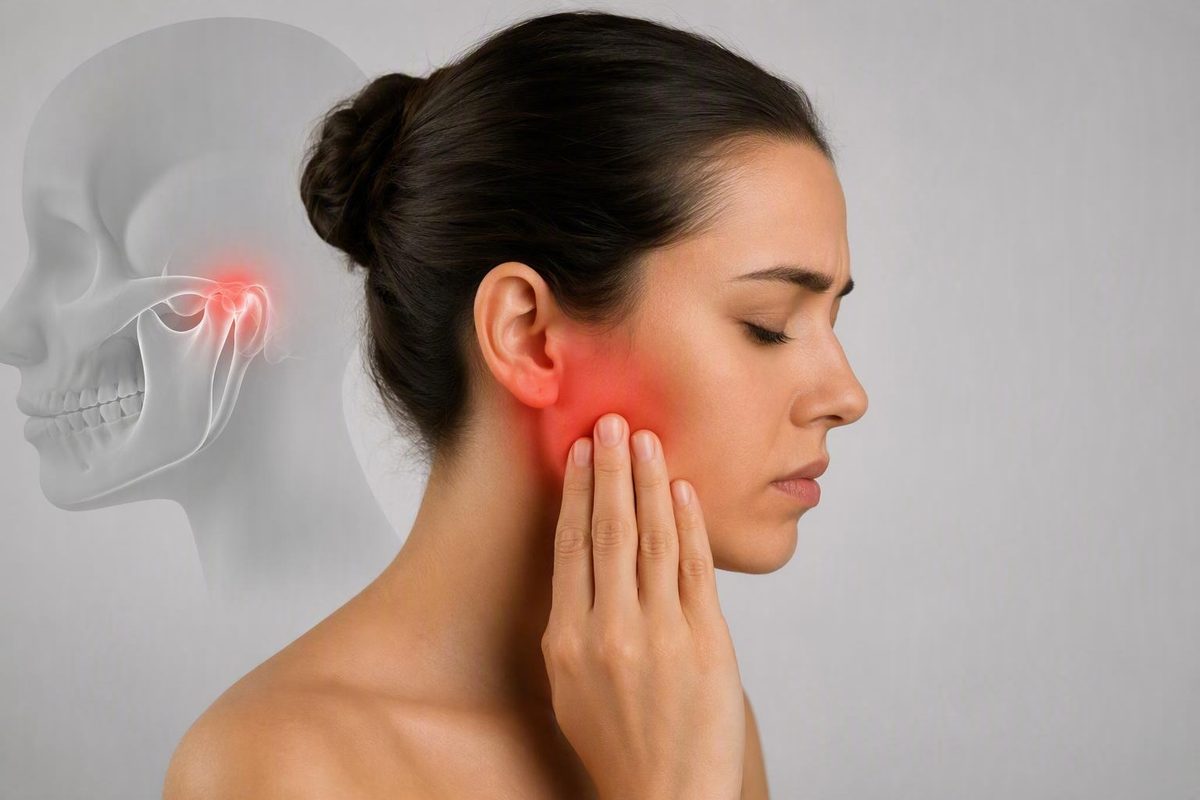
Temporomandibular disorders can occur alongside tinnitus and may contribute to ringing or other phantom sounds in some people, particularly when the tinnitus changes with jaw movement and accompanies jaw, head, or neck symptoms. However, current evidence shows an association rather than proving that TMD directly caused an individual’s tinnitus. Overlapping symptoms should be assessed by a doctor or dentist instead of automatically being attributed to the jaw. A 2019 observational study describes the association and its limits.
The short answer: TMD and tinnitus can be related
Although “TMJ” and “TMD” are often used interchangeably, they have different meanings:
- TMJ is the temporomandibular joint connecting the lower jaw to the skull.
- TMD refers to disorders affecting that joint, the chewing muscles, and related structures.
The National Institute of Dental and Craniofacial Research (NIDCR) lists ringing in the ears among the possible symptoms of TMD. Other possible symptoms include jaw or chewing-muscle pain, stiffness, restricted movement, locking, and painful joint sounds. NIDCR also notes that TMD can be difficult to diagnose because its symptoms overlap with those of other conditions, no widely accepted definitive test covers every case, and the exact cause of many cases remains unclear. See NIDCR’s overview of TMD symptoms and diagnosis.
Tinnitus alone therefore does not establish a TMD diagnosis. Ear, hearing, facial, and jaw symptoms can have other explanations, so a broader clinical assessment may be needed even when the symptoms occur together.
What research says about the connection
A 2019 observational study examined people who already had tinnitus. Researchers compared 486 participants reporting TMJ-area complaints with 1,996 who did not report those complaints. TMJ complaints were reported by 19% of the tinnitus cohort overall and by 36% of participants classified as having severe tinnitus. Participants with TMJ complaints also more often reported severe or stress-sensitive tinnitus, tinnitus that changed with bodily input, sensitivity to loud sounds, headache, neck pain, dizziness or vertigo, and sound intolerance. The researchers discussed nerve connections involving the jaw region and auditory pathways as a possible basis for this interaction. Read the peer-reviewed observational study.
Those figures require careful interpretation. They describe self-reported TMJ-area complaints among people who already had tinnitus. They are not estimates of clinically confirmed TMD prevalence in the general population, and they do not establish that a jaw disorder caused the participants’ tinnitus.
The evidence is best understood at three levels:
- Observed association: Self-reported TMJ-area complaints were present in a defined portion of the tinnitus cohort and were more common among participants with severe tinnitus.
- Plausible interaction: Sensory and nerve connections involving the jaw region and auditory pathways could allow jaw or muscle input to affect tinnitus.
- Unproven individual causation: Neither the observed association nor the proposed mechanism can establish why a particular person has tinnitus.
Shared influences may also contribute to the overlap. This makes a simple one-way explanation less likely in some cases.
Clues that the jaw may be contributing
This type of change is often described as somatic modulation. It suggests that sensory or muscular input may be interacting with the tinnitus signal, but it is not a diagnostic test.
Accompanying symptoms that support assessing the jaw include:
- Pain or tenderness around the jaw joints or chewing muscles
- Jaw stiffness or restricted movement
- Locking or catching
- Painful clicking, popping, or grinding
- Headache or neck pain occurring with jaw symptoms
- Clenching associated with jaw soreness or a change in tinnitus
Headache and neck pain are not specific to TMD. They can add context when they occur with clear jaw symptoms, but they cannot identify the cause by themselves. The observational study found modulation, headache, and neck pain more frequently among participants reporting TMJ complaints, while NIDCR includes pain, stiffness, restricted movement, locking, and painful joint sounds among possible TMD symptoms.
| Symptom pattern | What it may mean | Practical next step |
|---|---|---|
| Tinnitus changes with jaw input and jaw symptoms are present | A TMD or somatosensory component is worth assessing | Discuss both symptom groups with a doctor or dentist |
| Tinnitus occurs without jaw pain, restricted movement, locking, or modulation | The jaw should not automatically be assumed to be responsible | Seek a broader assessment of the tinnitus |
| Clicking or popping occurs without pain or impaired function | Painless clicking is common and generally does not require treatment | Avoid treating the sound alone |
A clinician can interpret any naturally noticed changes alongside the full symptom history and physical examination.
How suspected TMD is evaluated
There is no single widely accepted test that definitively identifies every case of TMD. Diagnosis can be difficult because jaw pain, facial discomfort, ear symptoms, headache, and restricted movement can overlap with other conditions.
An evaluation generally begins with a review of:
- Where and when symptoms occur
- Jaw pain, stiffness, locking, and functional limitations
- The tinnitus characteristics and whether ordinary jaw movement changes them
- Clenching, chewing, and other factors associated with symptom changes
- Relevant medical and dental history
A doctor or dentist may then examine the head, neck, face, jaw joints, and chewing muscles. The examination may include observing how the jaw opens and closes, assessing its movement, and checking for painful areas.
X-rays, MRI, or CT imaging may be ordered selectively when the history and examination indicate that imaging could answer a particular clinical question. Imaging is not automatically required for everyone with tinnitus or jaw symptoms, and no scan can universally determine whether the jaw caused tinnitus. NIDCR describes symptom history, physical examination, and selective imaging as possible parts of a clinical evaluation for temporomandibular disorders.
Because tinnitus and ear-area symptoms are not specific to TMD, the assessment may also need to consider other explanations for ear, hearing, facial, or jaw symptoms.
Conservative steps when TMD is suspected
When TMD is identified or reasonably suspected, NIDCR generally favors conservative, reversible care first. Many TMD symptoms may improve without extensive intervention, and evidence supporting several more involved treatments is limited.
Supported initial measures include:
- Temporarily choosing softer foods when chewing is painful
- Reducing or avoiding gum chewing
- Avoiding nail biting and other repetitive jaw habits
- Noticing and reducing daytime clenching
- Using heat or cold with gentle, clinician-appropriate exercises
These steps are intended to reduce jaw strain and manage TMD symptoms. They are not established tinnitus treatments, and the ear noise may remain unchanged even if jaw pain, locking, or movement improves.
Jaw outcomes and tinnitus outcomes should be considered separately. Reduced pain, easier chewing, or better jaw movement does not guarantee that tinnitus will improve. More involved care—such as an oral appliance, medication, injection, or procedure—should depend on an individual assessment rather than on tinnitus alone.
Why treatment should not come with a tinnitus-cure promise
The available evidence does not establish that treating TMD reliably cures or eliminates tinnitus. Even when jaw involvement appears plausible, tinnitus may have several contributing factors or may persist after jaw symptoms improve.
Treating a properly assessed TMD can still have worthwhile goals. Reduced jaw pain, easier chewing, improved movement, and less locking are meaningful outcomes even if the tinnitus remains unchanged.
Tinnitus by itself should not be used to justify irreversible bite-changing procedures or jaw surgery. NIDCR recommends beginning with simpler, reversible approaches and advises against treatments that permanently alter the teeth, bite, or joint unless there is a separate, clearly established clinical indication.
The practical goal is to determine whether a jaw-related component is plausible, identify and manage any genuine TMD, and keep expectations for tinnitus improvement appropriately uncertain.