
Massage Treatment for TMJ Pain: Benefits, Limits, Safety
See when massage may ease muscle-related TMD pain, how to try gentle self-massage, what research shows, and which warning signs require prompt care.
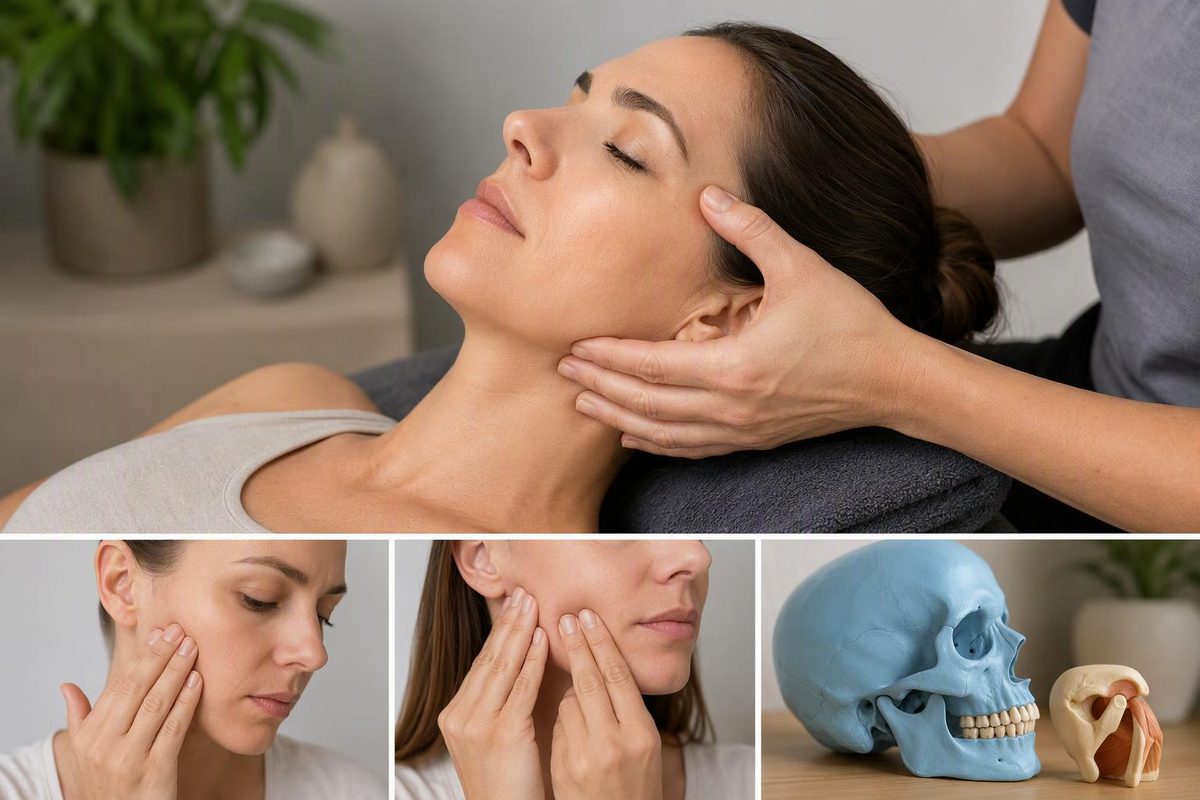
Massage can be a reasonable, non-invasive part of care when jaw pain has a muscular component. It may reduce pain or make movement easier, but it cannot “put the TMJ back in place,” repair joint damage or establish what is causing the pain.
TMJ is the temporomandibular joint; TMD is the group of disorders affecting the jaw joints, chewing muscles or both. Massage is more likely to be relevant to aching, tender chewing muscles than to a locked jaw, dental infection or recent injury.
Check your symptom pattern; the result shows whether massage may fit or should wait.
Does Massage Fit This Symptom Pattern?
Choose an answer for each group. This checker cannot identify the cause of jaw pain.
Massage fit is not established
Answer all three groups. If you are unsure about a warning sign, let massage wait until a clinician clarifies it.
Without JavaScript: massage may be reasonable only for a muscular symptom pattern when none of the listed warning signs is present.
Sources: NIDCR guidance on TMD and NHS guidance on dental abscess warning signs.
What the Evidence Supports
Research usually studies massage within the broader category of manual therapy. That category can include pressure on tender muscle points, soft-tissue massage, stretching, joint mobilization and manipulation. Results for the category do not prove that every massage method works equally well.
A 2023 systematic review of 20 randomized trials found that manual therapy had positive effects on TMD pain, mouth opening and disability. However, the average effects were small and might not be clinically important. The treatments varied considerably: only one trial classified its intervention simply as massage, while others tested pressure release, mobilization, manipulation or combined methods (Oliveira et al., 2023).
A separate BMJ evidence review found moderate-certainty evidence that manual trigger-point therapy probably improves pain compared with sham treatment in people whose TMD pain has lasted at least three months. The linked guideline strongly recommended manual trigger-point therapy, therapist-assisted jaw mobilization and supervised jaw exercises for this chronic-pain population. Those findings do not necessarily apply to a new, unexplained jaw problem or to generic relaxation massage (Yao et al., 2023; Busse et al., 2023).
The practical conclusion is modest: targeted massage may help some people, particularly as part of a broader plan, but it is not a universal TMD treatment.
When Massage May Fit
It may be reasonable to discuss massage when symptoms include:
- a dull ache or tightness in the cheeks or temples;
- tenderness over the chewing muscles;
- discomfort that increases with clenching, prolonged talking or chewing; or
- jaw-muscle fatigue without a sudden bite change or injury.
These features can suggest a muscular component, but they do not confirm one. Tooth, ear and jaw-joint problems can feel similar. The National Institute of Dental and Craniofacial Research (NIDCR) notes that there is no single standard test for TMD and that clinicians may need to rule out other causes of mouth, jaw or facial pain (NIDCR).
Massage is unlikely to address the main problem if the jaw is mechanically locked, pain follows significant trauma or symptoms come from an infected or fractured tooth. Painless clicking by itself usually does not require treatment, according to NIDCR.
What Professional Treatment May Include
Hands-on care may involve external soft-tissue work over the masseter muscles at the sides of the jaw and the temporalis muscles at the temples. Depending on the assessment, a practitioner may also use tolerable pressure on tender areas, guided jaw or neck movement, exercise and education about clenching or chewing load.
Some practitioners use intraoral techniques, placing a gloved finger inside the cheek to reach deeper muscles. There should be a clear reason for doing this, along with consent and appropriate hygiene. It should not be marketed as a proprietary “release” that realigns the jaw. See Does Deep Jaw Release Therapy Work for TMJ? for a closer look at those claims.
Massage often makes more sense alongside movement and self-management than as an indefinite stand-alone service. A six-trial review found that manual-therapy benefits appeared to decrease over time, while combining it with therapeutic exercise might help maintain the effects. The small and varied evidence base limits that conclusion (La Touche et al., 2020). TMJ Physical Therapy Techniques explains how manual treatment, exercise and education may fit together.
How to Try Gentle External Self-Massage
If the discomfort feels muscular and none of the warning signs below applies, a gentle external technique avoids the hygiene and technique issues of working inside the mouth:
- Let your teeth separate slightly and relax your lips.
- Briefly clench to locate the firm masseter muscle between the cheekbone and the angle of the jaw, then release the clench.
- With two or three fingertips, make slow, light circles over the relaxed muscle for one to two minutes.
- Use the same gentle circles over the temples.
- Try this two or three times a day only if it feels soothing rather than aggravating.
Leeds Teaching Hospitals advises massage for muscular pain affecting the masseter and temporalis and says it is often best performed two or three times daily (Leeds Teaching Hospitals NHS Trust). Another NHS physiotherapy leaflet describes slow circular massage over the jaw, cheek, temples and forehead for about two to five minutes (Calderdale and Huddersfield NHS Foundation Trust). These are patient instructions, not evidence that more time or pressure produces a better result.
Use comfortable pressure. Do not dig forcefully into the joint just in front of the ear or force the mouth wider. Stop if massage causes sharp pain, more locking, new altered sensation or a lasting increase in symptoms. Have a suitably trained clinician demonstrate any intraoral method before trying it yourself.
Judge Results by Function, Not Just Relaxation
Choose a few outcomes to follow during a short trial:
- pain while chewing;
- ease of eating a normal meal;
- comfortable mouth opening; and
- morning jaw fatigue.
Temporary relaxation can be useful, but it is different from sustained improvement. Reassess the plan if treatment repeatedly causes flares, does not improve function or requires increasingly forceful pressure. A practitioner should be able to explain the goal, how progress will be measured and when treatment will stop or change—not promise permanent realignment.
When Massage Should Wait
Arrange prompt dental or clinical assessment rather than massaging through:
- a jaw locked open or closed, or rapidly worsening restriction;
- pain after facial or jaw trauma;
- fever, facial swelling, drainage or a bad taste in the mouth;
- a new change in how the teeth meet;
- severe or escalating pain; or
- difficulty eating, drinking or speaking.
Fever, facial or jaw swelling, a bad taste and difficulty opening the mouth can occur with a dental abscess, which requires urgent dental treatment. Difficulty breathing or swallowing, or extensive swelling inside the mouth, requires emergency care (NHS). For a broader response to worsening symptoms, see TMJ Flare-Up? What to Do and When to Get Care.
If symptoms persist, limit eating or keep returning, a dentist, physician or clinician experienced in orofacial pain can help clarify what is being treated. When the problem has a muscular component, a physical therapist with TMD experience may combine hands-on care with movement, exercise and a measurable home plan.