
What to Expect When Your Upper Jaw Needs Expansion
Conventional expansion is more predictable during growth. Later adolescents and adults may require different anchorage or surgical assistance.
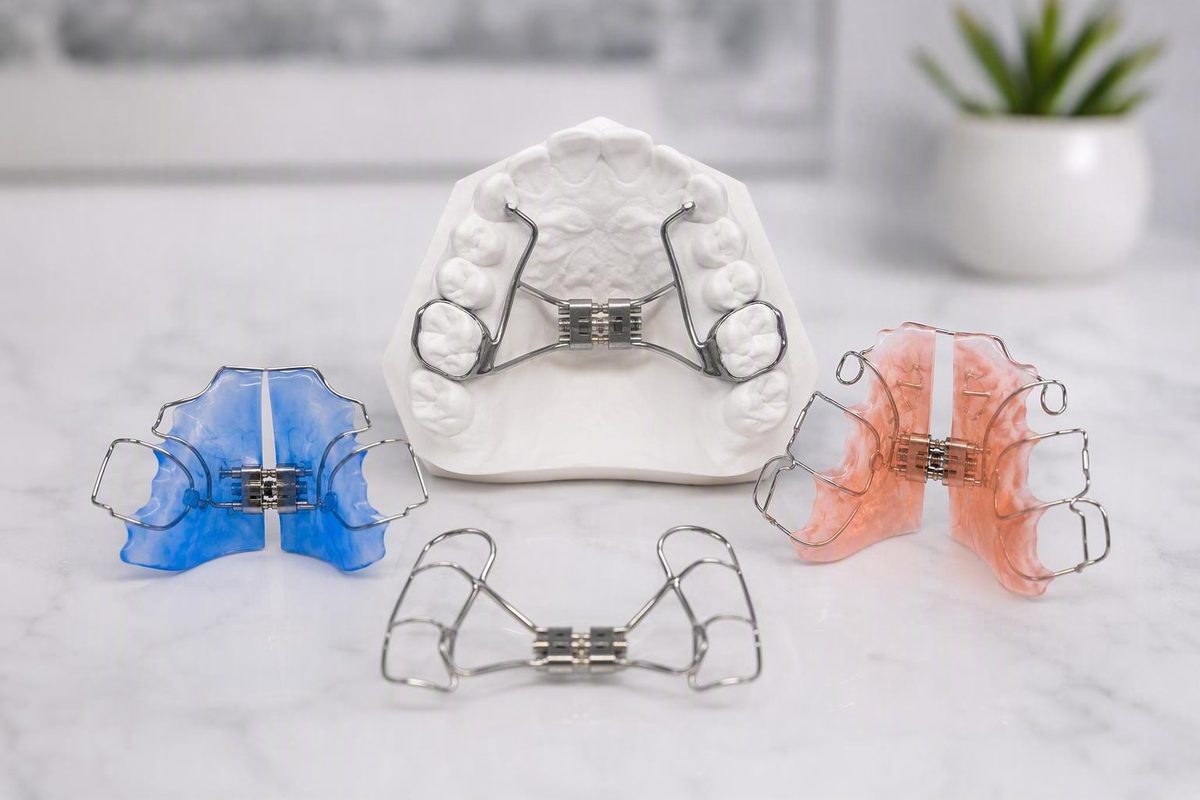
Orthodontists use these appliances to widen a diagnosed narrow upper jaw or upper dental arch.
Expansion may widen the underlying bone, move or tip teeth outward, or produce a combination of skeletal and dental change. Which effect is realistic depends on growth and skeletal maturity, anatomy, appliance design, anchorage, and the orthodontist’s protocol. Crowded teeth alone do not prove that the upper jaw needs expansion.
That distinction affects appliance selection, activation, treatment length, expected results, and risk. Conventional expansion is generally more predictable during growth, while later adolescents and adults may require different anchorage or surgical assistance. There is no universal age cutoff, appliance, or turning schedule that applies to everyone.
What a maxilla expander is—and what it actually changes
The maxilla is the upper jaw. The palate is the roof of the mouth and forms part of that upper-jaw structure. In everyday use, maxillary expander, palatal expander, and palate expander refer to the same broad family of orthodontic appliances.
The aim is to widen a narrow upper jaw or upper dental arch so that the upper and lower arches fit together more appropriately. A conventional fixed expander commonly attaches near the upper back teeth. Its two sides are connected by a central screw that applies lateral force when activated according to an individualized prescription. Fixed and removable designs are available, and the central objective is expansion of the upper arch—not correction of every alignment problem (Cleveland Clinic’s medically reviewed overview).
“Widening” can describe different biological changes:
- Skeletal expansion: widening of the upper-jaw structure, involving the midline region of the palate.
- Dental expansion: outward movement or tipping of teeth within their supporting tissues.
- Mixed expansion: a combination of skeletal widening and dental movement.
Appliance design, age and maturity, anatomy, anchorage to teeth or bone, and the force protocol can change the balance between the two effects.
A useful consultation question—especially for a mature teenager or adult—is: “How much of the anticipated change is expected to be skeletal, and how much is expected to come from moving the teeth?”
Upper-jaw expansion should not be equated with lower-jaw expansion. The upper jaw has a midline sutural region that orthopedic treatment may target. The lower jaw has different anatomy. Appliances used on the lower arch generally produce dental changes such as uprighting or repositioning teeth rather than the same type of nonsurgical skeletal expansion described for the maxilla.
Why an orthodontist may recommend upper-jaw expansion
One of the clearest reasons to evaluate expansion is a posterior crossbite caused by a transverse discrepancy. In plain language, that means the upper and lower arches do not match properly in width, and some upper back teeth bite inside rather than outside the corresponding lower teeth.
Other possible reasons include:
- A narrow upper arch that does not coordinate with the lower arch
- Selected crowding associated with inadequate upper-arch width
- A need to create or redistribute space for unerupted or impacted teeth
- Preparation for another stage of orthodontic or orthopedic treatment
- A mixed problem involving both jaw width and tooth position
A 2010 narrative review discusses crossbite, arch coordination, mild crowding, and selected related orthodontic treatment among the indications for expansion. It also describes a particular discrepancy measurement as one possible clinical criterion, but that older review does not provide a self-diagnosis rule. Diagnosis requires more than one measurement (review of maxillary expansion).
Crowding requires particular caution. Crooked or overlapping teeth may result from tooth size, tooth position, available space, skeletal jaw width, or a combination of these factors. Expansion can be appropriate when deficient upper-jaw or upper-arch width contributes to the problem, but it is not the automatic response to every crowded mouth.
Before recommending an appliance, an orthodontist may evaluate:
- How the upper and lower teeth meet
- Whether the width problem appears skeletal, dental, or mixed
- Tooth position and angulation
- Gum and supporting-tissue health
- Facial and dental proportions
- Growth and skeletal maturity
- Symmetry
- Relevant dental records or imaging
The resulting diagnosis generally falls into one of three broad categories:
- Skeletal: the upper jaw itself is too narrow.
- Dental: tooth position makes the arch appear narrow.
- Mixed: both jaw width and tooth position contribute.
Expansion may create or redistribute space, but it does not necessarily rotate, level, or align every tooth. Braces or clear aligners may still be needed to manage tooth positions, close residual spaces, coordinate the arches, and refine the bite.
How growth and skeletal maturity affect treatment
Conventional skeletal expansion is generally more predictable while a patient is growing. As the midpalatal and related structures mature, resistance to expansion tends to increase. With a traditional tooth-borne appliance, more of the applied force may then be expressed as dental movement instead of the intended skeletal widening.
This does not create a universal birthday after which expansion becomes impossible. Chronological age is only a rough guide. It cannot, by itself, determine whether a patient is suitable for conventional, miniscrew-assisted, or surgically assisted expansion.
Expanders are used most often in children, but teenagers and adults may also be treated after an individualized assessment. Mature patients may require a more complex approach, including miniscrew-assisted rapid palatal expansion or surgically assisted expansion. A nonsurgical result is not guaranteed simply because an appliance is anchored partly or mainly to bone.
Age and maturity pathway
- Growing patient: Conventional removable, slow, or fixed rapid options may be considered, depending on the diagnosis.
- Later adolescent: Assessment of skeletal maturity becomes especially important because age alone may not predict the response.
- Skeletally mature adult: Miniscrew-assisted or surgically assisted options may enter the discussion, together with the possibility that a nonsurgical attempt will not produce the intended skeletal opening.
Traditional expansion should therefore not be described as working only in children. A more accurate summary is that conventional skeletal expansion is usually more predictable during growth, while treatment after growth may require additional anchorage or surgical assistance. Provider-produced explanations also distinguish dental from skeletal effects and describe MARPE as an option used in selected post-pubertal patients—not as a universal substitute for surgery (overview of skeletal and dental expansion).
For a later-adolescent or adult consultation, consider asking:
- How did you assess whether this approach is reasonable for me?
- What skeletal and dental changes do you expect?
- How will you evaluate whether the intended expansion is occurring?
- What findings would make you pause or stop activation?
- What is the alternative plan if the intended skeletal response does not occur?
The supplied evidence does not establish one validated home sign, maturity test, or stopping rule that applies across all appliances. Those decisions are case-specific and belong with the treating clinician.
Types of maxillary expanders compared
“Expander” describes a treatment category, not one uniform device. Terminology and construction vary among clinicians and manufacturers, so the following table is a simplified overview rather than a ranking or prescribing guide.
| Appliance type | Anchorage | Removability | General use case | Activation approach | Invasiveness | Principal limitation |
|---|---|---|---|---|---|---|
| Removable expander | Usually teeth through a removable framework | Patient-removable | Selected cases requiring relatively modest arch-width change | A prescribed screw, spring, or related mechanism | No surgical placement | Effect depends heavily on wear; change may be primarily dental |
| Slow fixed expansion | Usually teeth, sometimes with tissue contact | Fixed | Gradual correction in selected patients, commonly during growth | Lower-rate force protocol chosen by the orthodontist | No surgical placement | Longer active phase; teeth can still move or tip |
| Rapid palatal or maxillary expander (RPE/RME) | Commonly tooth-borne or tooth-and-tissue-borne | Fixed | Diagnosed transverse deficiency, particularly during growth | Central screw activated to an individualized prescription | No surgical placement | Skeletal response becomes less predictable with maturity |
| MARPE | Palatal miniscrews, often with dental attachments | Fixed | Selected later-adolescent or adult cases in which greater skeletal anchorage is sought | Clinician-directed screw activation with monitoring | Requires miniscrew placement | Intended skeletal opening may be incomplete or fail to occur |
| MSE | A particular miniscrew-assisted configuration | Fixed | Selected mature patients | Clinician-directed central-screw activation | Requires miniscrew placement | A design within the MARPE category, not a guaranteed way to avoid surgery |
| SARPE | Expansion appliance combined with surgical assistance | Fixed during expansion | Selected skeletally mature or more difficult cases | Surgery followed by prescribed activation | Surgical | Greater invasiveness and recovery needs |
Cleveland Clinic describes removable, fixed rapid, implant-supported, and surgically assisted approaches and notes that removable appliances may be considered when only a small amount of widening is needed. Its descriptions are general patient education, not comparative evidence that one design is best.
A removable appliance only works as intended when worn according to instructions, making adherence especially important. It may not be suitable when substantial skeletal change is the goal or dependable wear is unlikely.
Fixed rapid expansion commonly uses a central jackscrew attached near the upper back teeth. HYRAX is one example of a tooth-borne design, not a universally preferable appliance. Diagnosis and the intended biological effect matter more than a brand name or acronym.
“Rapid” and “slow” refer to different force and rate protocols. Neither term should be converted into one universal number of turns. The same apparent screw movement can have different effects depending on the patient, appliance, anchorage, and tissues involved.
MARPE means miniscrew-assisted rapid palatal expansion. Palatal miniscrews are intended to direct more force toward the maxillary bone than a purely tooth-borne appliance. MSE, or maxillary skeletal expander, is a design within the broader miniscrew-assisted category. The evidence supplied here does not support claims that either approach works for adults of every age or reliably eliminates the need for surgery.
SARPE means surgically assisted rapid palatal expansion. It may be considered for selected skeletally mature or otherwise difficult cases. The decision to use it—and whether to move to another approach after an incomplete nonsurgical response—requires case-specific clinical and surgical assessment.
No appliance can be declared “best” without considering the diagnosis, treatment goal, maturity, anatomy, oral and supporting-tissue health, expected adherence, and tolerance for invasive treatment.
Laboratory modeling cannot settle that choice. A three-dimensional finite-element study found different modeled stresses and tooth displacement for removable and fixed appliances, but it simulated assumed materials and loading rather than treating patients. It cannot establish real-world superiority, comfort, safety, effectiveness, or stability (finite-element comparison).
The treatment journey: assessment, activation, stabilization, and alignment
A realistic timeline separates four phases. Online estimates often conflict because some sources count only active widening, while others include stabilization or the entire orthodontic plan.
1. Orthodontic assessment and appliance selection
The orthodontist first determines whether the width problem is skeletal, dental, or mixed. Examination and individualized records may be used to assess the bite, tooth positions, symmetry, growth or maturity, oral tissues, and treatment goals.
This phase should also clarify what comes afterward. If braces, aligners, retention, miniscrew removal, or surgical care might be required, ask whether those services are included in the proposed treatment plan and fee.
2. Active expansion
With many fixed appliances, a prescribed turn of the central screw creates a small mechanical adjustment. The number and frequency of turns are specific to the patient and appliance. Some devices are activated by the patient or caregiver after training; others are adjusted by the clinician.
Activation safety
Never copy another patient’s schedule, add extra turns to catch up, or continue activation contrary to the treating orthodontist’s directions. If a turn is missed, the key does not engage, pain is worsening, or the mechanism behaves differently from what you were shown, contact the orthodontic team rather than improvising. Hospital guidance may provide a schedule for its own patients, but that must not be treated as a universal protocol (Nationwide Children’s Hospital patient instructions).
Active expansion may take weeks or months. Variation reflects the patient’s maturity, anatomy, appliance, treatment goal, and biological response. A short online timeline may describe only rapid active widening in a growing patient; a longer estimate may include slow expansion, adult treatment, or the time the inactive appliance remains in place.
Regular monitoring allows the orthodontist to evaluate progress, the bite, teeth and gums, appliance integrity, symmetry, and whether prescribed activation should continue.
3. Retention or stabilization
Reaching the desired width usually does not mean immediate appliance removal. The expander commonly remains in place without further active widening while new bone and surrounding tissues stabilize.
Published patient guidance often describes this phase as lasting several months, but there is no universal duration. Cleveland Clinic explains that an expander may remain after active widening to support bone formation and stabilization, with overall timing varying by age, condition, appliance, and response (treatment and recovery guidance).
Retention is not an optional afterthought. Teeth and tissues can tend to move back toward their earlier positions, and newly created skeletal space requires time to mature. Some relapse can still occur, and the supplied evidence does not establish one long-term relapse rate that applies across ages and appliances.
4. Tooth alignment and longer-term retention
Braces or aligners may follow expansion to align teeth, manage a front-tooth gap, coordinate the arches, and refine the bite. A retainer may then be prescribed to support stability.
When asking how long treatment will take, request three separate estimates:
- Time spent actively widening
- Total time the expander is expected to remain in place
- Total orthodontic treatment, including alignment and retention
These estimates may change in response to clinical progress.
Normal adjustment effects, meaningful risks, and warning signs
An expander changes how the tongue rests, creates new surfaces around which food can collect, and applies force to teeth, bone, or both. Temporary adaptation effects can occur, but severe or worsening symptoms should not automatically be dismissed as normal pressure.
| Often temporary during adjustment | Contact the orthodontic team promptly |
|---|---|
| Pressure during or after prescribed activation | Severe, sharp, persistent, or worsening pain |
| Mild soreness or tooth tenderness | Inability to activate the screw as trained |
| Excess saliva or drooling | A loose, distorted, or broken appliance |
| A lisp or temporary speech change | Significant red, swollen, or bleeding gums |
| Eating feels unfamiliar at first | Persistent sores or tissue irritation |
| Temporary bite changes | Food repeatedly trapped where it cannot be removed |
| Headache or pressure sensation | Persistent foul odor or taste despite cleaning |
| A gap between the upper central incisors | Marked asymmetry or concern that expansion is not progressing |
A front-tooth gap can appear during active expansion. It may narrow after activation ends as the teeth and surrounding fibers respond, but spontaneous closure is not guaranteed. Braces or aligners may be needed for residual spacing.
Possible dental and supporting-tissue effects described in the supplied literature include outward tooth tipping, downward movement of upper molars, tissue irritation or impingement, periodontal injury, and effects on tooth roots. The older review also warns against continuing force when sutural separation has not occurred because supporting structures may be harmed.
These sources do not establish precise complication rates or allow patients to diagnose failed expansion at home. Mild, short-lived pressure after an instructed activation may be part of adjustment. Severe or escalating pain—particularly with swelling, looseness, sores, gum inflammation, or inability to activate the appliance—requires prompt advice from the treating team.
For pain relief, ask the treating clinician what is appropriate and follow the product label for the patient’s age and circumstances. Medication choice and dosing can depend on allergies, medical conditions, other medicines, and clinician instructions. No universal drug or dose is appropriate for every expander patient.
Eating, speaking, and cleaning an expander
A fixed expander introduces bands, wires, palate-contact areas, and a central mechanism where food, plaque, and debris can collect. Speech and swallowing may feel awkward initially because the tongue has less familiar space. Smaller bites, slower chewing, and softer foods can make early adaptation easier, although not everyone needs the same diet.
Care differs among fixed, removable, bonded, and miniscrew-assisted appliances. The treating orthodontist’s instructions should take priority, particularly for removing or storing an appliance, cleaning around healing tissues or miniscrews, and deciding whether a rinse or cleaning product is suitable.
A practical routine for many fixed appliances is:
- Rinse with water after eating to loosen food.
- Brush the teeth and appliance gently with fluoride toothpaste, including the areas around bands and the nearby gumline.
- Clean tight spaces with an interdental or proxy brush if the orthodontic team recommends one.
- Inspect the appliance for trapped food, distorted wires, looseness, or irritation.
- Use a water flosser only as an optional aid if approved; it does not replace brushing or appliance-specific instruction.
Practice-produced care guidance supports rinsing, gentle brushing with fluoride toothpaste, interdental cleaning, and checking for loose parts or persistent irritation. Because these instructions are not a substitute for individualized care, patients should confirm which tools are appropriate for their appliance (palatal-expander care guidance).
For MARPE, extra attention may be needed where the appliance approaches the palate and around the turning-key hole. Clean gently to avoid disturbing miniscrews or other components. Appliance-specific MARPE guidance recommends carefully clearing debris from these areas and contacting the office for looseness, irritation, or difficulty using the mechanism (MARPE cleaning guidance).
Check regularly for:
- Food that cannot be dislodged
- Red, swollen, or bleeding gums
- Persistent odor or foul taste
- Sores that do not improve
- A loose band, wire, screw housing, or other component
- Eating difficulty that worsens rather than gradually improving
Sticky, chewy, and hard foods can become trapped in or damage some fixed appliances. Common examples include caramel, gum, ice, popcorn, and nuts. Restrictions differ by appliance, so use the treating clinician’s food list rather than assuming every design has identical rules.
Younger patients may need help with brushing, inspecting the palate and bands, recording prescribed activations, and keeping the key secure. A written log can reduce duplicate or missed turns, but any discrepancy should be reported—not corrected by adding extra turns.
Do not automatically use mouthwash, peroxide, soap, cleaning tablets, or another chemical on an appliance. Suitability can depend on the patient’s age and swallowing ability, appliance materials, healing tissues, product labeling, and the orthodontist’s instructions.
What expansion can—and cannot—promise
The established purpose of upper-jaw expansion is orthodontic: addressing a diagnosed width problem, improving selected posterior crossbites, coordinating the arches, or creating space in carefully chosen cases. Claims beyond those objectives require more caution.
Expansion can alter dimensions near the nasal cavity. Anatomical widening, however, does not prove that every patient will experience better breathing or meaningful symptom relief. The supplied evidence is insufficient to promise improvement in chronic nasal obstruction, snoring, sleep quality, or obstructive sleep apnea.
Persistent nasal obstruction, loud snoring, witnessed breathing pauses, or other sleep concerns require appropriate medical assessment. An orthodontic width diagnosis is not the same as a respiratory or sleep diagnosis, and an expander should not be presented as a guaranteed treatment for either.
Expansion also cannot reliably be promised to:
- Prevent tooth extraction in every case
- Eliminate the possibility of surgery
- Shorten total orthodontic treatment
- Produce a particular facial or smile change
- Leave appearance completely unchanged
- Close all resulting space without braces or aligners
- Remain permanently stable without relapse
Retention is intended to support stability, but relapse can occur. Long-term results may vary with the original problem, the skeletal and dental response, later growth, tooth positioning, and adherence to retention. The supplied evidence does not support a single precise relapse percentage.
Relevant variables include:
- Consultation and diagnostic records
- Appliance design and fabrication
- Miniscrew placement or removal
- Surgical planning and care
- Geographic region
- Insurance terms and exclusions
- Follow-up visits
- Retention appliances
- Later braces or aligners
- Management of incomplete or unsuccessful expansion
A price advertised by one provider is not a representative market estimate. Compare written quotes by what they include rather than by the headline amount alone.
Before agreeing to treatment, consider asking:
- Is my problem skeletal, dental, or mixed?
- What portion of the expected change is skeletal?
- Why is this appliance appropriate for my diagnosis and maturity?
- How will progress be evaluated?
- What happens if the intended skeletal change does not occur?
- What risks apply to my teeth, roots, gums, and supporting tissues?
- How often will the appliance be checked?
- What symptoms mean I should stop and call?
- Which treatment phases are included in the quote?
- Will alignment, retention, miniscrews, or surgical care cost extra?
- Which outcomes are realistic, and which cannot be promised?
This article provides general education and cannot determine candidacy or replace an examination. Pain Catalog characterizes its health material as educational rather than diagnostic (content notice).
Frequently asked questions
Is a maxilla expander the same as a palate expander?
Usually, yes. “Maxilla expander” is common search wording for an appliance more often called a maxillary, palatal, or palate expander. The maxilla is the upper jaw, while the palate is the roof of the mouth and part of that structure.
The terms describe a broad treatment category rather than one device. Removable expanders, conventional fixed expanders, MARPE appliances, and surgically assisted systems differ substantially in anchorage and invasiveness.
Does a maxillary expander hurt?
Temporary pressure, mild soreness, tooth tenderness, headache, irritation, and changes in speech or eating can occur during adjustment.
Severe, escalating, or persistent pain should not be normalized. Contact the orthodontic team if pain is worsening, the appliance is loose, the screw cannot be activated as trained, sores persist, or the gums become significantly inflamed. Do not add turns or continue contrary to the clinician’s instructions.
Why does a gap appear between the front teeth, and will it close?
A gap can develop as active expansion changes the width of the upper jaw or arch and the upper central incisors move apart. A gap alone does not confirm that every aspect of treatment is progressing correctly; the orthodontist must evaluate the complete expansion pattern.
The space may narrow after active expansion, but it does not always close completely on its own. Braces or aligners may be needed to manage residual spacing and position the teeth.
Can adults use a maxillary expander without surgery?
Some adults may be considered for nonsurgical miniscrew-assisted expansion, including MARPE or an MSE design. These appliances are intended to direct more force toward the upper-jaw bone than a purely tooth-borne appliance.
Nonsurgical adult expansion is not guaranteed. Candidacy and response vary and require individualized assessment. Surgically assisted treatment may therefore remain part of the discussion.
Can a maxillary expander improve breathing or sleep apnea?
Expansion may alter dimensions near the nasal cavity, but anatomical widening does not establish meaningful symptom improvement for every patient. The supplied evidence is insufficient to promise better nasal breathing, less snoring, improved sleep quality, or treatment of obstructive sleep apnea.
Patients with persistent nasal obstruction, snoring, witnessed breathing pauses, or other sleep concerns should seek an appropriate medical assessment. An expander should be selected to address a diagnosed orthodontic width problem, not used as a guaranteed respiratory or sleep treatment.
The practical decision rule is straightforward: a maxillary expander is intended to correct a diagnosed upper-jaw or upper-arch width problem—not simply any crooked tooth. The safest next step is an individualized orthodontic assessment that determines whether the problem is skeletal, dental, or mixed; identifies an appropriate appliance; sets realistic expectations; establishes activation and retention plans; and explains which symptoms require prompt follow-up.