
How to Decide Whether This Nitrogen-Heavy Fertilizer Fits Your Soil and Plants
Five pounds of product also supplies half a pound each of available phosphate and soluble potash. The need for both and the label determine whether the grade fits.
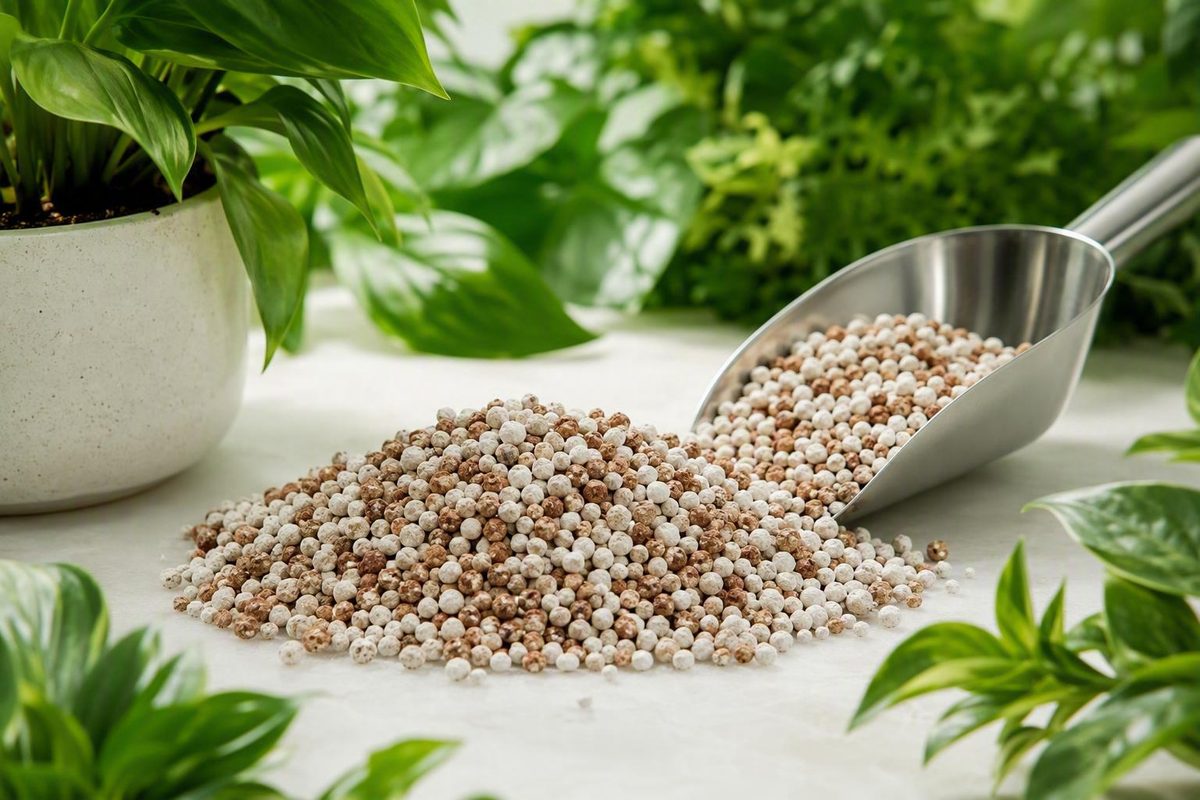
A 20-10-10 fertilizer supplies nutrients in a nitrogen-heavy 2:1:1 numerical ratio. It may match a recommendation calling for relatively more nitrogen while also supplying phosphorus and potassium, but it is not a universal lawn or garden fertilizer.
Before buying or spreading it, answer four questions:
- What nutrients does the soil or plant need?
- Does the plant need those nutrients in a 2:1:1 ratio?
- What phosphorus requirements apply at the property?
- What uses, rates, and precautions appear on the complete product label?
Only after answering those questions should you calculate an application quantity.
What the 20-10-10 fertilizer analysis actually means
The three numbers are the fertilizer grade, commonly described as N-P-K. In a 20-10-10 product, they represent the following percentages by product weight:
- 20% total nitrogen
- 10% available phosphate, expressed as P₂O₅
- 10% soluble potash, expressed as K₂O
The familiar N-P-K shorthand can obscure an important labeling convention. The second number is not the percentage of elemental phosphorus, and the third is not the percentage of elemental potassium. They are stated as phosphate and potash equivalents. A commercial explanation of this grade likewise identifies 20-10-10 as 20% nitrogen, 10% phosphate expressed as P₂O₅, and 10% potash expressed as K₂O by weight (Terra Lawn Care’s explanation of 20-10-10).
Numerically, 20-10-10 reduces to 2:1:1. The formula is therefore nitrogen-heavy rather than an equal-ratio fertilizer. Describing it simply as “balanced” can be misleading because the stated nitrogen percentage is twice the percentage of either available phosphate or soluble potash.
The three numbers add up to 40% of the product’s weight. The grade alone does not identify the remaining 60%. The complete guaranteed analysis, ingredient or derived-from statement, and other label disclosures are needed to determine what a specific product contains.
For example, five pounds of 20-10-10 nominally contains:
5 lb × 0.20 = 1 lbof nitrogen5 lb × 0.10 = 0.5 lbof available phosphate5 lb × 0.10 = 0.5 lbof soluble potash
Those calculations follow directly from the guaranteed percentages stated for the grade (Terra Lawn Care’s fertilizer-grade discussion).
This fixed relationship is both the formula’s potential value and its main limitation. Every time you apply nitrogen through 20-10-10, you also apply half as much available phosphate and half as much soluble potash. It cannot be treated as though it supplies nitrogen alone.
The three nutrients have broad plant functions:
- Nitrogen supports plant growth and green color.
- Phosphorus participates in cell division and the development of roots, flowers, and fruit.
- Potassium supports chemical processes involved in plant growth.
Fertilizer helps poorly growing plants only when nutrient availability is part of the underlying problem. It will not correct poor drainage, excessive shade, or competition from tree roots (Texas A&M AgriLife’s garden-fertilization guidance).
Correcting a documented deficiency may support normal growth, but the 20-10-10 grade does not establish control of insects, pathogens, or weeds.
Is 20-10-10 the right fertilizer for your soil?
Use a three-part test:
- Does the soil or plant need nitrogen?
- Does it need added phosphorus?
- Does it need added potassium?
A “yes” to nitrogen alone does not make 20-10-10 the right choice. Because the three components are delivered together, the site should be able to use available phosphate and soluble potash in the proportions that accompany the nitrogen.
A soil test should take precedence over visual guesses. A desire for faster green-up is not enough to establish that this particular ratio is appropriate.
A 20-10-10 grade may fit when a qualified recommendation calls for relatively more nitrogen and also supports additions of phosphorus and potassium. If soil phosphorus is already adequate or high, a lower-phosphorus or phosphorus-free product may deliver the needed nitrogen more precisely. The same principle applies when potassium is not needed.
Plant requirements and growing conditions matter as much as the soil result. Consider:
- Plant or grass species
- Established versus newly planted growth
- Current growth rate
- Soil texture and drainage
- Climate and recent weather
- Irrigation availability
- Dormancy or drought stress
- Previous fertilizer applications
- Product formulation and permitted uses
Some grasses and plants have relatively modest nitrogen requirements and may be poorly matched to a nitrogen-heavy grade. Recommendations can also differ among cool-season and warm-season turf and between intensively managed and lower-input lawns. A retailer’s broad statement that a fertilizer works on lawns cannot replace species- and site-specific guidance.
Before attributing poor growth to fertility, inspect the site systematically:
- Moisture: Is the soil consistently dry, excessively wet, or cycling between extremes?
- Drainage: Does water remain around the roots after rain or irrigation?
- Sunlight: Does the site provide enough light for the species?
- Root competition: Are nearby trees or large shrubs competing with the plant?
- Soil condition: Is the soil compacted, shallow, or otherwise unfavorable?
- Pests: Is there visible insect or animal damage?
- Disease: Are there lesions, decay, or distinct patches that require diagnosis?
- Recent treatments: Could an herbicide or another treatment have injured the plant?
- Weather: Has the site recently experienced drought, flooding, unusual heat, or cold?
Adding fertilizer is unlikely to correct a problem caused primarily by deep shade, poor drainage, drought, or competition from established roots. It may instead stimulate growth in the healthier parts of the site while leaving the actual problem unresolved.
Before buying a phosphorus-containing fertilizer, verify the current state and local requirements that apply to the property. The available product pages and general garden guidance do not establish what rules, if any, govern a particular location.
The practical selection rule is straightforward: choose 20-10-10 only when the soil findings, plant requirements, current conditions, applicable requirements, and complete product label all point in the same direction.
Where 20-10-10 may—and may not—fit
A fertilizer grade does not define one universally suitable plant category.
Established lawns. The formula may fit actively growing turf when a soil test or qualified recommendation supports all three nutrients in the accompanying proportions. It is a poor default when phosphorus is already sufficient, the grass has modest nitrogen requirements, or the turf is dormant or drought-stressed.
New lawns and seeded areas. New growth does not prove that phosphorus is needed. Soil findings, grass species, local requirements, and the individual product label still govern. Do not assume that every fertilizer marketed for lawns is labeled for seeding or establishment.
Vegetable gardens. General garden-fertilization advice is not product-specific permission to use every 20-10-10 formulation. Lawn fertilizers may contain weed-control chemicals or other additives.
Shrubs, flowers, ornamentals, and containers. Some sellers market 20-10-10 products for these categories, but a seller’s category list does not prove suitability for every plant. Confirm the permitted site, measured rate, placement, frequency, and watering directions on the individual label.
Trees. Do not infer a tree application quantity from a lawn coverage claim. The supplied evidence does not provide a defensible, product-specific tree rate. If use on trees is contemplated, both the label and an appropriate plant or soil recommendation must support it.
GreenPro’s seller markets its 20-10-10 product for lawns, trees, shrubs, ornamentals, leafy plants, and nitrogen-loving crops such as corn. These are seller-listed intended uses, not independent proof that the fertilizer suits a particular plant, soil, or application.
| Site | Questions to answer first | Why 20-10-10 might fit | Why another ratio might be better | Label details required |
|---|---|---|---|---|
| Established lawn | Is the grass actively growing? What do the soil result and species guidance recommend? | Nitrogen need is relatively high, and phosphate and potash are also warranted | Phosphorus is sufficient, nitrogen requirements are modest, or the turf is stressed | Permitted turf site, rate, timing, nutrient sources, watering directions |
| New lawn or seeded area | Does testing support phosphorus? Is the product labeled for establishment? | The establishment recommendation matches the 2:1:1 ratio | Phosphorus is sufficient or another grade is recommended | Seeding use, rate, timing, placement, restrictions |
| Vegetable garden | Is the crop or garden site listed? Are other active ingredients present? | The crop recommendation supports all three nutrients | The product supplies excessive nitrogen, adds unneeded phosphorus, or excludes edible sites | Approved crops or sites, rate, placement, additives |
| Trees and shrubs | Has a nutrient need been established? Is the site listed? | The label and qualified recommendation both support use | No documented need exists or no product-specific rate is available | Permitted site, rate basis, placement, frequency |
| Flowers and ornamentals | Does the nutrient recommendation match the grade? | All three nutrients are needed in the supplied ratio | Another nutrient ratio is more precise | Permitted plants or sites, rate, frequency, placement |
| Containers | Does the label provide a container direction? | A specific, measurable container rate is provided | The label lacks a container use or usable measurement | Dose or dilution, frequency, placement, watering instructions |
No single quantity or schedule can safely cover all these categories. A lawn rate should not be transferred to a vegetable row, container, shrub bed, or tree area unless the label provides that direction.
How to calculate a 20-10-10 application quantity
There is no universal pounds-per-1,000-square-feet rate for every 20-10-10 product, soil, plant, and region. Start with a soil-test or other qualified recommendation expressed as pounds of actual nitrogen for a defined area. Then verify that the resulting product quantity is permitted by the label.
Because the product contains 20% nitrogen by weight:
Pounds of 20-10-10 product = target pounds of actual nitrogen ÷ 0.20
Suppose an appropriate recommendation—not this article—specified one pound of actual nitrogen for the area being treated:
1 ÷ 0.20 = 5 pounds of product
Five pounds of 20-10-10 would simultaneously supply:
- 1 pound of nitrogen
- 0.5 pound of available phosphate
- 0.5 pound of soluble potash
This is a mathematical example, not a rate recommendation. Before applying the calculated amount, compare all three nutrient quantities with the soil findings. If the site does not need the accompanying half-pound of available phosphate or soluble potash at that scale, another grade may be a better match.
For a second illustration, assume a qualified recommendation specified one-half pound of actual nitrogen:
0.5 ÷ 0.20 = 2.5 pounds of product
Again, the one-half-pound nitrogen target must come from an appropriate recommendation. It should not be adopted merely because it produces a convenient calculation.
Do not copy a product quantity published for another fertilizer grade directly to 20-10-10. Texas A&M’s general garden guidance discusses untested-soil quantities for fertilizer such as 10-20-10 and expressly advises using less when a fertilizer contains more nitrogen. Applying the same product weight of 20-10-10 would supply twice as much nitrogen as 10-20-10 (Texas A&M AgriLife’s fertilizer-quantity guidance).
Once a valid quantity per 1,000 square feet is known, scale it to the measured treatment area:
Site quantity = confirmed quantity per 1,000 square feet × actual square feet ÷ 1,000
If a label-consistent calculation produced X pounds per 1,000 square feet and the measured treatment area were 2,400 square feet:
X × 2.4 = quantity for the site
Using a variable keeps the area calculation separate from the nutrient recommendation. Measure only the ground that will actually receive fertilizer rather than including buildings, pavement, water, or untreated beds.
Coverage claims require similar caution. GreenPro’s seller states that a 50-pound bag covers 10,000 square feet. That claim mathematically implies five pounds of product per 1,000 square feet, which would supply one pound of nitrogen at that coverage. However, the missing product label must establish whether that is an authorized rate, which site it applies to, and whether the same coverage applies to every advertised use (Albert Lea Seed’s GreenPro 20-10-10 listing).
A bag size or vague “covers up to” statement is not enough to establish an application quantity. If the complete label is unavailable, obtain it before proceeding. Verify:
- Approved plants or sites
- Product-specific application rate
- Rate measurement basis
- Maximum frequency or annual limits, if stated
- Timing restrictions
- Watering or incorporation directions
- Environmental and handling precautions
Correct arithmetic cannot compensate for missing product directions.
A safer application workflow for lawns and gardens
A careful application begins with diagnosis and measurement rather than a borrowed spreader setting.
1. Test and diagnose. Determine whether poor growth is nutritional. Review the soil result, plant requirements, moisture, drainage, light, weather, pests, and other potential causes.
2. Choose a label-approved product. Confirm that the label permits the intended lawn, crop, ornamental, or other site. Check the complete formulation for herbicides or other additives that could limit where it may be used.
3. Measure the treatment area. Divide irregular areas into measurable shapes and calculate their combined area. Exclude structures and any ground that will not be treated.
4. Calculate the label-consistent quantity. Convert the qualified nutrient recommendation into product weight, scale it to the measured area, and verify that the result falls within the label directions.
5. Calibrate the equipment. A spreader setting is not a universal application unit. Calibrate using a measured amount over a known area rather than copying an unsupported setting.
6. Apply evenly. One general rotary-spreader technique is to divide the confirmed quantity in half and make two passes in opposite directions. Begin walking before opening the spreader and close it before stopping. This approach is intended to reduce concentrated deposits at starts and stops (Briggs & Stratton’s general fertilizer-spreading guidance).
7. Follow the label’s watering and cleanup directions. Irrigation, incorporation, equipment cleaning, storage, and disposal instructions can differ among formulations. Treat the selected product’s directions as controlling.
Timing should correspond to active plant or turf growth and current local conditions rather than fixed national holiday dates. Grass species, climate, recent weather, irrigation, and dormancy all affect the decision. Broad commercial spring, summer, or fall schedules should not be treated as universal.
Avoid fertilizing drought-stressed or dormant turf. General lawn guidance recommends fertilizing only while grass is actively growing and stopping or reducing fertilizer use during drought. It also warns that applying several times the recommended rate can damage turf.
Do not apply immediately before heavy rain. Commercial guidance for 20-10-10 specifically warns that excessive high-nitrogen fertilizer can contribute to runoff and nutrient leaching and advises against application before heavy rainfall. The product label may add more specific weather or site restrictions.
Even distribution matters. Avoid overlapping passes and concentrated deposits. If material spills, stop the application, retain the package, and consult the label or manufacturer for instructions appropriate to that formulation rather than improvising a universal response.
Watering instructions cannot be generalized across all 20-10-10 fertilizers. One product may direct irrigation after application, while another formulation or use may provide different directions. Moistening soil beforehand, watering afterward, and relying on expected rainfall are not interchangeable unless the selected label says so.
Physical form also does not establish release behavior. Inspect the label for:
- Nitrogen sources
- Slowly available or water-insoluble nitrogen percentages
- Coatings
- Soluble nutrient sources
- Permitted plants and sites
- Application rates and intervals
- Irrigation or incorporation directions
- Handling and storage instructions
Apply only the measured quantity supported by the recommendation and label—not the amount that happens to fit in the spreader.
Burn, runoff, and other consequences of overapplication
Excess fertilizer can injure or kill plants. Because 20-10-10 is 20% nitrogen by weight, an error in product measurement directly changes the nitrogen dose and also increases the accompanying phosphate and potash.
General lawn guidance associates extreme overapplication—described as five to ten times the recommended rate—with tan or straw-colored grass and leaf blades burning from the tips downward (Briggs & Stratton’s discussion of fertilizer overapplication).
Those signs are not diagnostic by themselves. Drought, disease, chemical injury, drainage problems, root damage, and weather stress may also discolor turf. Applying more fertilizer to a discolored lawn can worsen the situation if nutrient deficiency is not the cause.
Fertilizer is likewise unlikely to solve poor growth caused by excessive shade, poor drainage, drought, or competition from tree roots. Those conditions require diagnosis and correction of the underlying site problem.
Excess quantities increase the opportunity for nutrient runoff or leaching, particularly when application is followed by heavy rain. Unnecessary phosphorus deserves particular attention because every five pounds of 20-10-10 adds half a pound of available phosphate whether the soil needs it or not.
Use this prevention checklist:
- Measure the actual treatment area
- Start with a qualified nutrient recommendation
- Convert the recommendation to product weight correctly
- Confirm the result against the label
- Measure the product accurately
- Calibrate the equipment with the selected fertilizer
- Divide the quantity between passes when appropriate
- Avoid overlapping swaths
- Begin moving before opening a rotary spreader
- Close the spreader before stopping
- Prevent concentrated piles and spills
- Check the forecast for heavy rain
- Preserve the original package and label
If accidental overapplication occurs, stop immediately and prevent additional fertilizer from being released. Keep the package, record the approximate amount and area involved, and seek formulation-specific guidance from the label or manufacturer.
How to compare 20-10-10 products before buying
Two products with the same 20-10-10 grade are not necessarily interchangeable. The grade establishes the percentages of total nitrogen, available phosphate, and soluble potash, but it does not establish identical ingredients, release characteristics, coatings, additives, approved sites, or rates.
Use this buying checklist:
- Complete product label available before purchase
- Guaranteed analysis
- Ingredient or derived-from statement
- Confirmed net fertilizer weight
- Permitted plants and sites
- Product-specific rates
- Coverage at the labeled rate
- Maximum frequency or annual limits, if any
- Nitrogen sources
- Slowly available nitrogen percentage
- Coatings or controlled-release features
- Secondary nutrients and micronutrients
- Herbicides or other additives
- Irrigation or incorporation directions
- Handling and personal-safety directions
- Storage and disposal instructions
Missing label information is a significant buying limitation. Without it, a purchaser cannot properly compare approved uses, application rates, nutrient sources, restrictions, or verified coverage.
The supplied GreenPro retail listing shows a seller-listed price of $34.99 for a 50-pound bag, SKU 5005, and claimed coverage of 10,000 square feet. It directs users to the product label for rates, timing, and permitted uses, but the complete label is not included in the available listing. Prices and availability can change.
A second retailer lists Greenskeeper’s Secret 20-10-10 at $25.37, with a listed weight of 51 pounds, dimensions of 16 × 16 × 8 inches, and SKU 4682. The page does not establish whether 51 pounds is net fertilizer weight or packaged shipping weight and supplies no application rate, coverage, nutrient-source, or permitted-use information (Shop Stutsmans’ Greenskeeper’s Secret listing).
That missing documentation prevents a reliable bag-to-bag value comparison. Bag price alone does not reveal:
- Cost per confirmed pound of fertilizer
- Cost per pound of nitrogen
- Cost per labeled treatment area
- Number of permitted applications
- Slowly available nitrogen fraction
- Whether the intended site is approved
- Whether additives restrict use
Promotional language such as “premium,” “rapid green-up,” “vigorous growth,” “stronger roots,” or “sustained health” should be separated from verified specifications. Such phrases express a seller’s product positioning; they do not independently demonstrate how the fertilizer will perform on a particular soil or plant.
Cost per pound of nitrogen can be a useful preliminary calculation when net weight is confirmed. For example, a 50-pound bag of 20-10-10 nominally contains 10 pounds of nitrogen. That calculation still cannot establish overall value when approved uses, release characteristics, labeled rate, and verified coverage remain unknown.
The purchase rule is simple: do not buy solely because the front of the bag says 20-10-10. Confirm that the ratio, complete formulation, approved uses, rate, and directions match the tested need.
Frequently asked questions
Is 20-10-10 fertilizer good for lawns?
It can be appropriate for some lawns, but it is not universally suitable for turf. It is most plausible when the grass is actively growing, needs relatively substantial nitrogen, and the soil findings also support adding phosphorus and potassium.
Choose another grade when phosphorus is already adequate, the grass has modest nitrogen requirements, or the lawn is dormant, drought-stressed, or affected by a non-nutrient problem. Commercial lawn guidance also acknowledges that fertilizer selection should reflect soil-test findings and grass species, including the lower nitrogen requirements attributed to centipede grass (Lawn Synergy’s discussion of 20-10-10 lawn fertilizer).
Check the complete product label and applicable phosphorus requirements before use.
How much 20-10-10 fertilizer should I use per 1,000 square feet?
There is no universal quantity. Begin with a qualified recommendation for pounds of actual nitrogen per 1,000 square feet, divide that target by 0.20, and verify the result against the label:
Product pounds per 1,000 square feet = target nitrogen pounds per 1,000 square feet ÷ 0.20
Mathematically, a one-pound nitrogen target corresponds to five pounds of 20-10-10, while a one-half-pound target corresponds to 2.5 pounds. These are calculation examples, not recommended nitrogen targets.
Five pounds of product also supplies half a pound each of available phosphate and soluble potash. If the soil does not need those accompanying nutrients, choose a more suitable grade.
Should I water before or after applying 20-10-10 fertilizer?
Follow the selected product’s label. Watering directions can vary with formulation, site, soil conditions, and application method. Do not assume that all granular products or all liquid products require the same treatment.
Avoid application immediately before heavy rain because fertilizer may move away from the intended area. If the label is unavailable or its watering directions are unclear, obtain the complete directions before spreading.
Can I use 20-10-10 fertilizer in a vegetable garden?
Only if the label permits use on the intended edible crop or garden site and the product contains no incompatible additive. Do not apply a lawn fertilizer to vegetables merely because the front of the bag displays a 20-10-10 grade.
Even a plain fertilizer may be a poor match if the garden already contains sufficient phosphorus or if the crop needs a different nitrogen rate. Use soil-test and crop-specific guidance to select both the formula and quantity.
What makes up the other 60% of a 20-10-10 fertilizer?
The grade alone cannot answer that question. The three stated percentages total 40% by product weight. Depending on the formulation, the remaining material may include carriers, fillers, coatings, secondary nutrients, or other declared ingredients.
Read the complete guaranteed analysis, ingredient or derived-from statement, and other label disclosures. Do not assume that the remaining 60% is entirely inert or that two 20-10-10 products contain the same materials.
The final decision sequence
Before using 20-10-10 fertilizer:
- Diagnose the growing problem.
- Obtain and interpret a soil test or other qualified recommendation.
- Confirm that nitrogen, available phosphate, and soluble potash are all needed in a 2:1:1 ratio.
- Check the phosphorus requirements that apply at the property.
- Obtain the complete product label.
- Verify the intended site, rate, formulation, and directions.
- Measure the treatment area and calculate the product quantity.
- Apply the measured amount evenly under suitable conditions.
A 20-10-10 fertilizer can match some nutrient recommendations. The grade alone, however, cannot determine the right plant, rate, season, watering method, application equipment, or product value.