
Two Similar-Looking Dental Appliances With Very Different Jobs
Standard versions usually aren't interchangeable. If you need both, a removable retainer and guard shouldn't be stacked unless a clinician approves the arrangement.
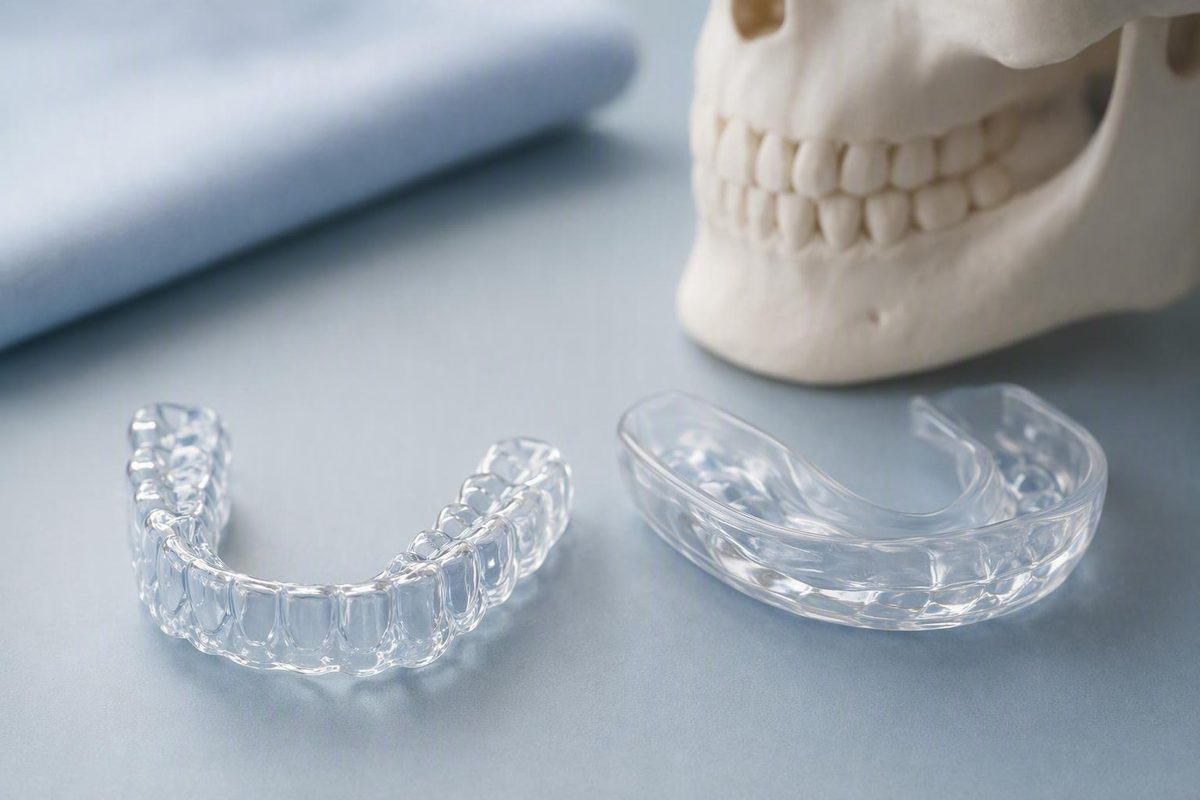
A retainer maintains the position of teeth after orthodontic treatment, while a night guard creates a protective barrier against grinding or clenching. Although clear removable versions can look alike, they are designed for different purposes.
That distinction is central to choosing between a night guard vs retainer. A retainer fits closely to maintain tooth position. A night guard is intended to protect teeth and dental work from mechanical wear caused by grinding or clenching. Standard versions should not usually replace one another. If both functions are needed, a dentist or orthodontist should assess the appliances and provide an individualized plan.
Night guard and retainer differences at a glance
Neither appliance is inherently better. The appropriate choice depends on the primary need: orthodontic retention, protection from grinding or clenching, or both.
| Feature | Retainer | Night guard |
|---|---|---|
| Primary purpose | Maintains tooth position after braces or clear aligners | Protects teeth and dental work from grinding or clenching forces |
| Typical user | Someone who has completed orthodontic treatment | Someone whose grinding or clenching warrants protective management |
| Fit | Usually closely fitted to maintain tooth position | Covers an arch and creates a barrier between opposing teeth |
| Relative thickness | Commonly thinner, particularly clear removable retainers | Generally thicker to tolerate or separate grinding surfaces |
| Common construction | Clear plastic; plastic with wire; removable or fixed designs | Soft, layered, or hard materials; may cover upper or lower teeth |
| Typical wear pattern | Follows an individualized orthodontic schedule; may be removable or fixed | Commonly worn during sleep, although use depends on the condition being addressed |
| Can it normally replace the other? | No—a standard retainer is not intended for repeated grinding forces | No—a standard guard may not maintain post-orthodontic tooth position |
These are general distinctions rather than universal construction rules. Retainers include clear removable trays, Hawley-style appliances made with plastic and wire, and fixed wires placed behind the teeth. Night guards may be soft, layered, or hard and may fit over the upper or lower teeth. Oral-health comparisons distinguish the appliances principally by purpose: retainers preserve alignment, while night guards protect against grinding or clenching damage. Colgate explains the functional distinction and common appliance types.
A night guard is also different from a sports mouth guard or an appliance intended for a sleep-related condition. “Mouth guard” is a broad label for devices with different purposes, so the product’s specific intended use matters.
Terminology note: A clear retainer is not an active clear aligner. An aligner applies planned pressure to move teeth. A retainer is intended to maintain the final position after orthodontic movement has been completed. Polident’s appliance overview describes this difference between active alignment and retention.
What a retainer does after braces or aligners
Orthodontic care does not necessarily end when braces are removed or the last aligner is completed. Retainers are prescribed to limit unwanted movement after teeth have reached their planned positions.
A removable retainer must fit closely enough to hold tooth position. The principal categories are:
- Clear removable retainers: Transparent trays formed closely around the teeth.
- Hawley-style retainers: Removable appliances generally combining a plastic or acrylic section with a wire.
- Fixed retainers: Wires attached behind selected teeth rather than removed each day.
Appliance category should not be chosen from appearance or convenience alone. A fixed retainer remains an orthodontic retention device; it does not automatically provide grinding protection. Likewise, covering the teeth with a clear removable retainer does not make that appliance a night guard.
Wear schedules vary by treatment plan. Some sources describe more frequent use initially followed by nighttime wear, but no single schedule is appropriate for every patient. Follow the instructions from the dentist or orthodontist managing the retention phase rather than copying another person’s schedule.
If a retainer suddenly feels tight, do not force it. Tightness may indicate that tooth position has changed or that the appliance no longer fits as it previously did. The supplied appliance guidance recommends contacting a dental professional rather than force-fitting a retainer; it also notes that a cracked or broken retainer may not hold teeth in place as intended. See the retainer fit and damage guidance in Polident’s comparison.
Contact the treating dentist or orthodontist and explain whether the retainer seats fully, when the change began, and whether the appliance appears cracked, warped, or otherwise damaged. A damaged retainer should be professionally assessed rather than treated as reliably functional.
Avoid heat or improvised reshaping. Heat can deform retainer plastic and change its fit. If possible, bring the appliance to the appointment so the clinician can inspect its fit and condition.
What a night guard can—and cannot—do for grinding
Bruxism refers to unconscious grinding or clenching. It commonly occurs during sleep but can also occur while a person is awake. Occasional or mild activity does not necessarily require the same response as persistent grinding associated with dental wear or damage, so treatment decisions should follow an examination rather than a symptom checklist alone. Parris Orthodontics’ overview describes both sleep and awake bruxism and notes that mild cases may not require treatment.
A grinding guard creates a barrier between the upper and lower teeth. Its protective purpose is to receive or limit some of the mechanical wear that could otherwise affect teeth, enamel, fillings, crowns, or other dental work.
A night guard is therefore protective equipment, not a guaranteed cure for bruxism. A person may continue to clench or grind while wearing it. The guard’s immediate role is protection from mechanical damage, not guaranteed elimination of the underlying behavior.
Morning headaches, facial fatigue, jaw soreness, and other jaw symptoms are nonspecific. They may occur alongside grinding, but they do not establish the diagnosis by themselves. The available evidence also does not justify promising that a night guard will cure headaches, jaw pain, temporomandibular disorders, sleep apnea, or other sleep problems.
Night guards vary in construction. They may cover the upper or lower teeth and may use soft, layered, or hard materials. A particular material should not automatically be assigned to every self-described “mild,” “moderate,” or “severe” case. Appliance selection depends on professional assessment, including the condition of the teeth and existing dental work.
A dentist can examine the teeth, inspect restorations and current appliances, and consider whether reported symptoms might have another explanation. Not everyone who occasionally clenches needs a guard, and symptoms alone do not determine the appropriate appliance.
Can a retainer replace a night guard—or vice versa?
Can a retainer replace a night guard? Usually not.
An ordinary retainer is designed to maintain tooth position rather than withstand repeated grinding forces. Grinding may thin or unevenly wear the appliance, and commercial comparison sources report that retainers exposed to repeated grinding may crack or deform. A standard retainer may also provide inadequate grinding protection because its construction was selected for retention rather than for managing tooth-to-tooth contact.
There is limited nuance. One orthodontic-practice source says a retainer may offer some protection in selected mild cases, but it also warns that grinding can wear or crack the appliance. That is a case-specific observation—not permission to use any clear retainer as a night guard. “Mild” should not be treated as a category readers can reliably diagnose for themselves.
Can a night guard replace a retainer? Usually not.
Most standard night guards should not be assumed to fit closely enough around each tooth to maintain the result of orthodontic treatment. A guard may remain on the teeth during sleep without performing the precise retention function of a prescribed retainer. Commercial appliance comparisons make the same distinction but should be read in context because they are published by companies that sell these products. Jawology’s commercial comparison describes retainers as close-fitting alignment devices and guards as thicker protective appliances.
The practical distinction is straightforward:
- A retainer manages tooth position.
- A night guard manages mechanical contact and wear.
Do not stop a prescribed retainer, substitute another appliance, trim a tray, or change its wear schedule without guidance from the dentist or orthodontist managing your care.
Three common scenarios
- After braces, with no evidence of grinding: Follow the prescribed retainer plan.
- Suspected grinding, with no orthodontic retention need: Seek an assessment to determine whether a guard or another response is appropriate.
- Both retention and grinding protection are needed: Request a coordinated plan rather than substituting or stacking appliances yourself.
What to do when you need both retention and grinding protection
Two removable appliances generally cannot simply be stacked over the same teeth. Both need access to the same space, so one appliance may prevent the other from seating or functioning as intended. Do not wear a removable retainer and night guard together unless a dental professional has specifically approved the arrangement.
Commercial and orthodontic-practice comparisons describe two possible clinician-directed approaches:
- A defined schedule using separate appliances at different times
- A professionally selected appliance intended to provide both retention and protection
These possibilities should not be interpreted as do-it-yourself instructions. An alternating schedule leaves periods in which only one appliance is being used, so the schedule must come from the clinician responsible for the patient’s care. Likewise, an appliance marketed for two purposes is not automatically suitable for every bite or retention need.
Hybrid night guard-retainer products are available, but much of the supplied information about them comes from companies that sell dental appliances. Product availability does not demonstrate that every hybrid design performs both functions reliably or suits every patient.
A combined plan must address four basic questions:
- Does the plan continue to maintain the post-orthodontic tooth position?
- Does it provide suitable protection from grinding or clenching?
- Does each prescribed appliance fit securely and comfortably?
- What wear schedule should the patient follow?
Coordination is particularly important if an orthodontist manages retention while another dental professional evaluates grinding. Each clinician should know which appliances are being used and what each is intended to accomplish.
Questions to take to an appointment include:
- Is my current retainer showing possible grinding wear?
- Do I still need nighttime retention under my existing plan?
- Is a dual-purpose design appropriate in my case?
- If separate appliances are used at different times, what exact schedule should I follow?
- What changes in fit, comfort, or appliance condition should I report?
- Who should I contact if an appliance cracks or stops fitting?
Signs of grinding, appliance damage, and poor fit
Possible signs associated with bruxism include:
- Flattened, worn, chipped, or fractured teeth
- Increased tooth sensitivity
- Damaged fillings, crowns, or other dental work
- Morning jaw soreness
- Tired or tight facial muscles
- Temple or morning headaches
- Grinding sounds noticed by another person
- Repeated wear or cracking of a removable appliance
These findings are not diagnostic by themselves. Headaches, facial discomfort, sensitivity, and jaw soreness can have causes unrelated to grinding. Even visible tooth wear may require professional interpretation rather than self-diagnosis.
A cracked retainer can be consistent with grinding, but it does not prove severe bruxism.
Inspect a removable appliance regularly and arrange a professional review if you notice:
- New cracks or splits
- Thin or deeply worn areas
- Rough or sharp edges
- Warping or visible distortion
- New looseness
- Increasing tightness
- Pain during use
- Loss of retention
- Failure to seat fully
Do not force a tight retainer or continue assuming that a broken appliance is maintaining tooth position correctly. A fractured, chipped, or loose tooth, damaged dental work, persistent sensitivity, or continuing discomfort also warrants dental assessment rather than an assumption that buying a guard will address the underlying cause.
Pain Catalog provides general education, not diagnosis or individualized treatment. Its site notice advises prompt clinical attention for jaw locking, trauma, or jaw pain accompanied by fever. This is an editorial safety notice rather than a substitute for individualized medical triage. Read Pain Catalog’s educational-use notice.
Custom versus over-the-counter night guards
Grinding guards are available over the counter or can be fabricated by a dental professional from an impression or digital scan. Some store-bought products are ready to wear, while others are softened and shaped by the user.
Cleveland Clinic states that custom-made mouth guards typically fit more comfortably and provide better protection than store-bought versions. It also notes that an ill-fitting mouth guard can cause soreness in the teeth, gums, or jaw. Cleveland Clinic’s medically reviewed mouth-guard guide covers custom and store-bought options.
That does not mean every custom guard is superior in every respect or that every over-the-counter guard is unsafe. Fit, intended use, appliance condition, and the person’s dental needs all matter.
Assessment involves more than creating a mold. A dentist may need to determine:
- Whether a grinding guard is indicated
- Whether orthodontic retention is also required
- Whether reported symptoms need separate investigation
- Which guard design is appropriate
- What wear instructions should be followed
Seek professional guidance before changing appliances if any of the following applies:
- You have completed orthodontic treatment.
- You currently have a retainer prescription.
- You can see tooth, dental-work, or appliance damage.
- Your current appliance does not seat correctly.
- You have persistent tooth sensitivity or jaw discomfort.
- You are unsure whether the primary need is retention, grinding protection, or both.
Cost and insurance may influence access, but prices and coverage vary. They do not determine the clinical purpose of an appliance.
Cleaning, storage, and when to replace an appliance
A basic care routine can help maintain the appliance and make damage easier to notice:
- Clean the removable appliance after use according to its instructions.
- Rinse away loosened debris.
- Allow it to air-dry.
- Store it in a ventilated case.
- Keep it away from pets, direct sunlight, hot water, and other sources of extreme heat.
- Inspect it regularly under good light.
Regular cleaning helps limit plaque buildup, odor, and discoloration. Use cleaning methods compatible with the appliance material and follow the instructions supplied by the manufacturer or dental professional.
Avoid hot water. Heat can deform some plastic appliances and alter their fit. Cleveland Clinic recommends cleaning a mouth guard after use, allowing it to dry, storing it in a ventilated case, and keeping it away from extreme heat. Its mouth-guard care guidance also explains that replacement needs vary.
Replacement depends on the material, fit, wear, damage, grinding forces, and whether the appliance still performs its intended function.
Distinguish cosmetic changes from functional warning signs. Cracks, warping, looseness, pain, increasing tightness, or lost retention warrant professional review.
One-minute appliance check
- Does it seat fully without force?
- Is the fit unchanged?
- Are there cracks, thin areas, or sharp edges?
- Does it remain comfortable during use?
- Is it loose where it was previously secure?
- Does it still perform its prescribed purpose?
When in doubt, bring the appliance to a dental appointment rather than waiting for it to break completely.
Frequently asked questions
Can I use my clear retainer as a night guard for mild grinding?
Not as a general rule. A clear retainer is designed to maintain tooth position. Repeated grinding may wear, crack, or deform it, and it may not provide adequate grinding protection.
Selected appliances may be considered acceptable in limited cases, but “mild grinding” is not a reliable self-diagnosis. Ask a dentist or orthodontist to inspect the retainer and determine whether separate protection is needed.
Will a night guard keep my teeth from shifting after braces?
Most standard night guards should not be assumed to maintain orthodontic alignment. They are designed for protection from grinding or clenching rather than precise retention of each tooth.
Continue using the prescribed retainer unless the treating dentist or orthodontist directs a change.
Can I wear a retainer and night guard together?
Usually not by stacking two removable appliances. They occupy the same space and may prevent each other from seating correctly.
Simultaneous use is appropriate only when a dental professional has specifically approved the arrangement. If both functions are needed, ask for an individualized plan.
Why does my retainer suddenly feel tight?
A suddenly tight retainer may indicate that tooth position has changed or that the appliance no longer fits as it did previously. Do not force it into place or expose it to heat.
Contact your dentist or orthodontist and explain whether it seats fully and whether you can see cracking, warping, or other damage.
Can an ill-fitting night guard make my teeth, gums, or jaw sore?
Yes. An ill-fitting mouth guard can cause soreness in the teeth, gums, or jaw. Continuing discomfort should be professionally assessed rather than ignored.
Use a prescribed retainer to maintain orthodontic alignment and a properly selected night guard to protect against grinding or clenching damage. Do not treat the appliances as interchangeable or stack them without direction. If an appliance is tight, cracked, warped, painful, or no longer fits—or if you need both retention and grinding protection—the next step is a coordinated assessment by a dentist or orthodontist, not an improvised appliance switch.